Your Renovation Permit Just Got Denied Because You’re Missing One Critical Financial Document
Picture this: you’ve invested months negotiating the perfect commercial property acquisition, assembled a talented construction team, secured financing for extensive renovations, and submitted permit applications to transform a tired strip mall into a vibrant mixed-use development. Your municipality loves the project and wants to approve it immediately—except for one non-negotiable requirement blocking your path forward. Before they’ll issue a single permit allowing you to connect utilities, repave parking lots, or upgrade drainage systems affecting public property, you must post a site improvement bond guaranteeing completion of all improvements touching municipal infrastructure. Without this bond, your entire project sits frozen regardless of how much capital you’ve committed or how beneficial the improvements would be to the community.
What Is a Site Improvement Bond?
A site improvement bond is a contract surety bond that guarantees developers, contractors, or property owners will complete renovations and improvements to existing properties according to approved plans, local building codes, and municipal specifications. These bonds specifically apply to improvement projects on previously developed sites rather than new construction on vacant land, protecting municipalities and the public from incomplete or substandard work on infrastructure that will become public property once construction finishes.
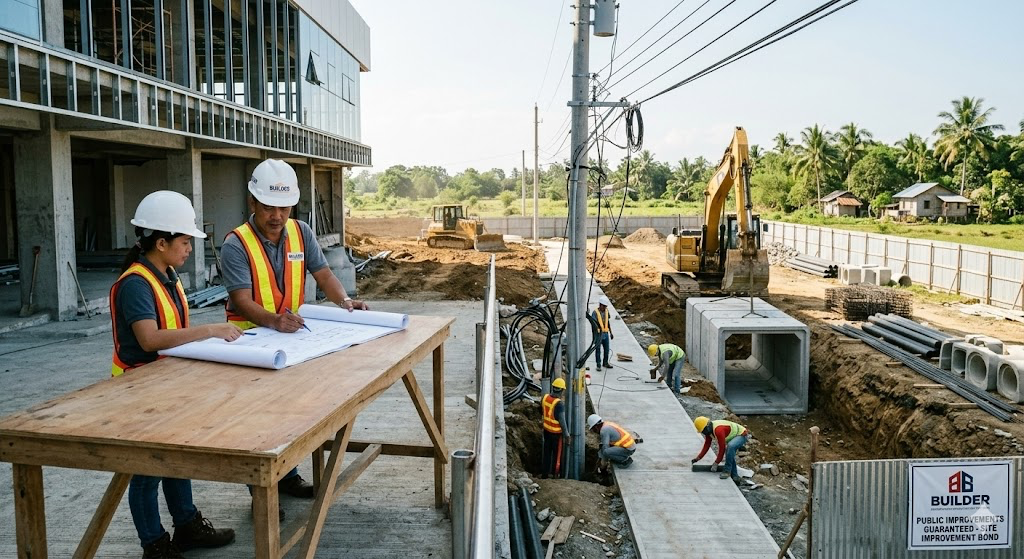
The bond creates a financial guarantee ensuring that essential improvements affecting public property—including sidewalks, streets, curbs, gutters, storm drainage systems, utilities, lighting, and landscaping—get completed properly even if the developer encounters financial difficulties, abandons the project, or attempts to cut corners on construction quality. When developers propose improvements that touch municipal infrastructure or public rights-of-way, local governments require these bonds to transfer completion risk away from taxpayers and onto the private parties profiting from the development.
Site improvement bonds function differently from traditional insurance policies that protect the bondholder from losses. Instead, these bonds protect third parties—specifically the municipality requiring the bond and the general public who will ultimately use and maintain the improved infrastructure. If a developer fails to complete required improvements according to specifications, the municipality files a claim against the bond. The surety company investigates the claim and, if valid, either pays for completion of the work up to the full bond amount or arranges for a qualified contractor to finish the improvements. However, the developer who purchased the bond remains ultimately liable and must reimburse the surety for all amounts paid plus investigation costs, legal fees, and interest.
Understanding the Critical Distinction: Site Improvement Bonds vs Subdivision Bonds
Site improvement bonds and subdivision bonds share many similarities in structure and purpose but apply to fundamentally different development scenarios. This distinction matters tremendously because municipalities specify which bond type developers must provide based on the nature of their proposed work, and submitting the wrong bond type can delay permit approval for weeks while the correct documentation is secured.
Site improvement bonds guarantee completion of upgrades and renovations to existing structures, previously developed properties, or improvements to sites that already contain buildings and infrastructure. These bonds apply when developers acquire existing commercial properties and plan infrastructure improvements, renovate older neighborhoods requiring upgraded utilities or streets, expand existing facilities necessitating new parking or drainage systems, or make improvements to established developments that impact public property or municipal infrastructure. The focus is on enhancing, upgrading, or expanding what already exists rather than creating entirely new developments from raw land.
Subdivision bonds guarantee completion of public improvements associated with transforming undeveloped land into new residential or commercial subdivisions. These bonds apply when developers acquire vacant land and subdivide it into multiple lots for sale, create entirely new neighborhoods requiring complete infrastructure installation from scratch, or develop greenfield sites where no previous development existed. The focus is on bringing utilities, streets, and drainage to previously undeveloped property rather than improving existing infrastructure.
The practical implications of this distinction affect project planning and bonding requirements. Site improvement projects typically involve working around existing structures and coordinating with occupied buildings, requiring more careful phasing and temporary infrastructure provisions. The bond amounts may be lower than subdivision bonds because they cover improvements to specific areas rather than complete neighborhood infrastructure systems. Documentation requirements often include as-built drawings of existing conditions and detailed plans showing how new improvements integrate with existing infrastructure. Site improvement bonds also typically involve shorter project durations because developers are enhancing specific elements rather than building complete subdivision infrastructure systems from the ground up.
The Unique Financial Structure of Site Improvement Bonds
Site improvement bonds operate under a financial structure that significantly increases risk for both developers and surety companies compared to traditional contract performance bonds. Understanding this enhanced risk profile helps explain why these bonds often cost more and require more extensive underwriting than similarly sized performance bonds on conventional construction contracts.
Traditional performance bonds on construction contracts guarantee contractors will complete work that project owners are paying them to perform. If a contractor defaults, the surety completes the work using funds the owner would have paid the original contractor anyway, limiting the surety’s exposure to the remaining contract balance. The owner’s obligation to pay for the work provides a funding source that offsets completion costs. Additionally, if the owner breaches the contract by failing to make payments or otherwise violating the agreement, the contractor may be excused from performance obligations under the bond.
Site improvement bonds reverse this financial relationship in a way that dramatically increases risk. Developers purchasing these bonds guarantee they will complete improvements to public infrastructure at their own expense regardless of whether anyone pays them to do so. Municipalities don’t hire developers to make these improvements—developers choose to make improvements as part of private development projects that benefit them financially. If a developer defaults on completing required public improvements, the surety must pay completion costs without any offsetting contract balance or payment obligation from the municipality. The developer receives no payment for the public improvements themselves, making them financially responsible for one hundred percent of completion costs if they abandon the project.
This structure creates additional complications when mortgage companies or financial institutions finance development projects. These lenders often hold first position liens on the property, creating dual-obligee situations where both the municipality and the lender have interests in the bond. The municipality wants assurance that public improvements will be completed regardless of the developer’s financial condition. The lender wants assurance their collateral won’t be encumbered by incomplete public improvements that prevent the development from being occupied, sold, or refinanced. These disparate and sometimes contradictory interests between dual obligees drastically increase a surety company’s exposure to claims and disputes.
What Improvements Do Site Improvement Bonds Cover?
Site improvement bonds guarantee completion of a wide range of infrastructure and site work improvements that affect public property or will become public assets once construction completes. The specific improvements covered vary by project but typically include several standard categories that municipalities routinely require when private development impacts public infrastructure.
Street and parking improvements represent one major category, including repaving existing streets affected by utility work or increased traffic from development, constructing new access roads connecting developments to public street systems, upgrading intersections with turn lanes or traffic signals necessitated by development, creating public parking areas that will be dedicated to municipalities, and repairing or replacing curbs and gutters damaged during construction or inadequate for upgraded drainage requirements.
Sidewalk and pedestrian infrastructure ensures safe public access, covering construction of new sidewalks along previously unimproved street frontages, replacement of damaged or substandard existing sidewalks, installation of handicap-accessible curb ramps at intersection corners and mid-block crossings, creation of pedestrian crosswalks with appropriate signage and striping, and construction of pedestrian bridges or underpasses where developments create safety concerns.
Utility upgrades and connections serve both the development and broader community, including extending or upgrading water mains to serve increased demand, expanding sanitary sewer systems or upgrading lift stations, installing or relocating storm sewer systems to handle increased runoff, upgrading electrical systems or installing new street lighting, and extending natural gas, telecommunications, or other utility services. These improvements often benefit not just the development itself but surrounding properties that can connect to the upgraded infrastructure.
Drainage and erosion control protect public property and downstream areas from flooding and environmental damage. Required improvements include constructing detention or retention ponds that control stormwater runoff rates, installing underground storm drainage collection systems with inlets and pipes, implementing erosion control measures including sediment barriers and vegetation, grading sites to direct stormwater away from buildings and toward collection points, and constructing channels or swales that convey stormwater safely to discharge points.
Landscaping and site amenities create attractive, functional public spaces including planting street trees along public rights-of-way, installing ground cover or sod in areas becoming public property, creating public green spaces or pocket parks as development amenities, and installing public art, benches, or other amenities required by development agreements.
How Much Do Site Improvement Bonds Cost?
Site improvement bond premiums typically range from one to four percent of the total bond amount annually, with most well-qualified developers paying between one and three percent. For a five hundred thousand dollar bond, this translates to annual premiums between five thousand and twenty thousand dollars, though the specific rate each developer receives depends on multiple risk factors that surety underwriters evaluate carefully.
Bond amounts are established based on engineer’s cost estimates detailing the expense to complete all required public improvements. Developers must provide itemized estimates breaking down quantities, unit prices, and total costs for each improvement category. Municipalities often require bond amounts equal to one hundred twenty-five to one hundred fifty percent of estimated costs to provide cushion for potential cost overruns, change orders, or inflation during multi-year projects. Conservative municipalities in areas with volatile construction costs may require even higher multiples to ensure adequate coverage.
Personal and business credit scores heavily influence premium rates. Developers with FICO scores above seven hundred fifty typically qualify for rates at the lower end of the one to three percent range, while those with scores between six hundred fifty and seven hundred fifty pay mid-range rates around two to three percent. Developers with scores below six hundred fifty face substantially higher rates between three and seven percent or may require collateral equal to ten to fifty percent of the bond amount. Poor credit signals higher likelihood of project abandonment or financial distress that could trigger claims.
Financial strength and liquidity demonstrate capacity to complete improvements even if market conditions deteriorate or unexpected costs arise. Surety underwriters examine balance sheets to verify adequate working capital, reasonable debt-to-equity ratios, and liquid assets sufficient to fund improvement completion. Developers with strong financial positions relative to bond amounts secure better rates than those highly leveraged or operating with thin equity cushions. A developer with two million dollars in liquid assets seeking a five hundred thousand dollar bond presents far less risk than a developer with one hundred thousand dollars in liquidity seeking the same bond.
Development experience and track record provide evidence of execution capability. Developers with histories of successfully completing similar projects on time and within budget demonstrate lower risk than first-time developers or those with records of project failures, cost overruns, or incomplete work. Sureties verify completion histories by contacting municipalities where developers completed previous projects, confirming that all required improvements were finished satisfactorily and bonds were released without claims.
Project-specific characteristics affect underwriting decisions as well. Smaller improvement scopes creating limited exposure generate more favorable rates than massive infrastructure upgrades spanning multiple phases. Projects in stable, proven markets with strong demand present less risk than speculative ventures in untested locations. Developments where the developer has already secured commitments from tenants, buyers, or users demonstrate more certain revenue streams than purely speculative projects where market absorption remains uncertain.
Site Improvement Bonds vs Alternative Financial Guarantees
Municipalities sometimes allow developers to choose among several financial guarantee instruments when securing public improvement completion, though surety bonds have emerged as the strongly preferred option for reasons that benefit both municipalities and developers. Understanding why surety bonds dominate this market helps developers appreciate the value these instruments provide despite their cost.
Letters of credit from banks or credit unions represent one alternative that some municipalities accept. These instruments obligate financial institutions to pay specified amounts to municipalities upon demand if developers fail to complete improvements. However, letters of credit carry significant disadvantages that make them less attractive than surety bonds. Banks can refuse to renew letters of credit when they expire, potentially forcing developers to immediately post replacement guarantees or face property seizure. Financial institutions hold collateral equal to the full letter of credit amount, consuming the developer’s credit capacity and tying up cash or assets that could fund construction or other investments. If municipalities draw on letters of credit, banks immediately seize pledged collateral without investigating whether the developer actually defaulted or whether the claim has merit. This hair-trigger structure provides no opportunity for dispute resolution or negotiation.
Cash deposits or certificates of deposit offer absolute certainty that funds are available to complete improvements but create severe cash flow problems for developers. Posting five hundred thousand dollars in cash for a site improvement guarantee means that money cannot be used for construction, operations, or other investments during what may be a multi-year hold period. The opportunity cost of tying up substantial cash in non-productive guarantees significantly reduces project returns and may make marginal projects economically infeasible. Additionally, municipalities bear the burden of proving cash deposits were properly secured and documented, creating administrative complications if disputes arise about whether conditions for release have been met.
Surety bonds avoid these disadvantages while providing superior protection for municipalities. Surety companies investigate claims thoroughly before paying, ensuring only valid claims receive payment and providing opportunities to resolve disputes or cure defaults before claims are paid. The investigation process protects developers from improper or premature claims while assuring municipalities that legitimate completion costs will be covered. Surety credit doesn’t consume the developer’s bank credit lines or require cash collateral except in cases involving poor credit, preserving financial flexibility for other project needs. Professional surety underwriting provides municipalities with third-party verification that developers have the financial capacity and experience to complete improvements, serving as a prequalification mechanism that traditional financial guarantees don’t offer.
How to Get Your Site Improvement Bond
Securing a site improvement bond follows a systematic application and underwriting process that typically requires one to three weeks for straightforward projects, though complex developments or developers with credit challenges may need additional time. First, submit a detailed bond application to a surety provider or broker specializing in development bonds, providing comprehensive information about your background, the specific improvement project, required bond amount, estimated timeline, and financial qualifications. Include the improvement agreement detailing all required work, engineer’s cost estimates supporting the bond amount, and documentation of your development experience.
Second, the surety underwrites your application by evaluating creditworthiness, financial strength, and project feasibility. This analysis includes reviewing personal and business financial statements, examining credit reports for all principals, verifying previous project completion histories, assessing current market conditions and project viability, and determining appropriate premium rates or collateral requirements. Well-qualified applicants often receive quotes within three to five business days, while those with complex situations may experience longer underwriting as sureties conduct additional due diligence.
Third, accept the surety’s quote by signing the bond agreement, indemnity agreement, and submitting premium payment. Most sureties offer flexible payment options including annual lump-sum payments, semi-annual installments, or monthly payment plans. Review all bond language carefully to ensure it matches municipal requirements and doesn’t contain unexpected provisions that could create problems later.
Fourth, the surety files the executed bond with the municipality’s engineering department, planning office, or other designated agency. Swiftbonds specializes in navigating complex site improvement bond requirements, working with experienced underwriters who understand development dynamics and efficiently secure bonds meeting municipal specifications while optimizing costs for developers.
Swiftbonds LLC
2025 Surety Bond Agency of the Year
4901 W. 136th Street
Leawood KS 66224
(913) 214-8344
https://swiftbonds.com/
Documentation Requirements for Site Improvement Bonds
Surety companies require extensive documentation to underwrite site improvement bonds because these instruments create multi-year exposure on projects where completion depends on market conditions, developer financial health, and numerous external factors beyond the surety’s control. Developers should prepare complete documentation packages before approaching sureties to accelerate the underwriting process and demonstrate professional preparation.
The improvement agreement between the developer and municipality forms the foundation of the bond requirement. This legally binding document specifies exactly which improvements must be completed, the standards and specifications they must meet, the timeline for completion, inspection and acceptance procedures, and any maintenance or warranty periods following acceptance. Sureties review these agreements carefully to understand the full scope of their potential exposure and identify any unusual provisions that might increase completion costs or complexity.
Engineer’s cost estimates provide the basis for establishing bond amounts and must be detailed, itemized, and based on current market pricing. Acceptable estimates include quantity takeoffs for each improvement component, unit pricing reflecting current material and labor costs, reasonable contingencies for unforeseen conditions typically ten to fifteen percent, and total costs broken down by improvement category. Unrealistically low estimates raise red flags suggesting the developer may not fully understand project costs, potentially leading to cost overruns that strain financial capacity and increase claim likelihood.
Complete financial documentation demonstrates the developer’s capacity to fund improvements through completion regardless of market fluctuations or unexpected challenges. Personal financial statements for all principals show liquid assets, real estate holdings, and debt obligations. Business financial statements reveal the development company’s financial position, work-in-progress values, debt structure, and equity. Three years of financial statements help sureties identify trends in profitability and financial stability. Current interim statements for projects spanning multiple accounting periods provide visibility into recent financial performance. Tax returns verify the accuracy of submitted financial statements and provide additional detail on income sources and business structure.
Development experience documentation establishes track record and execution capability. Resumes detailing all principals’ backgrounds, education, and development experience demonstrate professional qualifications. Lists of completed projects including project names, locations, improvement scopes, bond amounts, and completion dates provide evidence of successful execution. Reference letters from municipalities where previous projects were completed confirm satisfactory work quality and timely completion. Photographs of completed improvements showcase construction quality and attention to detail.
Project-specific materials help sureties assess feasibility and marketability. Site plans and improvement drawings show exactly what will be built and how it integrates with existing infrastructure. Market studies or appraisals demonstrate demand for the completed development. Letters of intent from anchor tenants or major users provide evidence of absorption. Development budgets detail all project costs beyond just public improvements, including land acquisition, building construction, soft costs, financing charges, and sales expenses. These comprehensive budgets help sureties assess whether the developer has realistically projected total capital requirements.
Common Challenges and How to Avoid Them
Developers frequently encounter obstacles when obtaining and maintaining site improvement bonds that can delay projects or increase costs if not anticipated and addressed proactively. Understanding common pitfalls helps developers navigate the bonding process more smoothly and avoid problems that derail permit approvals or construction schedules.
Cost estimate disputes between developers and municipalities create one frequent friction point. Developers naturally want to minimize bond amounts because they directly affect premium costs. Municipalities want conservative estimates ensuring adequate coverage if they must complete improvements using bond proceeds. This natural tension sometimes escalates into protracted negotiations that delay permit issuance. Developers can address this by engaging reputable engineers with strong municipal relationships to prepare estimates, providing detailed historical cost data from similar completed projects to support realistic pricing, and building reasonable contingencies into initial estimates rather than submitting bare-minimum numbers that invite pushback.
Bond form requirements sometimes catch developers by surprise when municipalities demand specific bond language, savings clauses, or other provisions that sureties resist accepting. Developers who wait until the last minute to address bonding often discover their surety won’t accept the municipality’s required bond form, creating delays while alternative language is negotiated or different sureties are approached. Reviewing bond form requirements early in the permit process, sharing municipal bond forms with sureties during preliminary discussions, and negotiating acceptable modifications before final permit approval prevents these last-minute crises.
Dual-obligee complications arise when construction lenders require their names be added to bonds as additional obligees alongside municipalities. This creates potential conflicts because municipalities care about public improvement completion while lenders care about protecting their collateral value. Sureties resist dual-obligee bonds because contradictory interests increase their exposure to disputes and claims. Developers should address this early by clarifying lender bonding requirements during loan negotiations, discussing dual-obligee implications with sureties before committing to bond amounts or terms, and considering alternative structures like separate lender bonds or escrow arrangements that avoid dual-obligee problems.
Release timing disagreements often emerge when developers complete improvements and seek bond releases but municipalities delay formal acceptance or inspection. Developers paying ongoing premiums want immediate releases while municipalities want to extend observation periods ensuring improvements perform properly before accepting maintenance responsibility. Clear acceptance criteria in improvement agreements, proactive communication with municipal engineers as construction nears completion, and thorough final documentation packages including as-builts and certifications facilitate faster releases.
Frequently Asked Questions
What is a site improvement bond?
A site improvement bond is a surety bond guaranteeing that developers or property owners will complete renovations and improvements to existing properties according to approved plans and municipal specifications. These bonds apply to improvement projects on previously developed sites rather than new construction, ensuring essential upgrades to sidewalks, utilities, drainage, streets, and other infrastructure affecting public property get completed even if developers encounter financial problems or abandon projects.
How does a site improvement bond differ from a subdivision bond?
Site improvement bonds guarantee completion of upgrades and renovations to existing structures and previously developed properties. Subdivision bonds guarantee completion of public improvements associated with transforming undeveloped land into new subdivisions. The key distinction is existing development versus new construction on vacant land. Both protect municipalities and the public but apply to fundamentally different development scenarios.
How much does a site improvement bond cost?
Site improvement bond premiums typically range from one to four percent of the total bond amount annually, with most well-qualified developers paying one to three percent. For a five hundred thousand dollar bond, annual premiums range from five thousand to twenty thousand dollars based on factors including credit score, financial strength, development experience, and project characteristics.
Who requires site improvement bonds?
Local municipalities, counties, and state governments require site improvement bonds when developers propose improvements to existing properties that affect public infrastructure or will become public assets. These bonds are typically required before permits are issued for projects involving utility connections, drainage modifications, street improvements, or other work touching municipal infrastructure.
What improvements do site improvement bonds cover?
Site improvement bonds guarantee completion of infrastructure improvements including streets and parking areas, sidewalks and pedestrian facilities, utility upgrades and connections for water, sewer, storm drainage, and electricity, drainage systems and erosion control measures, street lighting installations, and landscaping in public rights-of-way. The specific improvements covered are detailed in improvement agreements between developers and municipalities.
Can I use a letter of credit instead of a site improvement bond?
Some municipalities accept letters of credit as alternatives to surety bonds, but letters of credit carry significant disadvantages. Banks can refuse to renew letters of credit, potentially forcing immediate replacement or property seizure. Financial institutions require full collateral equal to the letter amount, consuming credit capacity. If municipalities draw on letters of credit, banks immediately seize collateral without investigating claim validity. Surety bonds avoid these problems while providing superior protection.
How long does it take to get a site improvement bond?
The application and underwriting process typically requires one to three weeks for straightforward projects with well-qualified developers. Complex developments, large bond amounts, or developers with credit challenges may require additional time as sureties conduct thorough due diligence. Developers can accelerate the process by preparing complete documentation packages including financial statements, engineer’s estimates, and improvement agreements before approaching sureties.
What happens if I don’t complete the required improvements?
If you fail to complete required improvements according to approved plans and timelines, the municipality can file a claim against your site improvement bond. The surety investigates the claim and, if valid, either pays for completion of the work or arranges for a qualified contractor to finish the improvements. However, you must reimburse the surety for all amounts paid plus investigation costs and legal fees. Defaulting severely damages your bonding capacity for future projects.
Can I get a site improvement bond with bad credit?
Developers with credit challenges can obtain site improvement bonds through specialized surety programs, though they’ll pay higher premiums ranging from three to seven percent of the bond amount. These programs often require collateral equal to ten to fifty percent of the bond amount, additional financial documentation, and may impose stricter project monitoring requirements. Working with experienced brokers who understand bad credit markets improves approval prospects.
When is my site improvement bond released?
Site improvement bonds are released after you complete all required improvements according to approved plans, municipal inspectors accept the finished work as meeting all specifications, and any required maintenance or warranty periods expire. Many municipalities allow partial releases as specific improvement categories are completed and accepted, reducing your premium costs as the project progresses. Obtaining releases requires submitting as-built drawings, final engineering certifications, and formal acceptance letters from municipal authorities.
Protecting Municipalities While Enabling Development
Site improvement bonds serve the critical public policy function of enabling private development that benefits communities without exposing taxpayers to financial risk if developers fail to complete promised improvements. This balanced approach protects municipal interests while giving developers the flexibility to proceed with projects before completing all infrastructure work, accelerating development timelines and improving project economics.
Without site improvement bonds, municipalities would face an uncomfortable choice between two problematic alternatives. They could prohibit any development activity until developers complete and receive final acceptance for all public improvements, forcing developers to fund one hundred percent of infrastructure costs upfront before generating any revenue. This approach would make marginal projects economically infeasible and significantly slow development activity, reducing tax base growth and economic development opportunities. Alternatively, municipalities could allow development to proceed without completion guarantees, accepting the risk that developers might abandon projects leaving incomplete or substandard infrastructure that burdens taxpayers with completion costs and creates safety hazards or eyesores in the community.
Site improvement bonds elegantly solve this dilemma by transferring completion risk to professional surety companies with expertise evaluating developer creditworthiness and project feasibility. The surety underwriting process serves as valuable third-party due diligence that helps municipalities identify financially capable developers while weeding out undercapitalized or inexperienced parties likely to fail. Developers benefit from improved project economics through earlier revenue recognition while municipalities gain financial protection without needing to develop internal expertise in construction finance or developer evaluation.
This public-private partnership structure has enabled decades of successful community development while protecting taxpayer interests. The bonding system works because all parties have aligned incentives. Developers want to complete projects successfully to preserve their bonding capacity and reputations for future work. Sureties want to avoid claims that reduce profitability and require costly completion efforts. Municipalities want quality infrastructure that serves communities without burdening budgets. When these incentives align through properly structured and enforced site improvement bonds, communities thrive while taxpayers remain protected from the consequences of developer failures.
Five Fascinating Facts About Site Improvement Bonds
Site improvement bond claim rates average between six and nine percent annually across the surety industry, meaning approximately one in twelve to one in fifteen bonds results in the surety paying to complete improvements the developer failed to finish. This claim rate exceeds general contract performance bonds which experience three to five percent claim rates but remains lower than subdivision bonds which see eight to twelve percent claim rates. The elevated claim frequency compared to contract bonds reflects the increased risk from developers’ lack of payment obligations and market-dependent revenue streams.
The legal concept of “savings clauses” has become standard practice in site improvement bonds following several landmark court cases in the 1980s and 1990s where sureties were forced to pay completion costs far exceeding original bond amounts. Savings clauses limit the surety’s obligation to the actual bond penalty amount rather than unlimited completion costs, preventing situations where cost overruns, change orders, or delays inflate completion expenses beyond the bonded amount. Modern bond forms typically include language capping surety liability at the face amount plus limited amounts for investigation and claim adjustment expenses.
Site improvement bonds created a secondary market in the early 2000s where specialized completion contractors focus exclusively on finishing bonded projects that original developers abandoned. These firms maintain relationships with major sureties, possess expertise in fast-tracking incomplete improvements to minimize holding costs, and often purchase distressed properties from defaulted developers at substantial discounts. This completion contractor market improves outcomes for sureties by providing experienced firms capable of efficiently finishing problem projects while reducing overall claim costs through competitive bidding among completion specialists.
The rise of public-private partnerships for infrastructure development has blurred traditional lines between site improvement bonds and more complex financial guarantees. Modern mixed-use developments often include developers constructing public facilities like transit stations, fire stations, or community centers as part of larger private projects. These hybrid arrangements require creative bonding structures that guarantee not just traditional infrastructure like streets and utilities but also completion of public buildings with ongoing operational requirements. Sureties have developed specialized underwriting approaches for these complex transactions that consider both construction completion risks and long-term facility operation obligations.
Environmental remediation requirements have dramatically increased site improvement bond costs and complexity since the 1990s as municipalities impose stricter controls on stormwater management, wetland protection, and brownfield cleanup. Modern site improvement bonds frequently include performance guarantees for green infrastructure like bioswales, permeable pavement systems, and constructed wetlands that require specialized construction techniques and long-term maintenance protocols differing significantly from traditional concrete and asphalt improvements. These environmental components add twenty to forty percent to typical bond amounts while requiring sureties to evaluate contractors’ environmental construction experience and municipalities’ capacity to properly maintain non-traditional infrastructure systems.
Leave a Reply