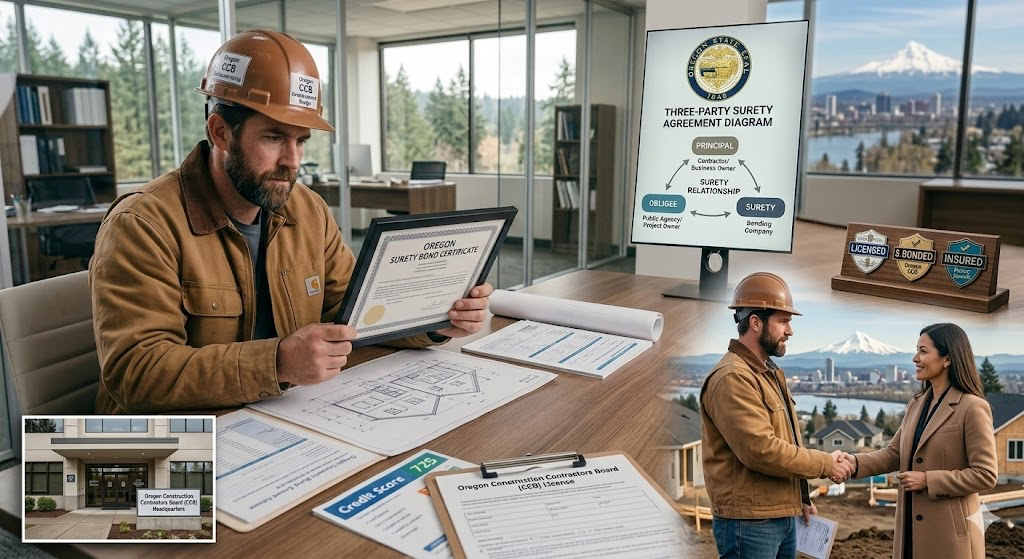
The email notification from the Oregon Construction Contractors Board arrived this morning informing you that your contractor license application has been approved pending final submission of the required surety bond, but the licensing packet contains confusing terminology about endorsements, bond amounts varying from fifteen thousand to eighty thousand dollars depending on classifications you don’t fully understand, and references to ORS Chapter 701 regulations you’ve never encountered during your apprenticeship years working for other licensed contractors, leaving you completely uncertain about which specific endorsement type matches the residential remodeling work you plan to perform, whether the bond amount listed represents cash you must deposit with the state or a smaller premium percentage you can actually afford, how long the sixteen-hour training requirement will take to complete before you can even submit your bond, and why Oregon requires continuous bonds without expiration dates creating ongoing premium obligations throughout your contracting career rather than one-time compliance costs. Understanding that Oregon mandates separate contractor license endorsements for residential general, residential specialty, residential limited, commercial general, and commercial specialty work with bond amounts ranging from ten thousand to eighty thousand dollars based on endorsement types and project scopes, how the Oregon Construction Contractors Board analyzes annual customer complaint data to adjust required bond amounts protecting consumers from contractor fraud or defective work, which other Oregon regulatory bodies including the Landscape Contractors Board and Bureau of Labor and Industries impose separate bonding requirements for specialized trades, and what premium rates you’ll actually pay ranging from one to ten percent of bond amounts depending on credit scores and business experience could mean the difference between launching your Oregon contracting business within weeks at manageable compliance costs or abandoning licensing plans because you fundamentally misunderstood bonding requirements that seem intentionally complex rather than clearly explained to prospective contractors seeking legitimate state authorization.
An Oregon surety bond is a legally binding three-party financial guarantee required by state regulatory agencies ensuring businesses and professionals comply with licensing laws, industry regulations, and consumer protection standards as conditions for obtaining licenses authorizing legal operations throughout Oregon.
Oregon Construction Contractors Board Licensing and Bonding Overview
The Oregon Construction Contractors Board serves as the primary regulatory authority for most construction contractors operating in Oregon, administering licensing requirements, establishing bond amounts, investigating consumer complaints, and enforcing compliance with ORS Chapter 701 construction contractor statutes. The CCB requires all contractors receiving compensation for construction activities to post surety bonds before issuing licenses, with specific bond types and amounts determined by endorsement classifications reflecting the scope of work contractors plan to perform.
Oregon uses unique terminology calling license classifications endorsements rather than the license types or contractor classifications used in most other states. This endorsement system creates five primary categories with residential general contractor endorsements authorizing comprehensive residential construction including foundation work, framing, electrical, plumbing, and all building trades for homes and residential structures, residential specialty contractor endorsements limiting work to specific trades like electrical, plumbing, HVAC, or roofing within residential settings, and residential limited contractor endorsements designed for part-time contractors, hobbyists, retirees, and handyman services performing unlimited building trades on small projects meeting specific value thresholds.
Commercial endorsements follow parallel structures with commercial general contractor classifications authorizing large-scale commercial projects including office buildings, retail centers, industrial facilities, and warehouses, while commercial specialty contractor endorsements focus on specific trades within commercial construction environments. Contractors performing both residential and commercial work must obtain dual endorsements requiring separate bonds for each classification, effectively doubling bonding obligations and premium expenses.
The Oregon Construction Contractors Board analyzes customer complaints against contractors annually, using complaint data along with project complexity factors, industry claim trends, and consumer protection needs to establish and periodically adjust required bond amounts for each endorsement category. This data-driven approach ensures bond amounts remain adequate for compensating damaged consumers while reflecting actual claim patterns rather than arbitrary amounts disconnected from real-world loss experiences.
Oregon Contractor Bond Amounts by Endorsement Type
Residential general contractor bonds require fifteen thousand dollars for standard endorsements, protecting homeowners from general contractors building or substantially remodeling residential structures through comprehensive construction services spanning multiple trades. These bonds cover typical residential projects from new home construction to whole-house renovations involving structural modifications, major system upgrades, and extensive remodeling work.
Residential specialty contractor bonds typically require ten thousand dollars for trade-specific contractors focusing on electrical work, plumbing installations, HVAC systems, roofing, or other specialized residential services. The lower bond amounts reflect narrower scopes of work with correspondingly smaller consumer loss exposures compared to general contractors performing comprehensive projects.
Residential limited contractor bonds require ten thousand dollars for part-time contractors, hobbyists, retirees, and handyman services performing construction activities as secondary income sources or retirement hobbies rather than full-time contracting businesses. This endorsement accommodates individuals building for personal satisfaction, retirees supplementing retirement income through small projects, and handyman services performing diverse minor repairs and improvements across unrelated trades.
Commercial general contractor Level 1 bonds require eighty thousand dollars for large-scale commercial contractors pursuing unlimited project sizes across all commercial construction categories. This highest bond amount reflects substantial consumer and project owner exposures when major commercial projects worth millions of dollars depend on contractor performance, creating potential losses far exceeding typical residential project risks.
Commercial general contractor Level 2 bonds require twenty-five thousand dollars for mid-sized commercial contractors working on moderate commercial projects with smaller scopes and lower financial exposures than Level 1 operations. The reduced bond amount recognizes that smaller commercial contractors pose proportionally lower risks to project owners and the public.
Commercial specialty contractor Level 1 bonds require fifty-five thousand dollars for trade-specific commercial contractors performing specialized work like electrical, plumbing, HVAC, or other commercial trades at unlimited project scales. These bonds protect project owners from specialty contractor defaults on major commercial installations.
Commercial specialty contractor Level 2 bonds require twenty-five thousand dollars for smaller commercial specialty contractors working on moderate commercial projects within specific trades. The bond amount parallels commercial general Level 2 requirements reflecting similar risk profiles for mid-sized commercial operations.
Landscape contractor bonds require fifteen thousand dollars for projects exceeding twenty-five thousand dollars in value or for probationary businesses, protecting consumers hiring landscaping contractors for substantial outdoor construction including irrigation systems, hardscaping, grading, drainage, and comprehensive landscape installations. The Oregon Landscape Contractors Board separately regulates landscaping professionals imposing distinct licensing and bonding requirements from general construction contractors.
How Oregon Contractor Bond Costs Work
Oregon contractor bond premiums range from one to ten percent of required bond amounts annually depending primarily on applicant credit scores, with excellent credit above seven hundred typically qualifying for one to three percent premium rates while challenged credit below six hundred faces five to ten percent through specialty programs. A fifteen-thousand-dollar residential general contractor bond might cost one hundred fifty to four hundred fifty dollars annually for strong credit applicants, while someone with a six hundred twenty-five credit score could pay seven hundred fifty to fifteen hundred dollars for identical coverage.
Credit score tiers create distinct pricing brackets with applicants scoring seven hundred or higher paying one to three percent of bond amounts, scores between six hundred and six hundred ninety-nine facing three to five percent rates, and scores below six hundred encountering five to ten percent premiums through specialized high-risk underwriting programs. An eighty-thousand-dollar commercial general Level 1 bond costs eight hundred to twenty-four hundred dollars annually for excellent credit contractors but could run four thousand to eight thousand dollars for challenged credit applicants.
No-credit-check bonds available for certain Oregon endorsements allow instant purchase at fixed premium rates without underwriting, creating accessible options for contractors who would face expensive premiums or declinations in credit-dependent markets. These freely written bonds typically apply to smaller residential endorsements where sureties accept standardized risk without individual credit evaluations, enabling contractors to satisfy bonding requirements within minutes rather than waiting days for underwriting approvals.
Business assets and industry experience influence premium rates beyond credit scores, as contractors demonstrating substantial working capital, profitable operations, and successful project completion histories can sometimes negotiate better rates even with modest personal credit. Sureties recognize that strong business financials and extensive experience reduce claim risks regardless of owners’ personal credit challenges.
Premium costs starting as low as one hundred dollars for small residential specialty bonds with excellent credit rise to potential eight-thousand-dollar annual expenses for large commercial general bonds with challenged credit, creating substantial variation in compliance costs across different endorsement types and applicant profiles. Understanding these cost ranges helps contractors budget appropriately for bonding expenses rather than being surprised by quotes substantially higher or lower than anticipated.
Other Oregon Surety Bond Requirements Beyond Construction
Auto dealer bonds required by the Oregon Department of Motor Vehicles protect consumers from dealer fraud, title problems, or failure to pay off liens before transferring vehicle ownership. Oregon auto dealers must post bonds before receiving dealer licenses authorizing vehicle sales.
Notary public bonds required in Oregon protect the public from financial losses caused by improper notarizations, identity verification failures, or fraudulent certificate completion. Oregon notaries must maintain bonds throughout their commission terms.
Collection agency bonds ensure debt collectors comply with consumer protection laws, avoid harassment or illegal collection tactics, and properly account for collected funds. Oregon collection agencies must post bonds with the Department of Consumer and Business Services.
Mortgage professional bonds required for lenders, servicers, and loan originators guarantee compliance with lending regulations and consumer protection standards. The Oregon Division of Financial Regulation mandates these bonds for mortgage industry participants.
Private investigator bonds and private security entity bonds required by the Oregon Department of Public Safety Standards and Training guarantee compliance with licensing regulations and ensure timely payment of wages to security professionals and investigators. Bond amounts start at five thousand dollars for entities with ten or fewer employees, increasing based on workforce sizes.
Employment agency bonds protect job seekers from fraudulent placement services, fee violations, or contractual breaches by agencies charging fees for job placement assistance.
Farm labor contractor bonds overseen by the Oregon Bureau of Labor and Industries ensure agricultural labor contractors comply with wage payment requirements and worker protection standards.
Escrow agent bonds required by banking and financial regulators protect parties to real estate transactions or other escrow arrangements from fund misappropriation or professional misconduct during escrow administration.
The Sixteen-Hour Contractor Training Requirement
Oregon requires all contractor license applicants to complete sixteen hours of approved training covering business management, Oregon construction law, lien law, and contractor licensing requirements before the Construction Contractors Board will process license applications. This mandatory education ensures contractors understand legal obligations, business best practices, and regulatory compliance standards before beginning independent contracting operations.
The training curriculum addresses topics including proper contract formation, change order procedures, payment schedules, lien rights and deadlines, insurance requirements, bonding obligations, complaint resolution processes, and regulatory compliance responsibilities contractors must fulfill throughout their licensed careers. Completing this training before license application prevents costly mistakes contractors might make operating without foundational knowledge of Oregon-specific construction regulations.
Upon completing the sixteen-hour course, applicants must pass an examination demonstrating comprehension of material covered in the training. Only after passing this exam can contractors proceed with license applications including surety bond procurement, insurance certificate submission, and business entity registration.
The Continuous Bond Requirement and Cancellation Procedures
Oregon requires continuous bonds without expiration dates, creating ongoing coverage obligations throughout contractors’ licensed operating periods rather than fixed-term bonds expiring on specific dates. This continuous requirement ensures uninterrupted consumer protection even as contractors transition between surety companies, adjust bond amounts, or modify endorsement classifications during their contracting careers.
Surety companies maintain rights to cancel continuous bonds but must provide thirty-day advance written notice to both contractors and the Oregon Construction Contractors Board before cancellations become effective, protecting the state from sudden coverage gaps when contractors might still hold active licenses or ongoing project obligations. This thirty-day window allows contractors to secure replacement bonds maintaining continuous coverage, though failure to replace cancelled bonds triggers automatic license suspensions until new bonds restore compliance.
Contractors planning to cease operations should coordinate bond cancellations with formal license terminations, as maintaining active licenses without corresponding bond coverage violates Oregon regulations triggering penalties and administrative complications. The thirty-day cancellation notice period creates timing challenges requiring contractors to carefully sequence license surrenders and bond terminations avoiding gaps or overlaps.
Bonds remain in effect until depleted by claims paid under ORS Chapter 701, meaning successful claims reduce remaining bond coverage available for subsequent claims. Once total claim payments reach full bond amounts, bonds become exhausted requiring contractors to post replacement bonds or increased amounts restoring adequate coverage levels.
How to Get Your Oregon Surety Bond
Obtaining your Oregon surety bond starts by determining your specific endorsement type based on whether you’ll perform residential or commercial work and whether you’ll operate as a general contractor across multiple trades or specialize in specific construction disciplines, with endorsement selections determining required bond amounts ranging from ten thousand to eighty thousand dollars. Contact experienced Oregon surety bond specialists like Swiftbonds who understand CCB requirements and maintain relationships with multiple surety companies authorized to write Oregon contractor bonds, providing access to competitive markets including both standard programs for strong credit applicants and specialty programs for challenged credit situations. Complete the online bond application providing business information, personal details including social security numbers enabling credit checks unless applying for no-credit-check freely written bonds, and endorsement specifications matching your planned contracting activities. Receive your premium quote typically ranging from one to ten percent of bond amounts depending on credit scores and underwriting factors, then submit payment through secure processing and most Oregon contractor bonds deliver within twenty-four to forty-eight hours via email, allowing you to file bonds with the Oregon Construction Contractors Board at 201 High Street SE, Unit 600, Salem, OR 97301 along with your completed license application, insurance certificates, and business entity documentation.
Swiftbonds LLC
Voted 2025 Surety Bond Agency of the Year
4901 W. 136th Street
Leawood KS 66224
(913) 214-8344
https://swiftbonds.com/
Filing Requirements with the Oregon Construction Contractors Board
Oregon contractor bonds must be filed with the Construction Contractors Board within sixty days of bond execution dates, with bonds bearing signatures more than sixty days old considered invalid for licensing purposes requiring new bonds with current execution dates. This sixty-day filing deadline ensures bonds remain current and surety companies maintain active awareness of bonded contractors rather than discovering bond obligations months or years after issuance.
The CCB requires specific bond forms meeting statutory language requirements codified in ORS Chapter 701 and OAR Chapter 812 administrative rules. Bonds using improper forms, missing required provisions, or lacking proper surety authorization face rejection requiring contractors to obtain corrected bonds before license processing continues.
Surety companies must be authorized to transact surety business in Oregon, with the CCB maintaining lists of approved sureties meeting state financial strength and regulatory compliance standards. Bonds from unlicensed or unapproved sureties face automatic rejection regardless of bond amounts or premium costs.
For renewing contractors, some surety providers automatically file renewal bonds directly with the CCB through electronic systems, simplifying renewal processes and preventing inadvertent coverage lapses from administrative oversights. Contractors should confirm whether their surety companies provide automatic filing services or whether contractors bear responsibility for submitting renewal bonds to the Board.
Regulatory Bodies Beyond the Construction Contractors Board
The Oregon Landscape Contractors Board separately regulates landscaping contractors performing outdoor construction including irrigation systems, hardscaping, grading, drainage systems, and comprehensive landscape installations. Landscape contractors must obtain separate licenses and bonds from this specialized board rather than through the Construction Contractors Board, creating parallel but distinct regulatory frameworks.
The Oregon Bureau of Labor and Industries oversees labor contractors and farm labor contractors, requiring separate surety bonds ensuring compliance with wage payment requirements and worker protection standards in agricultural and labor contracting contexts. These bonds protect employees from wage theft or contractor failures to meet payment obligations.
The Oregon Department of Public Safety Standards and Training regulates private security entities and private investigators, mandating bonds guaranteeing timely wage payments to security professionals and compliance with licensing regulations governing investigative and security services.
Local municipalities including Portland, Salem, Eugene, and other Oregon cities sometimes impose additional contractor licensing and bonding requirements beyond state-level obligations, creating layered compliance burdens for contractors working in jurisdictions with enhanced local regulations. Contractors should verify whether cities or counties where they plan to work impose local bonding requirements supplementing state CCB bonds.
Frequently Asked Questions
What happens if I need both residential and commercial endorsements?
Oregon requires separate bonds for residential and commercial endorsements, meaning contractors performing both types of work must purchase two distinct bonds and pay premiums for each classification. A contractor holding residential general and commercial general endorsements would need a fifteen-thousand-dollar residential bond plus either a twenty-five-thousand or eighty-thousand-dollar commercial bond depending on their commercial level, creating combined bond amounts of forty thousand to ninety-five thousand dollars with corresponding premium obligations for both bonds.
Can I operate without a bond if I only do small projects?
Oregon law requires all contractors receiving compensation for construction activities to be licensed and bonded regardless of project sizes, with no minimum project threshold exempting small jobs from bonding requirements. Unlike some states offering handyman exemptions for projects under specific dollar amounts, Oregon mandates licensing and bonding for any compensated construction work, though the residential limited endorsement accommodates part-time contractors, hobbyists, and retirees through appropriate classification options.
How long does it take to get an Oregon contractor bond?
Standard Oregon contractor bonds with good credit typically process within twenty-four to forty-eight hours from application submission to bond delivery, while no-credit-check freely written bonds available for certain endorsements allow instant purchase and immediate electronic delivery within minutes. More complex applications involving credit challenges or large commercial bonds may require forty-eight to seventy-two hours for detailed underwriting reviews before sureties approve bonds and issue certificates.
What if I can’t afford the required bond amount?
The bond amount represents maximum coverage the surety guarantees, not the cost you pay, with actual premiums ranging from one to ten percent of bond amounts creating manageable expenses for most contractors. A fifteen-thousand-dollar bond costs one hundred fifty to fifteen hundred dollars annually rather than the full fifteen thousand, making bonding affordable for businesses that might incorrectly assume they must deposit full bond amounts with the state.
Can the Oregon CCB increase my required bond amount after I’m licensed?
Yes, the Construction Contractors Board maintains authority to adjust bond amounts at any time based on changing circumstances including complaint patterns, claim histories, or regulatory determinations that existing amounts no longer provide adequate consumer protection. Contractors receiving notices of increased bond requirements must post additional coverage or bond riders raising amounts to newly required levels within specified timeframes avoiding license suspensions.
Do I need the sixteen-hour training if I’ve been contracting in other states?
Yes, Oregon requires all contractor license applicants to complete the sixteen-hour training and pass the examination regardless of prior licensing in other states or decades of contracting experience, as the training covers Oregon-specific laws, regulations, and licensing requirements that may differ substantially from other jurisdictions. Out-of-state contractors relocating to Oregon must complete this training before license applications will be processed.
Conclusion
Oregon surety bonds required by the Construction Contractors Board create legally binding three-party financial guarantees protecting consumers from contractor fraud, defective work, or contractual defaults across five primary endorsement classifications covering residential general, residential specialty, residential limited, commercial general, and commercial specialty contracting activities. Bond amounts ranging from ten thousand to eighty thousand dollars vary based on endorsement types and levels, with the CCB annually analyzing customer complaint data to adjust required amounts ensuring adequate consumer protection while reflecting actual claim patterns.
Premium costs ranging from one to ten percent of bond amounts create affordable compliance expenses for most Oregon contractors when applicants understand that bond amounts represent maximum coverage rather than actual costs paid. Excellent credit applicants scoring seven hundred or above typically pay one to three percent of bond amounts, while challenged credit below six hundred faces five to ten percent through specialty programs, with no-credit-check bonds available for certain endorsements allowing instant purchase at fixed rates.
The sixteen-hour mandatory training requirement ensures all Oregon contractors understand business management fundamentals, construction law basics, lien procedures, and licensing compliance obligations before beginning independent operations. This education requirement combined with bonding and insurance mandates creates comprehensive consumer protection frameworks distinguishing Oregon from states with less rigorous contractor oversight.
Continuous bonds without expiration dates create ongoing coverage obligations throughout contractors’ licensed careers, with thirty-day cancellation notice requirements protecting the state from sudden coverage gaps while allowing sureties to terminate relationships with problematic principals. Contractors must carefully coordinate bond cancellations with license terminations avoiding regulatory violations from active licenses lacking required bond coverage.
Multiple regulatory bodies including the Construction Contractors Board, Landscape Contractors Board, Bureau of Labor and Industries, and Department of Public Safety Standards and Training impose distinct bonding requirements across different industries and professions, with local municipalities sometimes adding supplemental bonding obligations beyond state-level mandates. Understanding which regulatory authorities govern specific business activities prevents inadvertent compliance gaps from contractors assuming singular regulatory oversight when multiple agencies maintain jurisdiction.
The sixty-day bond filing deadline following execution dates ensures timely CCB receipt of current bonds rather than delayed submissions creating coverage uncertainties or administrative complications from aged bond forms requiring replacement. Automatic renewal filing services offered by some surety companies simplify compliance for established contractors avoiding manual submission processes.
Five Oregon-Specific Bonding Realities
The Oregon Construction Contractors Board pioneered data-driven bond amount adjustments using annual customer complaint analysis to establish and periodically revise required bond amounts for each endorsement category, creating one of the nation’s most sophisticated regulatory frameworks where bond requirements respond to actual consumer loss patterns rather than arbitrary amounts unchanged for decades, though this analytical approach means contractors can face unexpected bond amount increases mid-career when complaint trends demonstrate existing amounts prove insufficient for compensating damaged homeowners.
Oregon’s residential limited contractor endorsement designed specifically for part-time contractors, hobbyists, retirees, and handyman services represents a unique licensing category rarely found in other states, recognizing that many individuals perform construction work as secondary income sources or retirement activities rather than full-time businesses, though this specialized endorsement still requires the same ten-thousand-dollar bonds as residential specialty contractors despite ostensibly serving lower-risk weekend warriors and hobby builders.
The Oregon Landscape Contractors Board operates as a completely separate regulatory entity from the Construction Contractors Board with distinct licensing examinations, bonding requirements, and enforcement mechanisms, creating potential dual licensing obligations for contractors performing both general construction and substantial landscaping work, as landscaping activities exceeding certain complexity or value thresholds require separate landscape contractor licenses and bonds even when performed by licensed general contractors.
Oregon’s continuous bond requirement combined with bonds remaining in effect until depleted by claims creates unusual situations where contractors with multiple successful claims against their bonds can face partial bond depletion requiring supplemental coverage restoring full bond amounts, as each claim payment reduces remaining coverage available for future claims until total payments reach bond limits, forcing contractors to purchase bond increases or supplemental instruments maintaining adequate protection levels after significant claim activity.
The Oregon Bureau of Labor and Industries maintains concurrent jurisdiction with the Construction Contractors Board over farm labor contractors and certain labor contractor categories, creating potential dual bonding requirements where contractors must satisfy both CCB construction contractor bonds and separate BLI labor contractor bonds when their business activities span both construction work and agricultural labor contracting, effectively requiring two distinct state bonds from different agencies for overlapping but legally distinct business operations.