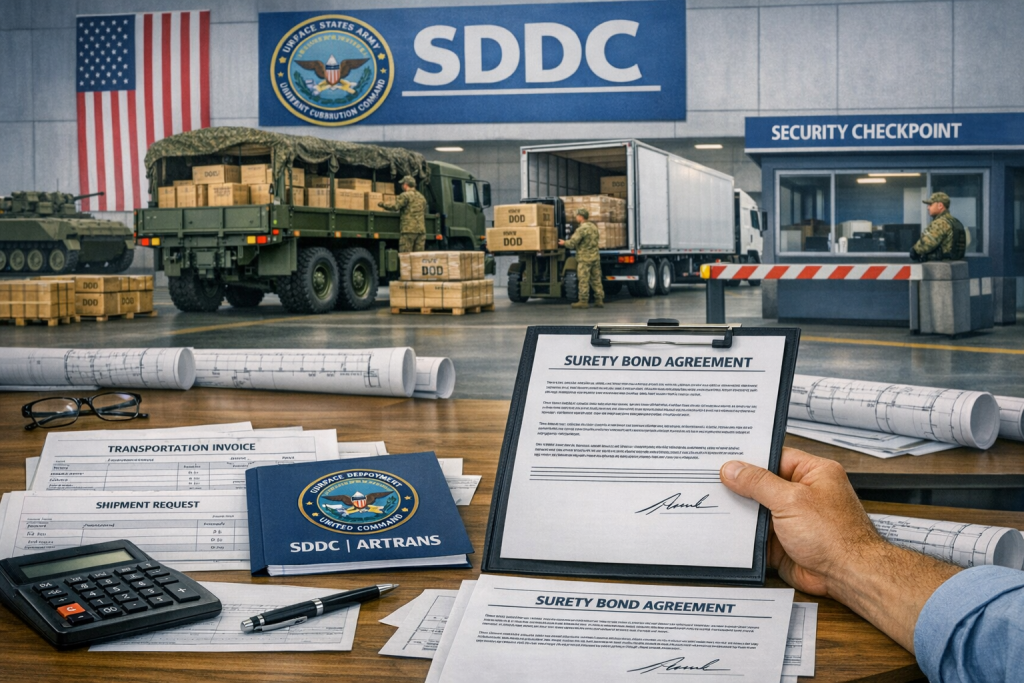
You’ve found a lucrative opportunity to haul Department of Defense freight at premium government rates—but then you discover that registration requires something called an SDDC Bond, and the process involves navigating military acronyms, registration windows, and multi-step compliance requirements that nobody clearly explains. Understanding exactly what this bond is and how to obtain it before you invest weeks in applications could save you from costly delays and rejected submissions.
An SDDC Bond, also known as a Department of Defense Performance Bond or Military Surface Deployment and Distribution Command Performance Bond, is a surety bond required by the Military Surface Deployment and Distribution Command for all Transportation Service Providers who transport military freight for the United States Department of Defense. This bond guarantees that freight carriers, brokers, forwarders, and logistics companies will fulfill contractual obligations to deliver DOD cargo as agreed, protecting taxpayer investments and ensuring critical military supply chains remain uninterrupted.
Understanding SDDC and Its Transportation Mission
The Military Surface Deployment and Distribution Command represents a critical branch of the United States Army responsible for managing the global movement of goods and personnel for the Department of Defense. The SDDC oversees surface transportation logistics including trucks, rail, and port shipments that keep military operations supplied worldwide. Understanding this organizational context helps clarify why bonding requirements exist and what standards the military expects from transportation partners.
Before 2004, this organization operated under the name Military Traffic Management Command, which explains why older documents and some veteran carriers still reference MTMC bonds. The agency was renamed to reflect its expanded mission beyond traffic management to comprehensive deployment and distribution coordination. Despite the name change, the bonding requirements and fundamental purpose remained identical.
The SDDC manages four distinct transportation programs, each with specific bonding requirements. The Domestic Personal Property Program handles interstate and intrastate shipments of household goods for military personnel relocating within the continental United States. The International Personal Property Program governs shipments between CONUS and outside continental United States destinations, plus movements between different OCONUS locations. The Mobile Home Personal Property Program specifically addresses manufactured home movements within CONUS using special One-Time-Only rate structures. The Boat Personal Property Program covers watercraft transportation within the continental United States also using One-Time-Only rates.
Most freight carriers focus on general cargo and equipment transportation rather than personal property programs, but understanding these distinctions prevents application errors when your company might provide multiple service types.
Who Must Obtain SDDC Bonds
Any Transportation Service Provider seeking to transport Department of Defense freight must obtain an SDDC bond before bidding on or moving military cargo. Without this bond, carriers cannot participate in the bidding process or receive contracts from the SDDC regardless of their equipment quality or operational excellence.
Freight carriers who physically transport military cargo using their own trucks and drivers need SDDC bonds. These companies move ammunition, supplies, equipment, and materiel between military installations, from civilian suppliers to military destinations, or to port facilities for international shipment.
Freight brokers who arrange transportation of DoD freight without operating trucks themselves must post bonds. These intermediaries connect the military with qualified carriers, coordinating shipments and managing logistics without physically driving the loads. Freight forwarders, including both surface and air freight forwarders, require bonds due to the high volume of traffic these operations handle as they consolidate shipments and arrange complex multi-leg movements.
Logistics companies providing third-party logistics services for DOD shipments need bonding even when subcontracting actual transportation to other carriers. The bond protects the military when logistics coordinators fail to ensure delivery through their network of subcontractors.
Several specialized carrier categories receive exemptions from SDDC bonding requirements. Local drayage carriers operating exclusively within commercial zones don’t need bonds. Commercial zone carriers similarly avoid bonding. Barge operators transporting military freight via waterways fall outside requirements. Rail carriers moving DOD cargo operate under different regulatory frameworks without SDDC bonds. Sealift operations, ocean carriers, and pipeline carriers all receive exemptions recognizing their distinct regulatory oversight through maritime and pipeline safety agencies.
What SDDC Bonds Cover Versus What They Exclude
Understanding precise coverage boundaries prevents costly misunderstandings about protection these bonds provide and situations that trigger claims. SDDC bonds protect the Department of Defense from catastrophic contractor failures, not routine operational problems.
The bond covers complete performance failures where your company cannot or will not deliver military freight tendered to you. Default on DOD freight contracts activates coverage when you refuse assigned loads or cease operations mid-contract. Abandoned shipments trigger the bond when you leave military cargo stranded without completing delivery to designated destinations. Carrier bankruptcy while holding DOD freight represents the most serious covered scenario requiring immediate alternative arrangements for critical military supplies.
What surprises most new military freight carriers is the extensive list of situations falling completely outside bond coverage. Late pickup beyond scheduled appointment times doesn’t trigger the bond regardless of contract violations or financial penalties incurred. Delayed delivery missing guaranteed transit commitments remains your responsibility without bond protection. Excessive transit times violating routing agreements or service standards fall outside coverage entirely.
Operational problems like refusals at pickup locations, no-shows for scheduled appointments, or presenting improper or inadequate equipment for assigned cargo types don’t activate bond claims. Payment disputes with subcontractors you hired to assist with deliveries remain entirely your problem—the bond won’t reimburse unpaid carriers in your supply chain. Claims for lost cargo during transport or damaged freight from handling problems trigger your separate cargo insurance policy, not the performance bond.
This critical distinction means you need robust operational systems, adequate cargo insurance, reliable equipment maintenance, and strong subcontractor payment practices to avoid the ninety-nine percent of problems the bond doesn’t cover. The bond protects the DOD from your complete failure to perform, but operational excellence preventing all other issues remains your full responsibility.
SDDC Bond Amount Requirements and Calculations
SDDC bond amounts follow tiered structures reflecting geographic scope, operational complexity, and company type. Understanding these calculations helps you budget accurately before investing in military freight registration.
Large freight carriers face bond requirements based on state coverage. Operating in a single state requires a twenty-five-thousand-dollar bond when both pickup and delivery occur within the same state boundaries. Movements must begin and end within your selected states—simply transiting through states without pickup or delivery doesn’t count toward state totals. Expanding to two or three states increases your requirement to fifty thousand dollars. Carriers servicing four or more states must post one-hundred-thousand-dollar bonds reflecting substantial geographic scope.
Small Business Administration-registered carriers receive more favorable treatment with different thresholds. SBA carriers operating in up to three states need only twenty-five-thousand-dollar bonds. Expanding to four through ten states requires fifty-thousand-dollar bonds for SBA carriers. Only when servicing eleven or more states do SBA carriers face one-hundred-thousand-dollar requirements. To utilize these favorable SBA amounts, you must provide supporting documentation proving your SBA registration when submitting bond information to the SDDC.
Certain Transportation Service Provider categories face flat requirements regardless of geographic coverage. Freight brokers, logistics companies, surface freight forwarders, shipper agents, and air freight forwarders all must post one-hundred-thousand-dollar bonds due to high cargo volumes these intermediaries handle. The DOD determined that companies arranging transportation warrant maximum bonding even for single-state operations.
Bulk fuel carriers receive special consideration with flat twenty-five-thousand-dollar requirements regardless of state coverage. This recognizes specialized petroleum product hauling operations and different risk profiles compared to general freight.
Experienced carriers who have conducted business in their own name with the Department of Defense for three or more consecutive years qualify for revenue-based calculations. These established operators submit bonds equal to two-and-a-half percent of their total DOD revenue for the previous twelve months. This calculation cannot exceed one hundred thousand dollars or fall below twenty-five thousand dollars, establishing clear ceiling and floor limits. Revenue-based bonding potentially lowers requirements for proven carriers with modest annual military freight volumes.
International Personal Property Program participants face distinct requirements. These carriers must file SDDC performance bonds of at least one hundred thousand dollars or two-and-a-half percent of previous-year international DoD revenue, whichever amount is greater. This “whichever is greater” provision ensures substantial bonding for high-volume international operations.
Domestic carriers participating in personal property programs must file transportation service provider performance bonds of fifty thousand dollars or two-and-a-half percent of previous-year DoD revenue, whichever is greater. Note that domestic intrastate movement—shipments both beginning and ending within a single state—receives exemption from surface deployment bond requirements entirely.
Essential Prerequisites Before Applying for SDDC Bonds
Several foundational requirements must already be in place before surety companies will consider your SDDC bond application. Missing these prerequisites wastes application time and delays market entry.
Standard Carrier Alpha Code assignment from the National Motor Freight Traffic Association provides your unique identifier in military transportation systems. This two-to-four letter code distinguishes your company in freight tracking and payment systems. You need a separate SDDC bond for each SCAC code under which you operate. Multi-SCAC businesses require multiple corresponding bonds, significantly increasing total bonding costs for companies operating several business entities.
Valid Department of Transportation operating authority represents a critical hurdle. You must maintain a valid DOT operating certificate for at least three consecutive years before the SDDC will register you as an approved freight carrier. This substantial prerequisite ensures only established carriers with proven regulatory compliance records access military freight opportunities. Startup carriers cannot enter military freight markets regardless of bonding capability until they accumulate three years of documented DOT operations.
Electronic payment certification through U.S. Bank Syncada enables you to receive government payment for completed shipments. You must form an agreement with U.S. Bank Freight Payments and become certified to accept electronic payments for your services. This system represents the mandatory payment channel for all military freight compensation.
PowerTrack or Syncada certification through free online registration allows real-time coordination between military shippers and approved carriers for load management and documentation. This software platform enables shippers and carriers to coordinate online managing transportation issues, tracking shipments, and maintaining required documentation.
Compliance with all applicable Federal, State, and Local requirements for movement and storage of personal property often obligates carriers and brokers to also satisfy the FMCSA’s BMC-84 freight broker bond requirement. Many carriers need both their DOT commercial freight broker bond and their separate SDDC bond if they handle both civilian and military freight.
Open Season Registration and Timing Considerations
Unlike many licensing and bonding programs with continuous open enrollment, the SDDC historically implements Open Season Registration periods—specific windows when new carrier registration applications are accepted. Understanding this timing constraint helps you plan market entry strategically.
The SDDC designates particular time periods when Transportation Service Providers can submit new registration applications. Outside these open seasons, new carrier applications typically aren’t processed regardless of your bonding or operational readiness. You must check the SDDC website periodically to identify when the next Open Season Registration will occur.
This registration structure creates natural barriers to immediate market entry even when you’ve secured your bond and met all other prerequisites. Carriers who miss registration windows may wait months before the next opportunity opens. The unpredictable timing of these seasons means you cannot always enter military freight markets immediately when business opportunities arise.
Recent years have seen some relaxation of strict registration windows, but the fundamental principle that registration isn’t continuously available remains important for planning purposes. Before investing in expensive bonding and compliance systems, verify current registration status and upcoming open seasons to avoid preparing for markets you cannot immediately access.
Understanding the Three-Party SDDC Bond Structure
SDDC bonds follow standard three-party surety bond frameworks creating distinctly different obligations than traditional insurance policies. Grasping these relationships clarifies your actual financial exposure and responsibilities.
The principal represents your transportation company as the party purchasing the bond, paying premiums, and bearing ultimate financial responsibility for all claims. When you sign surety agreements and obtain an SDDC bond, you personally and corporately guarantee to reimburse the surety company for every dollar they pay out on claims plus interest, legal fees, and collection costs. This reimbursement obligation makes performance bonds fundamentally different from insurance where covered losses stay with the insurance company.
The obligee is the Military Surface Deployment and Distribution Command, the DOD entity requiring the bond to protect government interests. The SDDC receives financial protection from contractor failures without pursuing lengthy litigation against potentially bankrupt carriers. They file claims directly against the bond when contractors default, abandon shipments, or go out of business while holding military freight.
The surety is the insurance or bonding company that underwrites your bond, evaluating your creditworthiness and operational capability before approval. The SDDC requires bonds from surety companies authorized to issue bonds on behalf of the federal government. Only Treasury-certified companies can write SDDC bonds. Sureties guarantee payment to the SDDC if you fail to perform, but they maintain absolute rights to recover those payments from you personally and corporately through collection actions.
This three-party structure means you’re not buying protection for your company. You’re providing financial assurance to the military that taxpayers won’t lose money if you fail them. Your benefit comes indirectly through qualifying for lucrative government freight contracts that might otherwise remain inaccessible.
Cost Factors and Premium Calculations
SDDC bond premiums vary substantially based on your financial profile, operational history, and required bond amount. Understanding these pricing factors helps you budget accurately and potentially improve rates before applying.
Personal credit scores represent the single largest premium determinant for most applicants. Transportation company owners with excellent credit scores above seven hundred typically pay one to three percent of the required bond amount annually. A one-hundred-thousand-dollar bond might cost one thousand to three thousand dollars per year for carriers with pristine credit histories. Business owners with credit scores between six hundred and seven hundred face rates between three and four percent annually. Poor credit below six hundred pushes premiums to four to ten percent or higher of bond amounts.
Business financial statement strength matters significantly for borderline credit applications. If your personal credit falls in marginal ranges, strong company financials showing substantial liquid assets, positive cash flow, and manageable debt ratios can reduce premiums. Demonstrating you have resources to pay potential claims reassures sureties even when personal credit looks questionable.
Type of carrier and operating region influence underwriting decisions. Carriers with limited geographic scope may receive slightly better rates than nationwide operators. Specialized carriers in niche markets sometimes qualify for preferential pricing based on lower historical claim rates in their segments.
The number of states you service affects not just your required bond amount but also pricing per thousand dollars of coverage. Multi-state operations involve more complexity and potential exposure, which sureties factor into premium calculations.
Years of experience with Department of Defense freight contracts significantly influence underwriting for established carriers. Three-plus years of successful military freight hauling without claims demonstrates reliability and often qualifies you for better pricing or the alternative revenue-based bond calculation.
What Cannot Substitute for Actual SDDC Bonds
Many transportation companies attempt to offer alternative financial guarantees hoping to bypass traditional surety bond requirements. The SDDC explicitly and universally rejects all proposed substitutes regardless of their apparent financial strength.
Trust funds held with financial institutions seem like straightforward cash guarantees, but the SDDC will not accept them. Trust arrangements lack the three-party legal framework that gives the military specific claim rights and recovery mechanisms. Banks administering trusts don’t conduct the same rigorous underwriting and ongoing carrier monitoring that surety companies provide.
Customs bonds covering international freight movements serve completely different regulatory purposes. These bonds guarantee payment of duties and customs compliance, not delivery of domestic military freight. The obligees differ, coverage differs, and regulatory frameworks don’t overlap.
Department of Transportation bonds required for freight broker authority under FMCSA regulations protect commercial shippers and motor carriers. These BMC-84 bonds don’t extend any protection to the Department of Defense for military-specific freight movements. You need both your DOT broker bond and your separate SDDC bond if you arrange both commercial and military transportation.
Letters of credit from your bank might appear to provide solid financial backing, but they lack surety industry expertise in performance risk assessment. Banks issue letters of credit based purely on your financial standing without evaluating your operational capability to complete freight movements successfully.
The SDDC’s absolute insistence on properly underwritten surety bonds from Treasury-certified companies reflects superior risk management compared to all proposed alternatives. Only licensed surety bonds with appropriate federal underwriting satisfy DOD bonding requirements.
How to Get an SDDC Bond
Getting your SDDC bond follows a straightforward process that experienced carriers with strong credit can complete in twenty-four to forty-eight hours. Start by submitting an application to a surety company or specialized transportation bond agency with complete details about your operation including the number of states you’ll service, your DOT authority dates and numbers, your Standard Carrier Alpha Code, whether you’re SBA-registered, and your years of prior DOD freight experience if applicable. Bond specialists like Swiftbonds who focus on military freight bonding understand SDDC-specific requirements and can guide you through registration complexities while often providing instant approvals for qualified applicants with excellent credit.
The surety conducts underwriting examining your personal credit scores, business financial statements if your credit falls in borderline ranges, and your DOT safety compliance record. They provide a quote showing your annual premium based on your complete risk profile. Once you accept the quote and pay your first premium, the surety issues your bond and files it electronically with the SDDC through the Defense Personal Property System. Your bond becomes active once the SDDC confirms receipt and processes your filing, typically within one to two business days. You’ll receive confirmation including instructions for obtaining your Electronic Transportation Acquisition password that grants access to DOD load tendering and freight management systems.
Swiftbonds LLC
2024 Surety Bond Provider of the Year
4901 W. 136th Street
Leawood KS 66224
(913) 214-8344
https://swiftbonds.com/
Annual Renewal Requirements and Continuous Coverage Obligations
SDDC bonds operate on annual terms requiring careful renewal management. Missing renewal deadlines can immediately terminate your authorization to haul military freight with potentially devastating business consequences.
Bond terms run exactly one year from issuance dates. As your anniversary approaches, your surety company contacts you about renewal with updated premium quotes reflecting current underwriting. When the bond renews, the surety emails confirmation of the renewal directly to the obligee’s specific email address designated by the SDDC. This electronic notification maintains your continuous coverage without requiring manual paperwork submissions from you.
SDDC bonds must be written as continuous obligations with absolutely no lapse in coverage at any time. If the Department of Defense determines that your SDDC surety bond needs to be increased due to expanded operations or higher revenue levels, you’ll receive notification and be granted thirty days to submit a new performance bond at the higher amount.
Coverage gaps create immediate and serious problems. If your bond expires without renewal, you lose authorization to accept new freight tenders the moment coverage lapses. The SDDC removes carriers with lapsed bonds from approved provider lists immediately, requiring complete requalification and new registration once bonding resumes.
Budget for annual renewal as an ongoing operational expense comparable to insurance or licensing fees. Many carriers mistakenly view initial bonds as entry barriers they’ll never face again. Annual renewals mean you’ll pay bond premiums every single year you remain active in military freight hauling.
Common Application Mistakes That Cause Delays
New military freight carriers make predictable errors during bonding and registration processes. Avoiding these mistakes accelerates your approval timeline and prevents costly reapplication fees.
Applying for bonds before establishing three full years of continuous DOT authority wastes time and application fees. The SDDC won’t accept your registration regardless of bonding if you lack the required operating history. Confirm your DOT authority dates reach back at least thirty-six months before starting bond applications.
Requesting incorrect bond amounts based on misunderstanding state coverage rules or SBA registration benefits causes application rejections. If you’re SBA-registered, ensure you provide supporting documentation of that registration to qualify for favorable bonding thresholds. Otherwise, you’ll be assessed as a large company with higher requirements.
Assuming one SCAC covers multiple business entities creates dangerous compliance gaps. Each Standard Carrier Alpha Code requires its own dedicated SDDC bond. Multi-SCAC operations without corresponding multiple bonds lose DOD hauling authorization immediately when audited.
Neglecting to establish U.S. Bank Syncada certification or PowerTrack registration while focusing solely on bonding leaves you non-compliant with complete SDDC registration standards. You need all prerequisite systems active simultaneously before the military will tender freight to you.
Failing to verify current Open Season Registration status before completing expensive bonding processes can leave you with an active bond but no ability to register as an approved carrier until the next open season begins.
Frequently Asked Questions
What’s the difference between an SDDC bond and my regular freight broker bond?
An SDDC bond specifically covers your obligations to transport military cargo for the Department of Defense under SDDC contracts. Your freight broker bond (BMC-84) covers your obligations to pay motor carriers and protect shippers in commercial freight transactions under FMCSA regulations. The obligees differ, the coverage differs, and the regulatory frameworks don’t overlap. Most freight brokers handling military freight need both bonds simultaneously.
Can I start hauling military freight while my SDDC bond is being processed?
Absolutely not. You cannot accept or transport any DOD freight until your bond is fully approved, issued, and electronically filed with the SDDC through the Defense Personal Property System with confirmation received. Attempting to haul military cargo without an active bond on file violates federal regulations and can result in permanent disqualification from SDDC programs.
Do I need separate SDDC bonds if I have multiple SCAC codes?
Yes. You must have a separate SDDC bond for each Standard Carrier Alpha Code you operate under. If you run multiple business entities or divisions each with their own SCAC, you need corresponding multiple bonds. This requirement significantly increases bonding costs for multi-SCAC operations.
How do SBA-registered carriers get lower bond amounts?
Small Business Administration-registered carriers can service up to three states with only a twenty-five-thousand-dollar bond, compared to regular carriers who need fifty-thousand-dollar bonds for two to three states. SBA carriers serving four through ten states need only fifty-thousand-dollar bonds versus one hundred thousand for regular carriers with four-plus states. To qualify, you must provide supporting documentation proving your SBA registration when submitting bond information to the SDDC.
What happens if the SDDC determines my bond needs to be increased?
If the Department of Defense determines your SDDC surety bond needs to be increased due to expanded operations, higher revenue levels, or changed risk assessment, you’ll receive official notification. You’re granted thirty days from that notification to submit a new performance bond at the higher required amount. Your bond must remain continuous without any lapse during this transition.
Are there specific times when I can register as an SDDC carrier?
Historically yes. The SDDC implements Open Season Registration periods—specific windows when new carrier registration applications are accepted. Outside these designated seasons, new applications typically aren’t processed. You must check the SDDC website periodically to identify when the next Open Season Registration will occur. Recent years have seen some relaxation of this restriction, but timing constraints remain important.
What if I only move household goods for military families, not freight?
Different bonding applies to you. The Domestic Personal Property Program, International Personal Property Program, Mobile Home Program, and Boat Program all have specific bonding requirements distinct from general freight carrier bonds. International personal property participants need bonds of at least one hundred thousand dollars or two-and-a-half percent of previous-year international DoD revenue, whichever is greater. Domestic carriers need fifty thousand dollars or two-and-a-half percent of revenue, whichever is greater.
Does my bond cover damage to military cargo during transport?
No. The SDDC bond does not cover damaged cargo, lost freight, or cargo claims. Those situations trigger your separate cargo insurance policy, not your performance bond. The performance bond only covers catastrophic failures like default, abandoned shipments, and bankruptcy—not operational problems or cargo damage.
Can I use my customs bond or DOT bond instead of getting an SDDC bond?
No. The SDDC explicitly rejects trust funds, customs bonds, DOT bonds, and letters of credit as substitutes. Only properly underwritten surety bonds from Treasury-certified companies authorized to issue bonds on behalf of the federal government satisfy SDDC requirements. You need the specific SDDC bond regardless of what other bonds you hold.
How long does SDDC bond approval typically take?
Approval timelines vary significantly based on your credit profile. Carriers with excellent credit above seven hundred often receive instant approvals through online applications with automated underwriting. Average credit applicants typically wait one to two business days for manual underwriting review. Poor credit or complex financial situations can take three to five business days. After approval, electronic filing through the Defense Personal Property System adds another one to two business days before your bond becomes fully active with ETA password access.
Conclusion
SDDC bonds represent essential requirements for carriers entering the stable, high-volume Department of Defense freight market. These bonds protect taxpayer investments and military supply chain integrity by ensuring only financially stable, reliable carriers handle critical military cargo. Understanding bond amounts, coverage limitations, cost factors, prerequisite requirements, and registration timing positions your transportation company for success in military freight contracts.
The distinction between regular carriers and SBA-registered carriers creates significant cost advantages for small businesses willing to document their SBA registration properly. The tiered bond amounts, revenue-based calculations for experienced carriers, and specialized requirements for personal property programs all require careful evaluation to determine your precise obligations.
Open Season Registration windows, three-year DOT authority prerequisites, and multiple software system certifications mean market entry takes substantial advance planning. You cannot simply decide to haul military freight and begin immediately—the preparation period spans months for most new carriers accumulating required operating history and navigating registration systems.
Annual renewal obligations and continuous coverage requirements with zero tolerance for lapses mean budgeting for ongoing bond expenses rather than treating bonding as a one-time market entry cost. The stable, government-backed payment reliability and premium freight rates in military transportation justify these bonding costs for carriers committed to government contracting.
Five Critical Facts About SDDC Bonds Missing From Standard Resources
The Defense Personal Property System through which SDDC bonds must be filed electronically represents a comprehensive military logistics platform most commercial bond resources never mention. This system doesn’t just receive bond filings—it manages the entire lifecycle of personal property and freight movements including shipment tracking, quality assurance reporting, claims processing, and carrier performance monitoring. When your surety files your bond through DPS, you’re entering a sophisticated military logistics ecosystem with ongoing reporting and compliance obligations beyond simple bonding. Understanding DPS requirements prevents surprises when the military expects detailed shipment documentation and performance metrics you didn’t anticipate.
The thirty-day grace period for increasing bond amounts when the SDDC determines higher coverage is necessary creates a critical compliance window most carriers don’t know exists until they receive notification. This provision means your bond amount isn’t permanently fixed at initial filing levels—the military continuously monitors carrier revenue, geographic expansion, and operational growth, adjusting bond requirements accordingly. Carriers who expand from single-state to multi-state operations or significantly grow their DOD freight volume may receive mid-term bond increase demands. Failing to submit the increased bond within thirty days terminates your authorization immediately, making this one of the most important deadlines in military freight operations.
The historical MTMC to SDDC organizational transition in 2004 actually represented a much broader military logistics transformation than simple renaming. The Military Traffic Management Command focused primarily on peacetime freight coordination, while the Surface Deployment and Distribution Command was created specifically to integrate deployment operations with distribution logistics in response to post-9/11 global military operations. This expanded mission brought stricter bonding requirements, more rigorous carrier vetting, and enhanced performance monitoring because the military recognized that surface transportation represented a critical national security vulnerability. Understanding this context explains why SDDC bonding feels more stringent than typical commercial freight requirements.
The Open Season Registration system exists specifically to manage carrier onboarding capacity within military logistics infrastructure. The SDDC discovered that continuous open enrollment created system overload as thousands of carriers attempted simultaneous registration, overwhelming military staff responsible for vetting applications and conducting background checks. Open seasons allow the SDDC to batch process carrier applications efficiently while maintaining thorough review standards. This also gives the military flexibility to restrict new carrier entry during periods of reduced freight volume or budget constraints. Savvy carriers monitor defense spending cycles and troop deployment schedules to anticipate when open seasons will likely occur.
The Electronic Transportation Acquisition password you receive upon successful SDDC bond filing and registration represents far more than simple login credentials. This ETA access connects you to the military’s entire freight tendering ecosystem including rate negotiations, capacity commitments, equipment certifications, and performance scorecards that determine your future freight allocation. Carriers with excellent ETA performance histories receive preferential load assignments and premium rate opportunities, while those with poor scores find freight volume drying up regardless of their bonding status. The ETA system essentially gamifies military freight operations, rewarding consistent performers with growing business while quietly phasing out unreliable carriers without formal contract terminations.