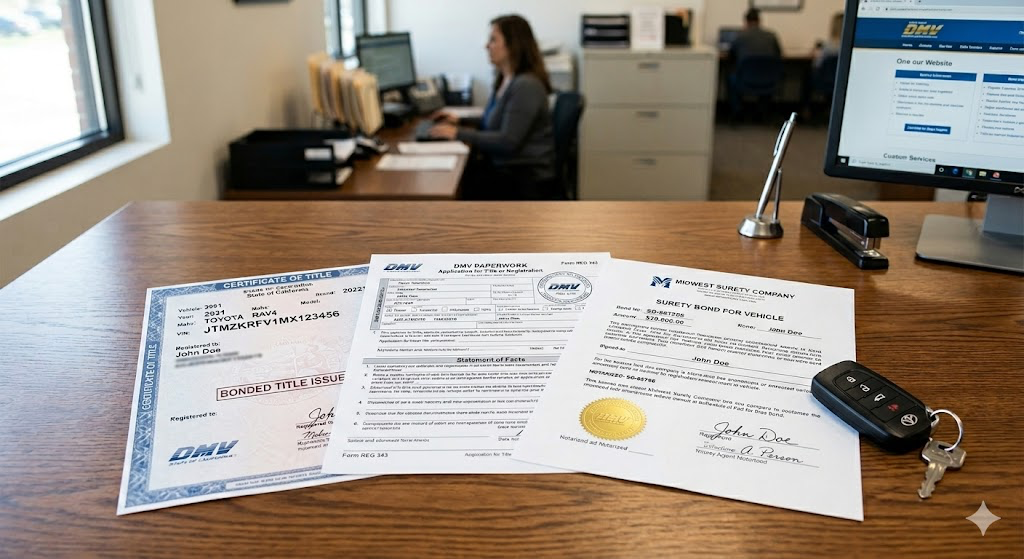
You bought a car but never received the title. Or maybe you lost it before transferring ownership. Now the DMV won’t register your vehicle, your insurance company won’t cover it, and that dream car is sitting in your driveway—completely illegal to drive. Thousands of vehicle owners face this nightmare every year, but there’s a proven legal solution that gets you back on the road: a title bond.
What Is a Title Bond for Vehicles?
A title bond—also called a certificate of title bond, lost title bond, or defective title bond—is a surety bond that serves as a financial guarantee to your state’s Department of Motor Vehicles when you cannot produce a valid vehicle title. Think of it as an insurance policy that protects the state, future buyers, and any rightful owners if your ownership claim turns out to be fraudulent or disputed.
This three-party agreement involves you (the principal), the DMV (the obligee), and the surety company (the guarantor). When you file this bond with your DMV, they issue you a “bonded title” that allows you to legally register, insure, and drive your vehicle immediately. The title will have a “bonded” brand stamped on it, which typically remains for three to five years depending on your state.
Unlike a duplicate title—which only works if you were already the registered owner—a bonded title helps establish ownership when the paper trail is broken, missing, or flawed. This makes it the go-to solution when traditional title transfer methods won’t work.
Why You Need a Title Bond
Your state requires a title bond to prevent vehicle title fraud while still allowing legitimate owners to register their vehicles. The DMV faces a challenging situation: they want to help honest people who’ve lost paperwork, but they also need to protect against stolen vehicles and fraudulent ownership claims.
The bond creates accountability. If someone later proves they’re the rightful owner of your vehicle, they can file a claim against your bond for compensation. The surety company investigates the claim, and if valid, pays the claimant up to the full bond amount. Here’s the critical part: you must then reimburse the surety company every penny they paid out, plus any legal costs. This isn’t insurance that protects you—it’s a guarantee that protects everyone else from you.
This financial liability discourages fraud while providing a legal pathway for honest people. Without this system, anyone who lost a title or bought a vehicle without proper paperwork would have no recourse except expensive court proceedings or abandoning the vehicle altogether.
Common Situations Requiring a Title Bond
Vehicle title problems happen more often than most people realize. You need a title bond when you cannot obtain a valid title through normal channels, such as:
Private Sale Complications: You purchased a vehicle with only a bill of sale, but the seller never provided a properly signed title. Maybe they lost it, moved out of state, or the business closed. Now you own a car you can’t legally register.
Inheritance Without Documentation: You inherited a vehicle from a deceased relative, but the title was never properly transferred or has been lost. The estate is settled, probate is closed, and tracking down original paperwork is impossible.
Abandoned or Neglected Titles: You’ve owned your vehicle for years but never titled it in your name. The previous owner is unreachable, deceased, or uncooperative. Or perhaps you purchased a project car decades ago and finally restored it, only to discover the title is long gone.
Incorrect Title Assignment: The title you received has the wrong name, incorrect VIN, signatures in wrong places, or white-out corrections that make it unacceptable to the DMV. These “defective titles” create the same problem as missing titles.
Custom-Built or Kit Vehicles: You built a vehicle from parts or a kit, and while you have receipts for components, there’s no manufacturer’s certificate of origin. Some states require title bonds for these situations.
Old Vehicles Without Titles: Your vehicle predates your state’s title laws, or it’s old enough that titles weren’t required when it was new. Classic car enthusiasts frequently encounter this issue.
Lien Release Problems: The previous owner paid off their loan, but the lienholder never released the title or has since gone out of business. You’re caught in bureaucratic limbo.
Each state handles these situations slightly differently, but most recognize title bonds as the standard solution when traditional documentation is unavailable.
How Much Does a Title Bond Cost?
Two numbers determine your cost: the bond amount and the premium rate. Most states require your bond amount to equal 1.5 to 2 times your vehicle’s current market value. The logic is straightforward—if someone claims the vehicle is theirs, there needs to be enough money to compensate them for their loss.
Your state DMV typically determines vehicle value using Kelly Blue Book, NADA guides, or a certified appraisal. For example, if your vehicle is worth ten thousand dollars and your state uses a 1.5x multiplier, you need a fifteen thousand dollar bond.
The premium—what you actually pay—represents a small percentage of the bond amount. Industry standards show:
For bond amounts under six thousand dollars, expect to pay a flat rate of one hundred dollars to one hundred fifty dollars. This covers the vast majority of older vehicles, motorcycles, trailers, and boats.
For bond amounts between six thousand and twenty-five thousand dollars, premiums typically run 1.5% to 3% of the bond amount. A fifteen thousand dollar bond would cost approximately two hundred twenty-five to four hundred fifty dollars.
For bond amounts above twenty-five thousand dollars, underwriting becomes more involved and may require a credit check. Premium rates stay in the 1.5% to 5% range depending on your credit score and the vehicle value.
This is a one-time fee, not an annual payment. Your bond remains active for the required period (usually three to five years) without renewal premiums. Bonds under twenty-five thousand dollars typically require no credit check, making them accessible to almost everyone regardless of financial history.
State-by-State Requirements and Restrictions
Not every state allows title bonds, and requirements vary dramatically by location. Thirteen states do not accept title bonds at all: Delaware, Hawaii, Indiana, Kansas, Kentucky, Louisiana, Maryland, New Jersey, North Dakota, Ohio, Oklahoma, Oregon, Pennsylvania, South Carolina, and Virginia. If you live in one of these states, you’ll need to explore alternative solutions like court-ordered titles or tracking down the original title through other means.
Indiana and Ohio specifically require court-ordered titles instead of bonded titles. This involves filing a lawsuit in civil court to establish ownership—a more expensive and time-consuming process than bonding.
States that do accept title bonds each have specific bond amount formulas:
Texas requires 1.5 times the Standard Presumptive Value as determined by the Texas DMV. California uses current fair market value determined by appraisal or Kelly Blue Book. Florida and Georgia demand twice the vehicle’s value (minimum five thousand dollars in Georgia). Most other states fall somewhere in the 1.5x to 2x range.
Some states add extra requirements beyond the bond itself. Arizona may require a vehicle inspection by law enforcement to verify the VIN matches DMV records. Iowa requires county treasurers to approve bonded titles, adding a local approval layer. Alabama provides a specific bond form that must be used, while most states accept standard surety bond forms.
Filing procedures differ too. California, Florida, Georgia, North Carolina, Nevada, New York, and Texas require original bonds with raised seals and wet signatures—you cannot submit copies or digital versions. Other states accept electronic or copied bonds, speeding up the process.
Before pursuing a title bond, contact your state DMV to confirm you’re eligible and understand their specific requirements. DMV websites often have bonded title guides with state-specific forms and instructions.
Understanding the Bond Period and What Happens Next
Your bonded title isn’t permanent—at least not initially. The “bonded” brand remains on your title for a statutory period, usually three years in most states, though some require five years. During this time, your bond stays active and anyone with a legitimate ownership claim can file against it.
This waiting period serves as a discovery window. If the original title exists somewhere or a rightful owner comes forward, they have time to make their claim. In practice, claims are relatively rare. Most title problems stem from genuine lost paperwork rather than fraud, so the waiting period passes without incident for the vast majority of bonded titles.
After the bond period expires with no claims filed, you can return to your DMV and request removal of the “bonded” brand. The DMV issues you a clean title—identical to any standard vehicle title—and your bond obligation ends. You now have unencumbered ownership documentation that will remain valid for the life of the vehicle.
During the bond period, you retain full legal rights to your vehicle. You can drive it, insure it, modify it, and even sell it. When selling, you must disclose that the title is bonded, as this information affects the buyer’s decision. After the bond period expires and you obtain a clean title, there’s no disclosure requirement—the vehicle’s title history is clear.
If you sell the vehicle before the bond period expires, the bond stays with the title, not with you personally. The new owner receives the bonded title and must wait out any remaining time on the bond period. Some buyers hesitate to purchase bonded-title vehicles for this reason, though the discount you offer often compensates for this minor inconvenience.
The Critical Difference Between Bonded Titles and Other Solutions
Vehicle title problems have multiple potential solutions, but they’re not interchangeable. Understanding which solution fits your situation saves time and money.
A duplicate title works only if you were already the registered owner and lost your paperwork. You simply pay a small fee, prove your identity, and the DMV prints a replacement. This takes days, not weeks, and costs twenty to fifty dollars. But if you were never the registered owner, a duplicate title won’t help you.
A court-ordered title involves filing a civil lawsuit to establish ownership. A judge reviews your evidence—bills of sale, receipts, witness testimony, vehicle history reports—and issues an order directing the DMV to title the vehicle in your name. This process costs several hundred to several thousand dollars in legal fees and takes months. Indiana and Ohio require this approach, but other states only recommend it for complex disputes or when bonds aren’t available.
A title bond occupies the middle ground: faster and cheaper than court proceedings, but accessible when duplicate titles won’t work. The bond provides a legal shortcut that satisfies the DMV’s need for financial protection without requiring expensive litigation.
Some states offer mechanic’s liens for vehicles in shop custody or abandoned vehicle procedures for cars left on private property. These specialized processes don’t help typical buyers who purchased vehicles without proper titles—title bonds remain the standard solution for those situations.
How to Get Title Bond – Vehicle, Lost & Defective
Getting your title bond takes less time than most people expect. The process follows four straightforward steps: apply, receive your quote, pay your premium, and file with your DMV.
Start by determining your bond amount. Check your state DMV’s website or call them directly to confirm their vehicle valuation method and multiplier. Most states provide a bond calculator or written instructions. Get your vehicle appraised using Kelly Blue Book or NADA if your DMV accepts those valuations, or obtain a professional appraisal if required.
Once you know your bond amount, complete an online application with a surety bond provider like Swiftbonds. You’ll provide basic information: your name and address, vehicle details including VIN, make, model, and year, and the bond amount required by your state. The application takes five to ten minutes for most people.
You’ll receive your quote immediately or within one business day for bonds over twenty-five thousand dollars. Review the quote, verify all vehicle information is correct (errors require amendments that delay the process), and submit payment. Most providers accept credit cards, debit cards, and electronic bank transfers.
Your bond arrives electronically the same day for most applications, or by mail within two to three business days if your state requires an original bond with a raised seal. Sign the bond in the designated space, then take it to your DMV along with your bonded title application, vehicle identification number verification, bill of sale or other ownership evidence, and payment for DMV title fees.
The DMV processes your application, which typically takes four to six weeks depending on your state’s workload. You’ll receive your bonded title by mail, and you can immediately register and insure your vehicle.
Swiftbonds LLC
2025 Surety Bond Agency of the Year
4901 W. 136th Street
Leawood KS 66224
(913) 214-8344
https://swiftbonds.com/
Instant online quotes. Fast approval. Licensed in all 50 states. Get your title bond today and get back on the road legally.
What If Someone Files a Claim Against Your Bond?
Understanding the claims process reduces anxiety, though claims remain relatively uncommon. When someone believes they have a legitimate ownership claim on your vehicle, they file a claim against your bond with the surety company. The surety investigates by contacting you, requesting documentation, interviewing the claimant, and reviewing vehicle history reports and title records.
You have two possible outcomes. If the surety determines the claim is invalid—perhaps the claimant has no documentation, their story doesn’t match records, or they missed statutory deadlines—they deny the claim and no further action occurs. You may owe the surety for investigation costs, but this typically only happens if the claim arose from your misrepresentation or negligence.
If the surety determines the claim is valid, they expect you to resolve it directly with the claimant. This might involve compensating them for the vehicle’s value, returning the vehicle to its rightful owner, or negotiating another settlement. If you fail to resolve the claim, the surety pays the claimant up to your full bond amount, then pursues you for reimbursement.
This reimbursement obligation distinguishes surety bonds from insurance. Insurance protects you from loss. Surety bonds protect others from your actions. When the surety pays a claim, you owe them every dollar plus legal fees, collection costs, and interest. This creates powerful incentive to ensure your ownership claim is legitimate before purchasing a title bond.
In reality, fraudulent claims are rare because most title problems stem from lost paperwork, not stolen vehicles. Most people seeking bonded titles have legitimate ownership but incomplete documentation. The bond requirement protects everyone while providing a legal pathway forward.
Frequently Asked Questions
Can I sell a vehicle with a bonded title?
Yes, you can sell a vehicle with a bonded title at any time. However, you must disclose to the buyer that the title carries a bond brand. This disclosure requirement protects buyers from unknowingly purchasing vehicles with clouded titles. Most buyers negotiate a lower purchase price to compensate for the bonded status, typically a few hundred to a thousand dollars less than similar vehicles with clean titles. After the bond period expires and you obtain a clean title, you can sell without any special disclosures.
Do all states accept title bonds?
No, thirteen states do not accept title bonds: Delaware, Hawaii, Indiana, Kansas, Kentucky, Louisiana, Maryland, New Jersey, North Dakota, Ohio, Oklahoma, Oregon, Pennsylvania, South Carolina, and Virginia. If you live in one of these states, you’ll need to pursue alternative solutions such as court-ordered titles, tracking down the previous owner, or using mechanic’s lien procedures where applicable. Indiana and Ohio specifically require court-ordered titles through civil lawsuits.
How long does a title bond last?
Title bonds remain active for three to five years depending on your state requirements. During this period, the bond protects potential claimants who might come forward with ownership disputes. After the bond period expires without any claims, you can return to your DMV and request removal of the bonded brand, receiving a clean title. The bond itself never technically “expires”—rather, the statutory period ends and the bond is released.
What happens if I never had a title for my vehicle?
If your vehicle predates state title laws, came from a state that didn’t title it, or you built it yourself from parts, a title bond provides your best solution. You’ll need to prove you own the vehicle through bills of sale, receipts for parts, affidavits from previous owners, or other documentation. The DMV will determine whether your evidence is sufficient to proceed with a bonded title application.
Can I get a title bond with bad credit?
Yes, most title bonds under twenty-five thousand dollars require no credit check whatsoever. Surety companies view these as low-risk bonds because the vehicle itself serves as collateral and the bond amounts are relatively small. For bonds over twenty-five thousand dollars, surety companies may check credit, but they typically approve applicants with poor credit at slightly higher premium rates—perhaps 5% instead of 1.5% of the bond amount.
Is a title bond the same as vehicle insurance?
No, title bonds and vehicle insurance serve completely different purposes. Vehicle insurance protects you from accidents, theft, and damage to your car. A title bond protects the state and other parties from your ownership claim being fraudulent. You need both—your insurance company will require you to have a legal title (even a bonded one) before they’ll issue a policy, and your state requires insurance before you can register and drive your vehicle.
What if the vehicle has a lien on the old title?
If the previous title showed a lien from a bank or finance company, you must resolve that lien before obtaining a bonded title. Most states won’t issue bonded titles for vehicles with active liens because the lienholder has a legal claim to the vehicle that supersedes your ownership claim. Contact the lienholder for a lien release, or if they’re out of business, provide documentation proving the loan was satisfied. Texas explicitly prohibits bonded titles for vehicles with active liens listed on previous titles.
How much does a bonded title cost in total?
Your total cost includes three components: the title bond premium, DMV title fees, and potentially an appraisal fee. The bond premium ranges from one hundred dollars for inexpensive vehicles to several hundred dollars for valuable ones. DMV title fees vary by state but typically run fifty to one hundred fifty dollars. If your state requires a professional appraisal rather than accepting book values, add another seventy-five to two hundred dollars. Total cost for most people falls between two hundred fifty and six hundred dollars—far less than court-ordered title proceedings.
Can I transfer my title bond to a new owner?
No, title bonds cannot be transferred between people. The bond remains attached to the vehicle title itself. When you sell a bonded-title vehicle, the new owner receives the title with its bonded brand still in place. They inherit the remainder of your bond period and must wait for it to expire before requesting a clean title. The original bond continues to protect potential claimants regardless of who currently owns the vehicle.
What if I move to a different state with my bonded title?
Moving states with a bonded title creates complexity. When you register your vehicle in a new state, you’ll present your existing bonded title from your previous state. The new state typically accepts it and issues a new title in their format, maintaining the bonded brand until the original bond period expires. Some states may require you to post a new title bond under their state’s requirements. Contact your new state’s DMV before moving to understand their specific policies on out-of-state bonded titles.
Conclusion
A title bond transforms an undriveable vehicle into a legally registered one, solving paperwork problems that would otherwise leave your car collecting dust. The process is straightforward: determine your bond amount, get bonded, file with your DMV, and receive your bonded title within weeks. After three to five years without disputes, you’ll have a clean title indistinguishable from any other vehicle title.
Most people find title bonds less intimidating than they initially expected. The cost is reasonable, approval is nearly guaranteed, and the result is immediate legal driving privileges. If you’re sitting on a vehicle you can’t register because of title problems, a title bond is likely your fastest and most affordable solution.
Five Surprising Facts About Vehicle Title Bonds
Classic car values create unexpectedly high bond requirements: Restored vintage vehicles often require bonds in the fifty thousand to one hundred thousand dollar range because their appraised values are so high. A 1967 Mustang that cost ten thousand dollars as a project car might need a seventy-five thousand dollar bond after restoration, though the premium still only runs around one thousand to fifteen hundred dollars. Collectors sometimes defer title bonding until after restoration to minimize bond amounts.
Some states waive bond requirements for low-value vehicles: Wyoming doesn’t require title bonds for vehicles valued under twenty-five hundred dollars—you can obtain a title with just an affidavit. Vermont famously doesn’t require titles at all for vehicles over fifteen years old, making it a backdoor solution for some out-of-state buyers, though this loophole has legal complications. Montana offers expedited bonded title procedures for vehicles under five thousand dollars with simplified evidence requirements.
Title bonds saved the kit car industry: When factory-built kit cars became popular in the 1980s and 1990s, many builders discovered states wouldn’t title their creations without manufacturer certificates of origin—which didn’t exist for garage-built vehicles. Title bonds provided the legal framework that allowed thousands of kit car enthusiasts to register their projects. Today, specialized kit car titling procedures in most states evolved from original title bond processes.
Marine vessels and trailers use the same bonding process: Everything described for vehicles applies equally to boats without titles, utility trailers with lost titles, and even some recreational vehicles. Boat title bonds follow identical procedures, with bond amounts based on vessel value according to marine appraisal guides. This surprises many boat owners who assume marine titles follow different rules than automotive titles.
One company’s bankruptcy created a title bond crisis: When a major floor plan financing company went bankrupt in 2019, thousands of used car dealers discovered they had vehicles on their lots with liens from the defunct company. The bankruptcy trustee couldn’t release titles quickly enough, forcing dealers to pursue title bonds for vehicles they legally owned. This event demonstrated how corporate failures can create mass title documentation problems affecting thousands of legitimate vehicle owners simultaneously.