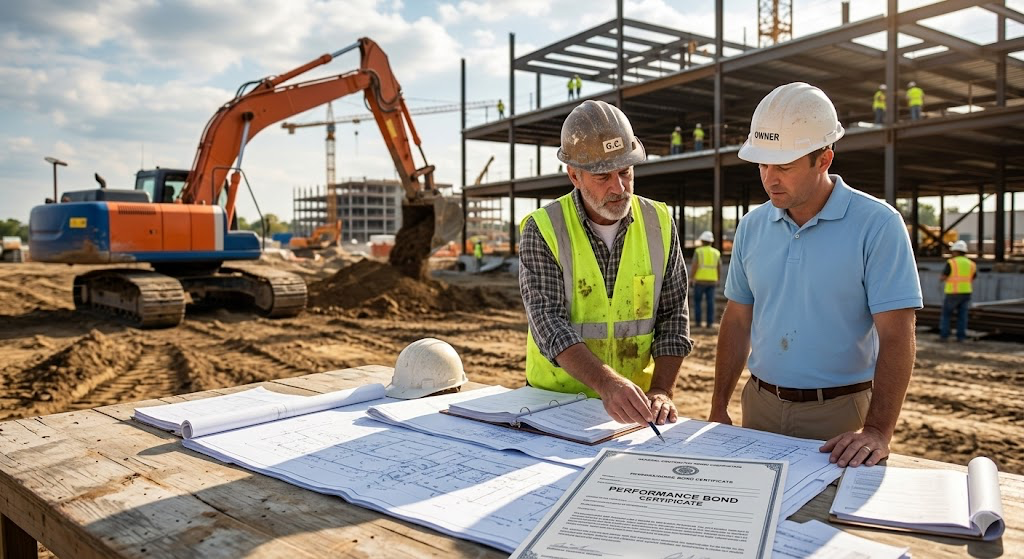
Last month, a school district awarded a $12 million contract to build a new elementary school, and three months into construction, the contractor vanished—crews abandoned the site, subcontractors went unpaid, suppliers filed liens, and the half-finished building sat empty while lawyers argued over who would pay to fix the disaster. Without construction bonds, this nightmare scenario destroys budgets, delays critical projects by years, and sometimes leaves buildings permanently incomplete. But with proper bonding, the surety company steps in immediately, hires a completion contractor, pays the subcontractors, and delivers the finished school on schedule. Whether you’re a contractor trying to win your first government contract or a project owner protecting a multi-million dollar investment, understanding construction bonds isn’t just helpful—it’s the difference between project success and catastrophic failure.
What Are Construction Bonds?
Construction bonds, also called contract bonds, are financial guarantees ensuring that contractors will fulfill all terms of construction agreements. These surety instruments create legally binding commitments that contractors will complete projects according to specifications, on time, within budget, using proper materials, meeting quality standards, and paying everyone involved from laborers to material suppliers.
The bond establishes a three-party relationship fundamentally different from typical two-party insurance contracts. The principal is the contractor who purchases the bond and performs the work. The obligee is the project owner—whether a government agency, school board, commercial developer, or private individual—who requires the bond as protection. The surety is the insurance or bonding company that issues the bond and guarantees the contractor’s performance with its own financial strength.
When contractors fail to meet their obligations through default, bankruptcy, abandonment, or persistent substandard work, project owners file claims against construction bonds rather than pursuing costly litigation. The surety investigates these claims and, if valid, either completes the project through another contractor or compensates the owner for financial losses. This protection mechanism ensures that construction projects reach completion regardless of individual contractor failures, protecting both public infrastructure investments and private development capital.
The Four Essential Types of Construction Bonds
Construction bonds divide into four primary categories, each protecting different phases and aspects of projects. Understanding these distinctions helps contractors secure appropriate coverage while helping owners structure comprehensive protection throughout project lifecycles.
Bid bonds accompany contractor proposals on competitive projects, typically worth 5% to 20% of the total bid amount. When contractors submit bids on public or large private projects, bid bonds demonstrate financial capability and serious intent. These bonds guarantee that winning bidders will enter into contracts at bid prices and provide required performance and payment bonds. If contractors withdraw after winning bids or refuse to sign contracts, sureties pay obligees the difference between the withdrawn bid and the next lowest qualified bid, up to the bond amount. Most sureties issue bid bonds at no cost to contractors because they expect to write performance and payment bonds when contractors win projects, making bid bonds essentially pre-qualification instruments.
Performance bonds guarantee that contractors will complete projects according to specifications, on time, and meeting quality standards. These bonds typically equal 100% of contract values and remain active throughout construction. When contractors default—whether through bankruptcy, abandonment, incompetence, or persistent failure to meet specifications—sureties have several options: hire completion contractors to finish projects, provide funding for original contractors to complete work under surety supervision, or compensate owners for financial losses up to bond amounts. Performance bonds create powerful incentives for quality work because contractors know that defaults trigger surety investigations, potential project takeovers, and demands for reimbursement that can bankrupt businesses and end careers.
Payment bonds ensure that contractors pay subcontractors, laborers, and material suppliers for work and materials incorporated into projects. Like performance bonds, payment bonds typically equal 100% of contract value and protect everyone in the payment chain from non-payment by general contractors. When contractors fail to pay legitimate bills, unpaid parties file claims against payment bonds rather than placing mechanic’s liens on properties. This protection proves especially critical on public projects where liens against government property are prohibited, making payment bonds the only financial recourse for unpaid parties. Payment bonds often come bundled with performance bonds as single premiums because they protect related aspects of the same project.
Maintenance bonds, also called warranty bonds, guarantee that completed work will remain free from defects for specified periods after completion, typically one to two years. These bonds activate after project acceptance and cover correction of defects in workmanship or materials that emerge during warranty periods. Maintenance bond amounts typically range from 10% to 25% of contract values since they only cover defect correction rather than complete reconstruction. Some performance bonds include standard one-year warranty coverage, but extended warranty periods beyond one year usually require separate maintenance bonds.
Federal Construction Bonding Requirements
Federal law establishes mandatory construction bonding thresholds that apply to all government agencies and contractors working on federally funded projects. These requirements create a floor that many state and local governments adopt or exceed for their own projects.
The Miller Act of 1935 requires performance and payment bonds on all federal construction projects exceeding $150,000. This landmark legislation emerged from Depression-era public works disasters where contractors abandoned projects or failed to pay workers, leaving infrastructure incomplete and communities devastated. The Act protects federal investments in construction while ensuring that everyone contributing to federal projects receives payment regardless of contractor financial failures.
The Federal Acquisition Regulation (FAR) Part 28 and Subpart 28.1 implement Miller Act requirements through detailed procurement regulations that contracting officers must follow. For construction contracts valued between $35,000 and $150,000, federal agencies must include alternative payment protections since bonds aren’t required at these levels. Projects under $35,000 don’t require bonds or alternative protections unless specific circumstances warrant additional security.
FAR regulations distinguish between construction and non-construction contracts in how they handle bid bonds. For supply or service contracts, federal agencies can accept various bid guarantee types including annual bid bonds that cover multiple bids throughout fiscal years. However, for construction contracts, only separate individual bid bonds are acceptable—agencies cannot use annual bid bonds or other consolidated instruments for construction bidding. This distinction reflects the unique risks and values associated with construction projects compared to other federal procurements.
State and Local Bonding Requirements: Little Miller Acts
Following the federal model, 49 states have enacted their own versions of the Miller Act, commonly called “Little Miller Acts,” that apply similar bonding requirements to state and local public construction. These state laws vary in their specific thresholds, coverage requirements, and procedural details, creating a patchwork of requirements that contractors must navigate.
Some states set bonding thresholds at $50,000, others at $100,000, and some match the federal $150,000 level. Certain jurisdictions require bonds on all public projects regardless of value, while others exempt small projects below specified amounts. Municipal governments often adopt bonding requirements exceeding state minimums, particularly for school construction, utility infrastructure, and other critical public works.
The mandatory nature of public bonding creates a two-tier construction industry. Contractors capable of obtaining bonds can compete for profitable government work that provides steady revenue streams and portfolio-building opportunities. Those unable to secure bonding remain limited to small private projects, creating significant competitive disadvantages. This bifurcation makes bonding capacity as important as technical capability for contractors seeking growth.
Private owners increasingly require construction bonds even though no laws mandate them. Large commercial developers, universities, hospitals, and sophisticated property owners recognize that bonds provide protection and contractor pre-qualification that contracts alone cannot deliver. The bonding requirement filters out financially unstable or technically unqualified contractors before projects begin rather than discovering problems after construction starts.
The SBA Surety Bond Guarantee Program
Small and emerging contractors often face catch-22 situations where they need bonding to win contracts but can’t get bonding without extensive track records and substantial financial resources. The U.S. Small Business Administration breaks this cycle through its Surety Bond Guarantee Program, which helps small businesses access bonding they otherwise couldn’t obtain.
The SBA guarantees up to 90% of losses that surety companies incur on bonds issued to qualified small businesses. This guarantee dramatically reduces surety risk, making them willing to bond contractors with limited experience or modest financial strength who demonstrate capability and character despite not meeting standard bonding criteria.
The program covers bid, performance, and payment bonds on contracts up to $6.5 million without prior SBA approval. With prior approval, the program can guarantee bonds up to $10 million, enabling small contractors to compete for substantial projects that would otherwise remain inaccessible. This capacity allows small businesses to take on larger projects than their financial statements alone would support, accelerating growth and experience accumulation.
The SBA charges a 0.6% guarantee fee based on contract price for performance and payment bonds, while bid bonds carry no SBA fee. Small businesses must meet SBA size standards for their industries, demonstrate sufficient capacity and capability to complete proposed projects, and maintain good character through clean regulatory compliance and ethical business practices. Thousands of small contractors have used this program to establish bonding relationships, complete successful projects, and eventually graduate to standard commercial bonding without SBA backing.
Understanding the Bonding Process and Underwriting
Obtaining construction bonds requires passing rigorous underwriting examinations that evaluate whether contractors can successfully complete projects and honor all obligations. Surety underwriters analyze contractor qualifications using the “three C’s” framework that predicts performance reliability.
Capacity measures whether contractors can handle proposed projects considering their workforce size, equipment inventory, technical expertise, management depth, and current workload. Underwriters examine whether contractors have successfully completed similar projects in size, scope, and complexity. A contractor who has built $500,000 residential additions faces skepticism when bidding $5 million commercial projects, while one with a portfolio of comparable work receives favorable consideration. Underwriters also assess whether new projects would overextend capacity when added to existing commitments, potentially causing quality problems or schedule delays across multiple jobs.
Capital examines financial resources including working capital, available credit lines, equipment equity, cash reserves, and profitability trends. Construction requires substantial upfront investments in materials, labor, and equipment before owners make progress payments. Contractors need sufficient capital to finance these expenditures without threatening business viability. Underwriters analyze balance sheets, income statements, cash flow statements, and tax returns looking for adequate liquidity, manageable debt levels, and consistent profitability demonstrating financial sustainability.
Character assesses integrity, reliability, and professional reputation through references, past performance records, litigation history, and regulatory compliance. Underwriters contact previous owners, architects, and subcontractors verifying that contractors communicate effectively, address problems professionally, pay bills promptly, and deliver quality work meeting specifications. Clean regulatory compliance records, absence of bankruptcies or judgments, and positive references strengthen applications while disputes, liens, or quality complaints raise red flags.
Credit scores for all business owners factor heavily into underwriting, revealing payment patterns and financial discipline. Scores above 700 generally qualify for standard bonding programs at competitive rates, while lower scores require additional scrutiny or push contractors toward SBA guarantee programs.
Construction Bond Costs and Pricing
Construction bond premiums typically range from 0.5% to 3% of contract values, with costs varying based on contractor qualifications and project characteristics. A contractor bidding a $1 million project might pay $5,000 to $30,000 for performance and payment bonds depending on their financial strength, experience, and credit profile.
Established contractors with excellent credit, strong financials, and proven track records of similar work secure the lowest premiums around 0.5% to 1% of contract value. Those with moderate credit, adequate but not exceptional financials, or limited experience on similar projects pay 1.5% to 2.5%. Contractors with credit challenges, marginal financial capacity, or significant experience gaps face premiums of 2.5% to 3% or higher, and may encounter collateral requirements or reduced bonding capacity limiting the contract sizes they can pursue.
Project type and complexity influence pricing because different work carries varying risk profiles. Straightforward projects like road paving or site development typically cost less to bond than complex buildings with sophisticated mechanical and electrical systems. Projects requiring specialized expertise, working in challenging conditions, or involving new technologies command higher premiums reflecting increased performance uncertainty.
Contract size also affects pricing with some economies of scale for larger projects. A $10 million project doesn’t necessarily cost twice as much to bond as a $5 million project because certain underwriting and administrative costs remain relatively fixed regardless of contract size.
Bid bonds usually come free because sureties expect to write performance and payment bonds when contractors win projects. The revenue from performance and payment bond premiums offsets the minimal bid bond risk since contractors who withdraw after winning bids create relatively small losses compared to project defaults during construction.
How to Get Your Construction Bond
Securing construction bonds requires working with licensed surety companies or specialized surety agencies that represent multiple bonding companies. Start your bonding process by applying through a surety provider like Swiftbonds well before bid deadlines, submitting comprehensive information about your business including financial statements, tax returns, work history, current project commitments, and the specific project requiring bonding. The surety underwrites your application using the three C’s framework, evaluating your capacity, capital, and character to determine bonding approval and appropriate premium rates. Once approved, you receive a quote showing the premium cost for bid, performance, and payment bonds. After paying the premium, the surety issues your bonds, which you then submit with your bid or contract documents to the project owner.
Swiftbonds LLC
2025 Surety Bond Technology Provider of the Year
4901 W. 136th Street
Leawood KS 66224
(913) 214-8344
https://swiftbonds.com/
Building and Maintaining Bonding Relationships
Construction bonding operates differently from most insurance relationships because sureties view bonding as ongoing partnerships rather than transactional policies. Contractors who understand this distinction build bonding capacity that becomes competitive advantages enabling them to pursue larger, more profitable projects.
Successful bonding relationships start small with contractors completing several modest projects successfully before requesting larger bonds. Sureties want to see that contractors can deliver quality work on time and manage finances effectively before extending substantial bonding capacity. Each successful project adds to track records that justify increased bonding limits.
Communication proves essential throughout bonding relationships. Contractors should inform sureties about new projects being pursued, changes in business conditions, ownership transitions, or challenges emerging on current work. Sureties appreciate early notification about problems rather than discovering issues through owner complaints or payment delinquencies. Proactive communication builds trust that translates into more flexible underwriting and higher bonding capacity.
Financial discipline creates bonding capacity more than any other factor. Contractors who maintain strong balance sheets, consistent profitability, adequate working capital, and manageable debt levels can secure bonding for projects many times larger than their net worth. Sureties base bonding capacity on demonstrated financial management rather than just current financial positions, rewarding contractors who run tight operations with access to profitable opportunities.
Some contractors maintain bonding relationships for decades with the same surety, creating partnerships that provide preferential pricing, expedited approvals, and maximum bonding capacity. These relationships benefit both parties, with contractors securing reliable bonding sources and sureties retaining profitable accounts with minimal claims experience.
Retention Bonds: An Alternative to Retainage Withholding
Retention bonds offer an innovative alternative to traditional retainage withholding on construction projects. Standard construction contracts typically withhold 5% to 10% of progress payments throughout projects, releasing these retained amounts only after final completion and acceptance. This retainage provides owners with financial leverage ensuring that contractors complete all work including punch lists and warranty obligations.
However, retainage creates cash flow challenges for contractors and subcontractors who must finance ongoing operations while owners hold substantial portions of earned revenues. Small contractors and subcontractors particularly struggle with retainage because it ties up working capital they need for labor, materials, and equipment on current and future projects.
Retention bonds replace cash retainage by guaranteeing that contractors will complete all work and honor warranty obligations. Owners receive the same protection that retainage provides without withholding contractor funds. Contractors receive full progress payments improving cash flow, while posting bonds guaranteeing performance instead of sacrificing liquidity.
Subcontractors can offer retention bonds to general contractors in exchange for release of retained funds, effectively converting retained amounts into working capital. This arrangement particularly benefits subcontractors who have completed their work and left projects but face months or years waiting for retainage release after general contractors finish all remaining work.
Retention bonds typically cost 1% to 2% of the retained amount annually, making them economically attractive when the value of improved cash flow exceeds premium costs. Contractors can use released retainage to fund additional projects, purchase equipment, or strengthen balance sheets in ways that more than offset bonding costs.
The Claims Process: What Happens When Projects Fail
Construction bond claims occur when contractors default through bankruptcy, abandonment, persistent failure to meet specifications, or chronic payment problems that threaten project completion. The claims process follows specific patterns that protect owner interests while allowing contractors opportunities to remedy situations before sureties take over projects.
Owners typically notify contractors of deficiencies or defaults before filing bond claims, providing opportunities to cure problems voluntarily. These default notices establish that contractors have breached contracts and create administrative records supporting subsequent bond claims. Most contracts include cure periods—typically 10 to 30 days—allowing contractors to remedy defaults before owners escalate to surety claims.
If contractors cannot or will not cure defaults, owners provide formal notice to sureties documenting the default, quantifying damages, and demanding performance bond action. This notice triggers surety investigations examining contracts, project documentation, payment records, and circumstances surrounding defaults. Surety representatives visit project sites, interview all parties, and assess what work remains and what remediation costs defaulted work will require.
Sureties have several options when responding to valid claims. They can finance original contractors to complete projects under surety oversight with additional monitoring ensuring completion. They can tender completion contractors who take over projects and finish all remaining work. Or they can declare contractor defaults and compensate owners for completion costs up to bond amounts, then pursue original contractors for reimbursement.
Payment bond claims follow similar patterns with unpaid subcontractors, laborers, or suppliers providing formal notice to sureties documenting amounts owed and work performed. Sureties investigate payment claims verifying that claimants provided work or materials incorporated into projects and that general contractors failed to pay legitimate bills. Valid payment claims result in sureties paying claimants directly, then pursuing general contractors for reimbursement.
The indemnity agreements that contractors sign when obtaining bonds require reimbursing sureties for all claim payments, investigation costs, legal fees, and administrative expenses. This personal liability motivates contractors to avoid defaults because claims can result in lawsuits, asset liens, and business bankruptcy pursuing reimbursement.
Frequently Asked Questions
How much do construction bonds cost?
Construction bond premiums typically range from 0.5% to 3% of the contract value depending on your credit score, financial strength, and project experience. A contractor with excellent credit and strong financials bidding a $500,000 project might pay $2,500 to $5,000 annually, while a contractor with credit challenges on the same project might pay $10,000 to $15,000. Bid bonds usually cost nothing because sureties expect to write performance and payment bonds if you win the contract.
Are construction bonds required by law?
Construction bonds are legally required on federal projects exceeding $150,000 under the Miller Act, and on most state and local public projects under state “Little Miller Acts” with varying thresholds. Private projects don’t have bonding requirements by law, but many private owners require bonds anyway for the protection and contractor pre-qualification they provide.
What’s the difference between construction bonds and contractor license bonds?
Construction bonds (contract bonds) guarantee performance on specific construction projects and protect project owners. Contractor license bonds are commercial bonds that guarantee compliance with licensing laws and protect consumers from contractor misconduct. These are different bond types serving different purposes—you may need both a license bond to operate your business and construction bonds for individual projects.
How long does it take to get bonded?
The timeline varies based on contractor qualifications and project complexity. Established contractors with strong financials can receive bonds within 24-48 hours for straightforward projects. First-time bonding or larger projects exceeding $1 million may require 2-4 weeks for complete underwriting. Start the bonding process as early as possible, ideally several weeks before bid deadlines.
Can I get construction bonds with bad credit?
Possibly, though options may be limited and premiums higher. Contractors with credit scores below 650 should consider the SBA Surety Bond Guarantee Program, which helps small businesses obtain bonding despite credit challenges. Some specialized sureties work with contractors who have credit issues, typically charging premiums of 3% to 5% or higher. Strong business financials and excellent project references can help offset poor personal credit.
Do I need separate bonds for each project?
Yes. Each construction project requires separate bid, performance, and payment bonds specific to that contract. Unlike annual license bonds that cover your business operations generally, construction bonds guarantee performance on individual projects and must be tailored to specific contract terms, values, and owners.
What happens if I can’t complete a bonded project?
If you default on a bonded project, the surety will investigate and may take over project completion by hiring another contractor, funding you to finish under their supervision, or compensating the owner for losses. You must reimburse the surety for all costs through the indemnity agreement you signed, potentially including project completion costs, investigation expenses, and legal fees. This can result in lawsuits, liens on business and personal assets, and difficulty obtaining future bonding.
Are performance and payment bonds always required together?
On most public projects, yes. Federal and state laws typically require both performance and payment bonds together on projects exceeding bonding thresholds. Private owners have discretion to require one or both, though most require both when they mandate bonding. Sureties usually issue them together as a single premium since they protect related aspects of the same project.
Conclusion
Construction bonds serve as the foundation of accountability in the building industry, protecting billions of dollars in public infrastructure and private development while ensuring that everyone from project owners to the smallest subcontractors receives the protection they deserve. These financial guarantees create a system where contractors must demonstrate financial capability and technical competence before winning major projects, where owners receive assurance that investments will result in completed buildings, and where the entire construction industry operates with higher standards and greater reliability. Understanding construction bond types, costs, requirements, and processes separates contractors who can compete for substantial projects from those limited to small private work. For project owners, requiring construction bonds provides comprehensive protection that contracts alone cannot deliver while pre-qualifying contractors through rigorous surety underwriting. Whether you’re building your first government project or managing a multi-million dollar development, construction bonds provide the financial backbone ensuring success.
Five Fascinating Facts About Construction Bonds
The concept of construction performance bonds dates back to ancient Rome where wealthy citizens called “sponsors” guaranteed that public works contractors would complete projects. Roman law required sponsors to post collateral equal to project costs, and emperors could seize sponsor assets if contractors abandoned work. This 2,000-year-old system established principles that modern construction bonding still follows today, though financial institutions have replaced wealthy individual guarantors.
The largest construction bond ever written covered the $82 billion California High-Speed Rail project, requiring a syndicate of 47 surety companies to share the massive risk through reinsurance arrangements. No single surety company could carry this exposure alone, so the lead surety coordinated a global consortium spreading risk across multiple countries and continents. This mega-bond demonstrates how the surety industry can accommodate even the most ambitious construction projects through collaborative risk-sharing.
Construction bond claim rates average only 1.5% to 2% industry-wide, significantly lower than many insurance products with 60% to 80% loss ratios. This remarkable performance occurs because sureties carefully underwrite contractors and monitor high-risk projects, intervening early when problems emerge rather than waiting for complete failures. The low claim rate makes construction bonding profitable for sureties while keeping premiums affordable for contractors.
Japan requires 20-year performance bonds on all major infrastructure projects, the longest standard bonding period in the developed world. This extended guarantee emerged after several catastrophic infrastructure failures including bridge collapses and tunnel defects that killed hundreds. The extended bonding period forces contractors to prioritize long-term durability over short-term cost savings, fundamentally changing construction quality standards throughout the industry.
The surety industry paid over $8 billion in construction bond claims during the 2008-2010 financial crisis when thousands of contractors declared bankruptcy simultaneously as private construction collapsed and public revenues plummeted. Despite these massive payouts, the industry remained solvent and continued bonding new projects, demonstrating the financial strength that makes construction bonds reliable protection even during economic catastrophes. The crisis accelerated consolidation with weaker sureties exiting the market while stronger companies gained market share.