The certified letter from Oklahoma’s Department of Consumer Credit arrived yesterday stating your mortgage broker license application has been conditionally approved pending submission of the required one-hundred-thousand-dollar surety bond within twenty days or your preliminary approval expires and you must restart the entire licensing process from scratch, but the licensing packet contains confusing references to Oklahoma Statutes Title 59 regulations you’ve never studied and conflicting information about whether the bond amount represents cash you must somehow deposit with the state creating impossible financial barriers or represents coverage limits you can purchase through insurance-like premium payments, the application forms reference submitting bonds to agencies at 421 Northwest 13th Street in Oklahoma City but provide no clarity about what surety companies are authorized to write Oklahoma bonds or whether your modest credit score of six hundred forty-five disqualifies you entirely from bonding markets, and your frantic Google searches return results about oil and gas well plugging bonds requiring Form 1006 submissions to the Oklahoma Corporation Commission creating additional confusion about whether mortgage professionals somehow need petroleum industry bonds despite having zero connection to drilling operations. Understanding that Oklahoma mandates industry-specific surety bonds for dozens of professions including notaries carrying one-thousand-dollar bonds for four-year commission terms costing only thirty to fifty dollars total, auto dealers posting twenty-five-thousand-dollar consumer protection bonds, public adjusters securing twenty-five-thousand-dollar professional liability guarantees, credit services organizations maintaining ten-thousand-dollar bonds, contractors obtaining five-thousand-dollar licensing bonds, freight brokers meeting seventy-five-thousand-dollar FMCSA federal requirements, oil and gas operators providing well plugging security through Category A or Category B instruments including bonds on Form 1006 or fifty-thousand-dollar net worth demonstrations, and medical marijuana commercial growers posting minimum fifty-thousand-dollar bonds per OMMA license with potential increases based on reclamation requirements, how the three-party principal-obligee-surety agreement structure creates financial guarantees without requiring full bond amount cash deposits, what premium calculation formulas mean for actual costs ranging from one to ten percent of bond amounts based on credit scores and industry risk profiles, and which Oklahoma-specific forms, filing addresses, and regulatory procedures govern each bond category could mean the difference between completing your licensing requirements within two weeks at a cost of one to three thousand dollars or unnecessarily abandoning your mortgage career because you fundamentally misunderstood how Oklahoma surety bonds function and incorrectly assumed they were financially unattainable.
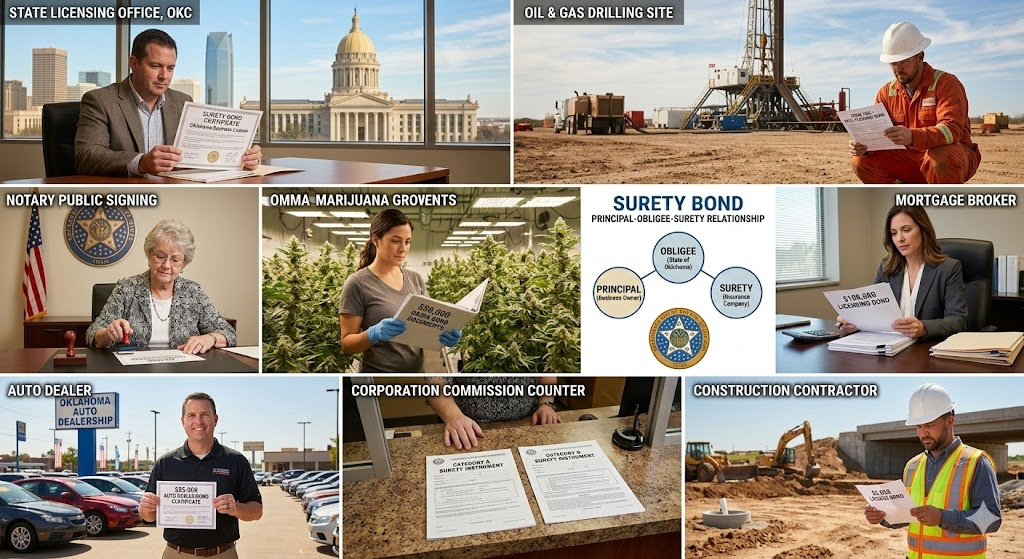
An Oklahoma surety bond is a legally binding three-party financial guarantee contract between a principal who purchases the bond to meet licensing or regulatory requirements, an obligee who mandates the bond as a condition for issuing licenses or permits, and a surety company that underwrites the bond and guarantees the principal’s compliance with Oklahoma statutes, administrative rules, and contractual obligations.
Understanding Oklahoma’s Three-Party Bond Structure
Oklahoma surety bonds create contractual relationships involving principals as the businesses, professionals, or individuals purchasing bonds to satisfy licensing requirements imposed by state agencies, municipalities, courts, or private entities. The principal assumes primary responsibility for complying with all applicable Oklahoma statutes, Oklahoma Administrative Code provisions, licensing standards, and regulatory obligations governing their bonded activities.
Obligees represent the second party requiring bonds, typically consisting of Oklahoma state agencies like the Secretary of State for notary bonds, Department of Consumer Credit for mortgage broker bonds, Oklahoma Corporation Commission for oil and gas operator bonds, Oklahoma Medical Marijuana Authority for commercial grower bonds, or various municipal governments and courts depending on bond types. Obligees establish bond requirements, determine required amounts, specify coverage terms, and receive bond filings as preconditions for granting licenses, permits, operator status, or legal authorizations.
Surety companies serve as the third party providing financial backing guaranteeing principals will fulfill obligations to obligees, underwriting bonds based on principals’ creditworthiness, business experience, financial strength, and industry risk profiles. Sureties must be licensed to conduct surety business in Oklahoma, maintain adequate capital reserves, and demonstrate financial stability ensuring they can pay valid claims if principals default on bonded obligations.
The financial guarantee mechanism operates through surety promises to pay valid claims filed by obligees or damaged parties when principals violate Oklahoma statutes, breach contractual terms, or fail to fulfill bonded obligations. If an Oklahoma mortgage broker misappropriates client funds, damaged consumers or the Department of Consumer Credit can file claims against the one-hundred-thousand-dollar bond, with the surety company investigating claims and paying valid losses up to the full bond amount. However, unlike insurance where premiums purchase coverage absolving policyholders of liability, surety bonds require principals to reimburse sureties for all claims paid plus interest, legal fees, investigation costs, and administrative expenses, as bonds guarantee performance without eliminating principals’ ultimate financial responsibility.
Oklahoma Surety Bond Requirements by Industry and Profession
| Profession/Industry | Bond Amount | Regulating Agency | Key Forms/Requirements |
|---|---|---|---|
| Notary Public | $1,000 | Secretary of State | 4-year term, $10 filing fee, 60-day deadline |
| Auto Dealer | $25,000 | Oklahoma Tax Commission | Consumer protection |
| Mortgage Broker | $100,000 | Department of Consumer Credit | Annual renewal |
| Public Adjuster | $25,000 | Oklahoma Insurance Department | Professional liability |
| Credit Services Organization | $10,000 | Attorney General | Consumer protection |
| Contractor | $5,000 | Various municipalities | License requirement |
| Freight Broker/Forwarder | $75,000 | Federal FMCSA | Continuous federal bond |
| Oil & Gas Operator (well plugging) | $25,000+ | Oklahoma Corporation Commission | Form 1006, Category B |
| Oil & Gas Operator (net worth) | $50,000 minimum | Oklahoma Corporation Commission | Form 1006A, Category A |
| Medical Marijuana Grower | $50,000 minimum per license | Oklahoma Medical Marijuana Authority | May increase based on reclamation |
Notary public bonds at one thousand dollars for four-year commission terms represent Oklahoma’s most common and affordable surety bond requirement, with all Oklahoma notaries mandated to file bonds with the Secretary of State at 421 Northwest 13th Street, Suite 210, Oklahoma City, OK 73103 within sixty days of commission issuance along with ten-dollar filing fees. The extremely low premium costs typically between thirty and fifty dollars for the entire four-year term make notary bonds financially accessible to virtually anyone pursuing notary commissions, creating minimal barriers to this widespread credential.
Auto dealer bonds at twenty-five thousand dollars protect Oklahoma consumers from dealer fraud, title problems, or failure to pay off liens before transferring vehicle ownership, with the Oklahoma Tax Commission requiring bonds as conditions for dealer licensing. These bonds provide recourse for consumers damaged by unscrupulous dealers who misrepresent vehicle conditions, fail to deliver promised titles, or engage in fraudulent sales practices.
Mortgage broker bonds at one hundred thousand dollars reflect substantial consumer protection concerns when professionals handle home financing transactions representing the largest financial commitments most Oklahomans ever make, with the Department of Consumer Credit requiring bonds to protect borrowers from fraud, misrepresentation, or professional misconduct during mortgage origination, processing, and servicing activities.
Public adjuster bonds at twenty-five thousand dollars ensure adjusters representing insurance claimants rather than insurance companies maintain professional standards and ethical conduct when negotiating claim settlements, protecting Oklahoma policyholders from adjuster fraud or misconduct during vulnerable post-loss periods following property damage or disasters.
Credit services organization bonds at ten thousand dollars required by the Oklahoma Attorney General protect consumers from companies promising to repair credit, remove negative information from credit reports, or provide credit improvement services, addressing an industry prone to fraudulent practices and unfulfilled promises to desperate consumers seeking credit rehabilitation.
Contractor bonds at five thousand dollars required by various Oklahoma municipalities for local contractor licensing protect homeowners and property owners from contractor fraud, abandoned projects, or substandard workmanship, though Oklahoma lacks statewide contractor licensing creating patchwork municipal bonding requirements varying by jurisdiction.
Freight broker and freight forwarder bonds at seventy-five thousand dollars satisfy federal FMCSA requirements rather than Oklahoma-specific regulations, though Oklahoma freight brokers arranging motor carrier transportation must comply with this federal bonding mandate as conditions for operating legally in interstate commerce.
Oklahoma Oil and Gas Well Operator Bonding Requirements
The Oklahoma Corporation Commission Oil and Gas Conservation Division regulates oil and gas drilling, re-drilling, deepening, abandoning, and production at well sites throughout Oklahoma, requiring financial security ensuring operators fulfill plugging and abandonment obligations if they cease operations or encounter financial difficulties preventing proper well closure. The Commission provides multiple financial security options allowing operators flexibility in meeting requirements through mechanisms best suited to their financial situations and business structures.
Category B Surety instruments include Surety Bonds on Form 1006, Letters of Credit on Form 1006C, Certificates of Deposit, Cash deposits, or Cashier’s Checks posted with the Oklahoma Corporation Commission providing direct financial security covering estimated well plugging and abandonment costs. Corporate surety bonds must be issued by companies licensed to conduct surety business in Oklahoma, with bonds typically written for amounts equaling estimated plugging costs if those costs will be less than twenty-five thousand dollars per well.
Form 1006D Affidavit of Well Plugging Cost for Oil and Gas Well Operators must be completed and signed by licensed pipe pulling and well plugging companies operating in Oklahoma, providing official cost estimates for plugging and abandoning specific wells. These affidavits submitted along with Form 1006 bonds establish the required bond amounts based on professional assessments rather than arbitrary figures, ensuring adequate coverage for actual anticipated plugging expenses.
Category A Surety allows operators to demonstrate financial strength through Form 1006A Financial Statements showing minimum fifty-thousand-dollar net worth, substituting financial capacity for traditional surety bonds or cash deposits. This option benefits established operators with strong balance sheets who prefer avoiding annual bond premiums or tying up capital in letters of credit or certificates of deposit.
Form 1006B Operator’s Agreement must be filed annually by all operators regardless of which surety instrument category they use, with anniversary dates determined by the specific surety instrument on file. Operators using Letters of Credit with auto-renewal clauses establish anniversary dates based on renewal dates shown in the letters, creating annual filing obligations coinciding with their credit renewals. Annual filing fees accompany Form 1006B submissions, creating ongoing compliance costs separate from bonding expenses.
The one-hundred-eighty-day prior notice requirement for all surety instrument cancellations or releases prevents sudden coverage gaps that could leave wells without adequate plugging security, giving the Oklahoma Corporation Commission substantial time to investigate whether operators maintain proper alternative security before releasing existing instruments. Surety companies or operators requesting releases must provide Notice of Cancellation or Request to Release, with Letters of Credit requiring Certified Mail Return Receipt Requested or overnight courier delivery meeting contractual notice requirements.
Original forms with wet signatures are required for Surety Bonds on Form 1006 and Letters of Credit on Form 1006C, with electronic signatures insufficient for these critical financial instruments. Operators must mail or hand-deliver original signed forms to the Oklahoma Corporation Commission offices at 2401 North Lincoln Boulevard, Oklahoma City, OK 73105, ensuring authentic execution of binding financial commitments. The Tulsa regional office at 201 West 5th Street, Suite 540, Tulsa, OK 74103 provides alternative submission locations for operators in northeastern Oklahoma.
Operators can email Certificate of Deposit submissions to OGSurety@occ.ok.gov with subject lines identifying proposed operator names, while Cash surety submissions require scheduling appointments through the same email address to arrange secure in-person delivery at Oklahoma City offices. These alternative procedures recognize practical differences between various financial instruments while maintaining security and proper documentation.
Oklahoma Medical Marijuana Authority Grower Bond Requirements
The Oklahoma Medical Marijuana Authority requires commercial grower licensees to post surety bonds in amounts no less than fifty thousand dollars for each license, with bonds issued by surety companies qualified to conduct business in Oklahoma as authorized sureties. OMMA maintains discretion to require higher bond amounts depending on reclamation requirements specific to individual cultivation facilities, recognizing that larger operations or environmentally sensitive locations may create greater potential liabilities necessitating increased financial security.
Surety Bond Forms or Attestation of Land Ownership Forms with accompanying documentation can be uploaded through the location information section of grower license applications accessed via OMMA’s online licensing portal, or alternatively emailed directly to OMMABonds@omma.ok.gov for manual processing when electronic upload systems encounter technical difficulties or applicants prefer direct email submission for tracking purposes.
Bonds that expire must be renewed at least thirty days before expiration dates, preventing coverage gaps that would violate licensing conditions and trigger potential license suspensions. Upon expiration of bonds, commercial grower licensees must provide proof to OMMA on forms and in manners prescribed by the Authority of new alternate bonds or attestations with accompanying documentation meeting requirements of Oklahoma Administrative Code 442:10-5-3.3 before expiration dates of previous bonds, ensuring continuous coverage throughout licensing periods.
The Attestation of Land Ownership alternative allows growers who own their cultivation properties outright to substitute property ownership documentation for traditional surety bonds, recognizing that real property provides tangible security comparable to surety company guarantees. This option particularly benefits family farmers or established agricultural operators transitioning into cannabis cultivation who possess significant land equity but prefer avoiding ongoing bond premium expenses.
Oklahoma Small Business Surety Bond Guaranty Program
Oklahoma Statutes Title 74 Section 85.47e establishes the Oklahoma Small Business Surety Bond Guaranty Program assisting small contractors unable to obtain adequate bonding through normal commercial channels to secure bonds enabling them to bid on public construction contracts or serve as prime contractors or subcontractors on such projects. This program addresses market failures where creditworthy small businesses face bonding declinations from commercial sureties despite possessing technical competence and operational capacity to complete public works successfully.
Principals must satisfy program administrators that they have reputations for financial responsibility as determined from creditors, employers, and other individuals with personal knowledge of principals, establishing character and reliability beyond simple credit score metrics. Principals must demonstrate they are unable to obtain adequate bonding on reasonable terms through normal channels and have been denied bonding by at least two sureties that write contract bonds, proving genuine market access problems rather than simple preference for government-assisted programs.
Bonding must be required for principals to bid on public construction contracts or serve as prime or subcontractors on such contracts, limiting program eligibility to situations where bonding represents genuine barriers to public sector participation rather than private sector work where bonding may be optional or unnecessary.
Surety companies participating in the program must have been licensed to do surety business in Oklahoma prior to July 1, 1991, ensuring established sureties with long-term Oklahoma presence rather than newly formed companies lacking track records. Program administrators may require principals to provide audited balance sheets before making decisions on applications, enabling thorough financial analysis beyond basic credit reports when evaluating higher-risk small business applicants.
How Oklahoma Surety Bond Costs Are Calculated
Premium rates ranging from one to ten percent of total bond amounts create the primary cost variable, with actual percentages determined by credit scores, business experience, financial strength, industry risk profiles, and specific bond types. A one-hundred-thousand-dollar mortgage broker bond costs one thousand dollars annually at one percent for excellent credit but could reach ten thousand dollars at ten percent for severely challenged credit or high-risk underwriting profiles.
Credit score tiers create distinct pricing brackets with applicants scoring seven hundred or above typically qualifying for one to three percent of bond amounts, scores between six hundred and seven hundred facing three to five percent rates, and scores below six hundred encountering five to ten percent through specialized high-risk programs. The one-thousand-dollar notary bond uses flat rate pricing between thirty and fifty dollars regardless of credit, charging standard premiums to all applicants without individual underwriting.
Business financial information including balance sheets, income statements, cash flow statements, and tax returns may be required for larger commercial bonds or oil and gas operator bonds where underwriters need to verify applicants possess adequate financial capacity to fulfill bonded obligations. Personal financial statements showing assets, liabilities, and net worth sometimes supplement business financials when principals own closely-held companies or personally guarantee business performance.
Bond terms affect total costs, with the four-year notary bond charging single premiums covering entire terms rather than requiring annual premium payments, while mortgage broker bonds and most commercial bonds require annual renewals with new premiums due each year. Renewal rates often decrease for established principals maintaining clean claims histories and demonstrating regulatory compliance over initial bond terms.
How to Get Your Oklahoma Surety Bond
Getting your Oklahoma surety bond starts by identifying which specific bond your obligee requires, whether it’s the Secretary of State for a notary commission, Department of Consumer Credit for mortgage broker licensing, Oklahoma Corporation Commission for oil and gas operations, Oklahoma Medical Marijuana Authority for commercial growing, or another state agency imposing bonding requirements, with each obligee providing specific bond forms, required amounts, and filing procedures you must follow precisely. Contact experienced Oklahoma surety bond specialists like Swiftbonds who maintain relationships with multiple surety companies authorized to write bonds in Oklahoma, providing access to competitive markets including both standard programs for strong credit applicants and specialty programs for challenged credit situations across all industries from notaries to oil field operators. Complete the online bond application providing business information, personal details including social security numbers enabling credit checks for underwritten bonds, and specific bond type information matching your regulatory requirements and Oklahoma statutes. Receive your premium quote calculated as a percentage of the total bond amount based on your credit profile and risk factors, then submit payment through secure processing with most Oklahoma surety bonds delivering within twenty-four to forty-eight hours via email for standard products like notary bonds or requiring several days for complex underwriting on large oil and gas or commercial bonds. Once you receive your bond certificate, sign it in original ink as most Oklahoma agencies including the Oklahoma Corporation Commission require wet signatures rather than electronic execution, then file the bond with your obligee at the correct address along with any required license applications, fees, or supporting documentation to complete your compliance process.
400 108th Avenue NE, Suite 500
Bellevue, WA 98004
Tel: (425) 454-7892
Swiftbonds LLC
2024 Surety Bond Provider of the Year
4901 W. 136th Street
Leawood KS 66224
(913) 214-8344
https://swiftbonds.com/
Common Oklahoma Bonding Mistakes to Avoid
Purchasing bonds before confirming exact requirements with obligees wastes money when applicants buy incorrect bond amounts, wrong bond types, or bonds from sureties not authorized in Oklahoma, with the Oklahoma Corporation Commission and other agencies maintaining specific approved surety lists excluding certain companies. Always verify precise bond requirements including exact amounts, approved surety companies, required forms like Form 1006 for oil and gas bonds, and filing procedures directly with your obligee before purchasing any bond.
Assuming bond amounts represent required cash deposits rather than coverage limits backed by surety companies leads to incorrect beliefs that bonding is financially impossible, when actual premium costs of one to ten percent make even large bond amounts affordable for most applicants. Understanding that you pay small percentages as premiums rather than depositing full amounts transforms seemingly impossible bonding requirements like the one-hundred-thousand-dollar mortgage broker bond from unattainable hundred-thousand-dollar cash outlays into manageable one-thousand to three-thousand-dollar annual premiums.
Missing filing deadlines like the sixty-day window for notary bonds or thirty-day renewal deadlines for OMMA medical marijuana grower bonds triggers license denials, commission cancellations, or regulatory penalties far exceeding the administrative effort required to meet simple deadline compliance. Set calendar reminders and file bonds well before deadlines preventing last-minute rushes or inadvertent expirations from simple oversight.
Failing to obtain wet signatures when required by agencies like the Oklahoma Corporation Commission for Form 1006 oil and gas bonds results in rejected submissions requiring complete resubmission with proper original signatures, delaying permit approvals or operator status while bonds are corrected and refiled.
Ignoring the one-hundred-eighty-day cancellation notice requirement for oil and gas surety instruments when changing operators or closing wells creates regulatory complications and potential enforcement actions when operators assume cancellations become effective immediately rather than six months after notice submission.
Frequently Asked Questions
Can I get an Oklahoma surety bond with bad credit?
Yes, Oklahoma surety bond markets include specialized programs for challenged credit situations, with most applicants bonded regardless of credit scores though premiums increase substantially for poor credit profiles. Notary bonds use flat rates between thirty and fifty dollars without credit checks, making them accessible to anyone regardless of credit history. Larger commercial bonds may require additional underwriting like personal financial statements or collateral for very poor credit, but outright declinations are relatively rare with premium rates typically between four and fifteen percent for challenged credit.
How long does it take to get an Oklahoma surety bond?
Standard Oklahoma surety bonds for common license types like notaries or auto dealers with good credit typically process within twenty-four to forty-eight hours from application to bond delivery via email, while flat-rate notary bonds often provide instant online purchase and immediate delivery. Complex bonds like oil and gas operator bonds, large mortgage broker bonds, or applications involving credit challenges may require three to five business days for detailed underwriting review before approval and issuance.
What happens if someone files a claim against my Oklahoma bond?
The surety company investigates claims to determine validity, reviewing evidence from both claimants and principals before making payment decisions. If claims prove legitimate, sureties pay damaged parties up to the full bond amount, then pursue reimbursement from principals for all amounts paid plus interest, legal fees, and investigation costs. Unlike insurance, bonds don’t protect principals from financial liability but rather guarantee obligees and damaged parties receive compensation even if principals lack resources to pay claims directly.
Do I need separate bonds for multiple oil and gas wells in Oklahoma?
Not necessarily, as operators can use blanket bonds covering multiple wells or company-wide operations rather than individual bonds for each well, though bond amounts must be adequate to cover estimated plugging costs for all covered wells. Operators should work with surety specialists familiar with Oklahoma Corporation Commission requirements to structure appropriate coverage for their specific well portfolios and operational scopes.
What’s the difference between Category A and Category B surety for Oklahoma oil and gas operators?
Category A Surety demonstrates financial strength through Form 1006A Financial Statements showing minimum fifty-thousand-dollar net worth, substituting financial capacity for traditional surety bonds. Category B Surety uses traditional financial instruments including Surety Bonds on Form 1006, Letters of Credit on Form 1006C, Certificates of Deposit, Cash, or Cashier’s Checks providing direct financial security. Operators choose based on their financial structures, with profitable established companies often preferring Category A to avoid ongoing bond premiums.
Can I cancel my Oklahoma surety bond if I close my business?
Yes, you can request bond cancellation when you no longer need coverage because you’ve closed your business, surrendered your license, or sold your company, though obligees must approve cancellations and Oklahoma requires specific notice periods. Oil and gas bonds require one-hundred-eighty-day prior notice before the Oklahoma Corporation Commission releases surety instruments, while other bonds may have different notice requirements. Some bonds like notary bonds cover fixed four-year terms without early cancellation options or premium refunds.
Are Oklahoma surety bond premiums tax deductible?
Generally yes, surety bond premiums represent ordinary and necessary business expenses for maintaining required licenses or fulfilling contractual obligations, making them deductible business expenses on federal and Oklahoma tax returns for most businesses and professionals. However, consult qualified tax professionals about your specific situation, as tax treatment can vary based on business structures, bond purposes, and individual circumstances.
Conclusion
Oklahoma surety bonds create legally binding three-party agreements between principals purchasing bonds, obligees requiring bonds as licensing or regulatory conditions, and surety companies guaranteeing principals’ compliance with Oklahoma statutes, administrative rules, and contractual obligations across dozens of professions and industries. The state requires bonds for notaries posting one thousand dollars for four-year terms, auto dealers securing twenty-five thousand, mortgage brokers bonding one hundred thousand, public adjusters carrying twenty-five thousand, credit services organizations maintaining ten thousand, contractors obtaining five thousand, freight brokers meeting seventy-five-thousand-dollar FMCSA requirements, oil and gas operators providing well plugging security through Form 1006 bonds or fifty-thousand-dollar net worth demonstrations, and medical marijuana commercial growers posting minimum fifty-thousand-dollar bonds per license.
Premium costs calculated at one to ten percent of bond amounts create actual expenses ranging from thirty to fifty dollars for four-year notary bonds to potentially ten thousand dollars annually for large mortgage broker bonds with challenged credit, though most Oklahoma professionals pay between one and three percent of bond amounts with good credit scores. Credit tiers create distinct pricing brackets with excellent credit above seven hundred qualifying for lowest rates, moderate credit between six hundred and seven hundred facing mid-range pricing, and challenged credit below six hundred requiring specialty programs at higher percentages.
The Oklahoma Corporation Commission oil and gas bonding system provides operators flexibility through Category A Surety using Form 1006A Financial Statements showing fifty-thousand-dollar minimum net worth or Category B Surety using Form 1006 Surety Bonds, Form 1006C Letters of Credit, Certificates of Deposit, Cash, or Cashier’s Checks, with Form 1006D Affidavits establishing plugging cost estimates and Form 1006B Operator’s Agreements required annually. The one-hundred-eighty-day prior notice requirement for surety instrument cancellations ensures adequate time for regulatory review before releasing financial security, protecting Oklahoma from abandoned wells lacking proper closure funding.
Oklahoma Medical Marijuana Authority commercial grower bonds at minimum fifty thousand dollars per license with potential increases based on reclamation requirements create substantial financial security for cannabis cultivation operations, with thirty-day renewal deadlines and Attestation of Land Ownership alternatives providing flexibility for property-owning growers. The OMMABonds@omma.ok.gov email submission option and Oklahoma Administrative Code 442:10-5-3.3 requirements create clear compliance frameworks for this emerging industry.
Understanding the three-party principal-obligee-surety structure clarifies that bonds create financial guarantees without requiring full bond amount deposits, as premiums representing small percentages of coverage purchase surety company backing ensuring obligees receive compensation even when principals default on bonded obligations. This mechanism protects Oklahoma consumers, government entities, and business partners while allowing businesses and professionals to meet licensing requirements at manageable costs.
The Oklahoma Small Business Surety Bond Guaranty Program established under Title 74 Section 85.47e assists creditworthy small contractors unable to obtain commercial bonding to compete for public construction contracts, requiring demonstration of financial responsibility, denials by at least two commercial sureties, and need for bonding to access public sector opportunities. This program addresses market access barriers helping capable small businesses participate in government contracting despite bonding market imperfections.
Five Oklahoma Surety Bond Realities Beyond Standard Information
Oklahoma’s unique oil and gas bonding system allowing operators to choose between Category A financial strength demonstrations or Category B traditional surety instruments creates one of the nation’s most flexible petroleum industry regulatory frameworks, recognizing that established operators with strong balance sheets shouldn’t face ongoing premium expenses simply to satisfy bureaucratic bonding requirements when their financial capacity provides equivalent or superior protection compared to surety company guarantees, though this flexibility creates complex anniversary date tracking obligations where operators using auto-renewing Letters of Credit establish different compliance calendars than operators posting one-time Certificates of Deposit or demonstrating net worth through annual financial statement updates.
The Oklahoma Medical Marijuana Authority’s Attestation of Land Ownership alternative to traditional surety bonds for commercial growers represents progressive recognition that real property provides tangible collateral comparable to surety guarantees, creating substantial premium savings for family farmers and agricultural operators transitioning into cannabis cultivation who already own cultivation properties outright, though this option creates unusual situations where growers who lease rather than own facilities must pay annual bond premiums potentially totaling thousands of dollars while neighboring growers cultivating identical crops on owned land face zero ongoing bonding costs despite creating identical regulatory risks and environmental concerns the bonds ostensibly secure.
Oklahoma’s one-hundred-eighty-day prior notice requirement for oil and gas surety instrument cancellations represents one of the nation’s longest notification periods protecting state interests in well plugging security, creating substantial liability exposure windows where surety companies remain technically liable for wells six months after submitting cancellation notices during which operators could drill additional wells, deepen existing wells, or create new plugging obligations the sureties never contemplated or underwrote when issuing original bonds, leading cautious sureties to impose restrictive covenants prohibiting new drilling during notice periods or requiring immediate replacement bonds before acknowledging cancellation requests.
The Oklahoma Small Business Surety Bond Guaranty Program’s requirement that participating sureties must have been licensed in Oklahoma prior to July 1, 1991 effectively freezes the program’s surety market to companies active over thirty years ago, excluding newer surety companies potentially offering innovative underwriting approaches or competitive pricing structures while protecting established sureties who invested in Oklahoma markets during the program’s 1990 legislative creation from competition by Johnny-come-lately sureties attempting to cherry-pick profitable small business accounts without having supported Oklahoma contractors during the program’s developmental phases.
Oklahoma’s sixty-day filing deadline for notary bonds after commission issuance combined with the ten-dollar filing fee and requirement to submit bonds to the Secretary of State at 421 Northwest 13th Street creates unusual situations where new notaries sometimes complete all education requirements, pass examinations, receive commission certificates, purchase bonds, but then miss the sixty-day window through simple procrastination or confusion about filing procedures, resulting in commission cancellations requiring complete reapplication including additional fees and examinations despite having validly purchased bonds that went unfiled, as the Secretary of State maintains no grace period or late filing provisions unlike many states allowing reasonable delays with modest penalties rather than complete credential forfeitures