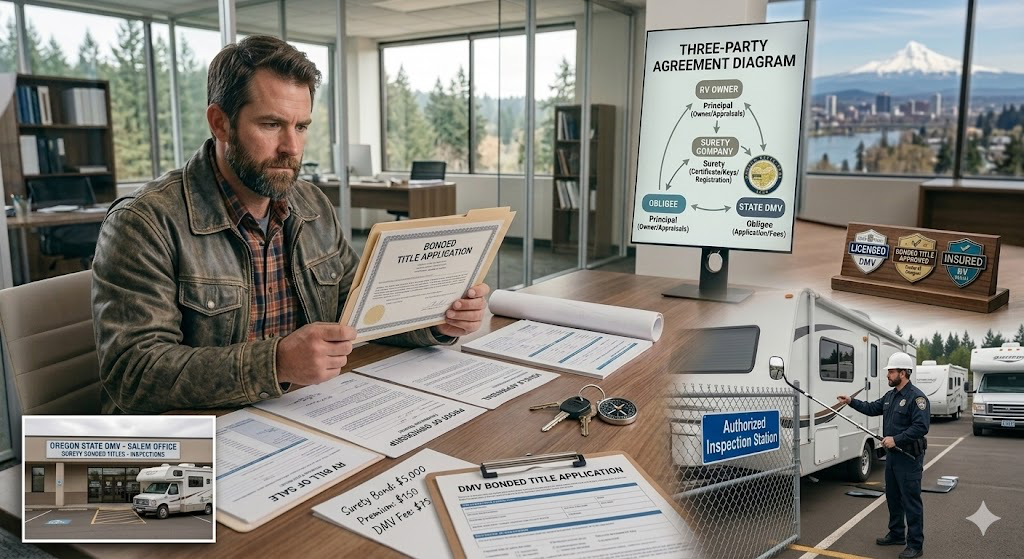
The certified letter from your state Department of Motor Vehicles arrived yesterday informing you that your attempt to register the beautiful thirty-two-foot travel trailer you purchased from a private seller three months ago has been denied because the handwritten bill of sale signed on a napkin at the campground where you met the seller does not constitute sufficient proof of ownership under state titling laws, the phone number the seller provided now goes to a disconnected voicemail message leaving you unable to contact them for proper title transfer paperwork, and the DMV representative tersely explained that your only remaining option involves something called a bonded title requiring you to purchase a surety bond worth one and a half times your RV’s appraised value before they’ll consider issuing legitimate registration documents, creating a confusing maze of unfamiliar terminology about three-party agreements, VIN inspections by authorized law enforcement officers, state-specific application forms you’ve never encountered, and premium calculations ranging from one to ten percent of bond amounts that could mean anything from one hundred dollars to several thousand depending on factors you don’t understand. Learning exactly what a bonded title is, why it exists as legal protection for all parties when original titles go missing or were never properly transferred, which six specific steps every RV owner must complete to successfully obtain bonded title approval from their state DMV, how to calculate the precise bond amount and premium cost you’ll actually pay based on your RV’s current market value and your personal credit score, what documentation you absolutely must gather including proof that your RV hasn’t been reported stolen and evidence of every attempt you made to contact previous owners, and which common mistakes cause applications to be rejected or delayed for months while you remain unable to legally drive your RV on public roads could mean the difference between resolving your title problem within two weeks at a cost of a few hundred dollars or abandoning your RV investment entirely because you incorrectly assumed the titling process was impossible to navigate without the original owner’s cooperation.
A bonded title for an RV is a legal certificate of ownership issued by your state Department of Motor Vehicles when the original title is lost, stolen, missing, damaged, contains incorrect information, or was never properly transferred from the previous owner, with the bonded title backed by a surety bond guaranteeing financial protection for anyone who might later prove they are the rightful owner of the recreational vehicle.
What Makes a Bonded Title Different from a Regular Title
A bonded title functions identically to a standard vehicle title for all practical purposes including registering your RV with the DMV, purchasing insurance coverage, driving legally on public roads, and eventually selling the recreational vehicle to another buyer. The critical difference lies in the financial guarantee backing the document through a three-party agreement between you as the RV owner, a licensed surety company issuing the bond, and your state DMV accepting the bond as proof you legitimately own the vehicle.
The surety bond acts as insurance protecting anyone who might appear within a specified period claiming they are the actual rightful owner of your RV. If someone produces evidence proving they legitimately own your recreational vehicle during the bond period, the surety company pays that person the RV’s full value as compensation. You then become legally obligated to reimburse the surety company for the full amount they paid, plus interest and administrative costs. This financial guarantee structure protects both innocent purchasers buying vehicles without titles and legitimate owners whose vehicles were sold without their knowledge or consent.
Most states impose bond periods lasting three to five years from the bonded title issuance date. During this window, anyone claiming ownership rights can challenge your title by presenting documentation to the DMV proving their superior ownership claim. If no challenges materialize during the entire bond period, the DMV releases the bond and converts your bonded title into a standard title indistinguishable from any other vehicle title, completely removing the bonded designation and eliminating any ongoing bond obligations or potential liability concerns.
Some insurance companies and lenders view bonded titles cautiously during the bond period, occasionally declining to provide financing or requiring higher insurance premiums reflecting the theoretical possibility someone might challenge your ownership. However, once the bond period expires and the title converts to standard status, these concerns disappear entirely as the title becomes legally equivalent to any original title issued through normal DMV channels.
Common Scenarios Requiring Bonded Titles for RVs
RV owners pursue bonded titles under several recurring circumstances where standard title transfer procedures prove impossible. Purchasing a recreational vehicle through private sales often creates title problems when sellers provide only bills of sale without accompanying titles, claiming they lost the original documents years ago or never received titles when they originally acquired the vehicles. Buyers who accepted these incomplete transactions find themselves unable to register their RVs without proper title documentation, leaving bonded titles as their only path to legal ownership recognition.
Inherited RVs frequently lack proper title paperwork when family members receive recreational vehicles from deceased relatives whose estates never completed formal title transfers, or when the original owner stored the RV for decades without maintaining title documents that were subsequently lost or destroyed. Heirs attempting to claim these inherited RVs discover DMVs require proper title chains of ownership that no longer exist, necessitating bonded title procedures to establish legitimate ownership rights.
Abandoned RVs present another common scenario where someone acquires a recreational vehicle left on their property for extended periods after the original owner disappeared or became unreachable. Property owners who legally claim abandoned RVs through proper procedures still need titles to register the vehicles, but the abandonment circumstances mean no original owner exists to provide title transfer documents, leaving bonded titles as the mechanism for establishing ownership.
Vehicles purchased at auctions sometimes lack titles when auction houses sell repossessed RVs, estate sale recreational vehicles, or storage facility inventory where title documentation was never provided to the auction company. Buyers who assumed auctions guaranteed proper documentation discover they purchased RVs without titles, requiring bonded title procedures to complete the ownership transfer process.
Incorrect information on existing titles creates bonded title needs when original documents contain misspelled names that don’t match current identification, wrong vehicle identification numbers that don’t correspond to the actual RV, or other errors making the titles legally invalid for transfer purposes. Rather than attempting to track down previous owners in the title chain to correct ancient documentation errors, bonded titles offer faster resolution paths.
Eligibility Requirements for RV Bonded Titles
State residency requirements mandate that bonded title applicants must be legal residents of the state where they’re applying, with most states requiring valid driver’s licenses, state identification cards, or other proof of residency issued by that state. Military personnel stationed in a state qualify even without formal residency, with active duty orders serving as acceptable proof of eligibility. Some states allow out-of-state residents to apply only when the RV itself was last titled in that state, creating geographical connections justifying the state’s authority to issue bonded titles.
The recreational vehicle must physically be in your possession and cannot be reported stolen in any national or state theft database. Attempting to obtain bonded titles for stolen RVs constitutes fraud carrying criminal penalties, making stolen vehicle verification the first critical step before beginning any bonded title application. RVs subject to pending lawsuits, mechanic’s liens, or other legal claims typically face ineligibility until those legal matters resolve, as courts must determine rightful ownership before DMVs issue bonded titles potentially conflicting with court jurisdictions.
Although RVs need not be operational or roadworthy to qualify for bonded titles, most states require recreational vehicles to be complete including intact frames, bodies, engines for motorhomes, and chassis for trailers. Severely damaged RVs missing major components may face ineligibility under state laws prohibiting bonded titles for vehicles deemed junked, totaled, or nonrepairable. These restrictions prevent bonded titles from being used to legitimize stripped vehicles sold for parts rather than operational recreational vehicles intended for eventual road use.
Vehicle value thresholds in some states exclude very inexpensive RVs from bonded title eligibility, with minimum values around four thousand dollars creating floors below which states won’t issue bonded titles. This exclusion reflects administrative costs and fraud prevention concerns, as processing bonded titles for very low-value vehicles creates disproportionate government expenses relative to the vehicles’ worth. However, even modest travel trailers and truck campers typically exceed these minimum thresholds, making most recreational vehicles eligible regardless of age or condition.
Vehicles purchased new directly from manufacturers or dealers face automatic ineligibility since selling companies always issue original titles as standard sale procedures, eliminating any legitimate reason to pursue bonded titles for brand new RVs. This restriction prevents fraud schemes involving new vehicle sales without proper title documentation, ensuring legitimate commercial channels maintain proper title procedures.
The Six-Step Bonded Title Process for RVs
Verifying your RV hasn’t been reported stolen begins the process, protecting you from unknowingly purchasing stolen recreational vehicles and avoiding serious legal complications. The National Motor Vehicle Title Information System provides nationwide theft database searches, while individual state DMV databases offer state-specific stolen vehicle verification. Running both searches provides comprehensive confirmation that your RV carries no theft flags that would automatically disqualify bonded title applications. This verification step typically costs ten to twenty-five dollars through commercial NMVTIS providers or may be available free through some state DMV websites.
Completing a VIN inspection by an authorized inspector establishes your RV’s identity and ensures the vehicle identification number hasn’t been tampered with, altered, or removed. State-certified inspectors include law enforcement officers, DMV-authorized inspection stations, licensed mechanics holding specific inspection certifications, and sometimes private companies operating under state contracts. The inspector physically locates the VIN on your RV’s frame, chassis, or dashboard depending on vehicle type, verifies it matches the VIN shown on your bill of sale or other ownership documents, checks for alteration signs, and completes official inspection forms your DMV requires. VIN inspection fees range from ten to fifty dollars depending on the inspector and your location, with law enforcement agencies sometimes providing free inspections as public services.
Determining your RV’s value establishes the bond amount you must purchase, as most states require bonds worth one and a half times the recreational vehicle’s appraised value. States use several valuation methods including Standard Presumptive Value databases published on DMV websites as primary sources, National Automobile Dealers Association guides when SPV data isn’t available, or professional appraisals from licensed motor vehicle dealers or insurance adjusters when neither SPV nor NADA provides values for your specific RV model and year. Trailers and semitrailers sometimes qualify for established values based solely on length, with vehicles under twenty feet assigned four-thousand-dollar values and twenty-foot or longer trailers valued at seven thousand dollars, simplifying the appraisal process for common recreational trailer types.
Purchasing your surety bond requires contacting licensed surety bond agencies authorized to issue certificate of title bonds in your state, completing bond applications providing personal information including social security numbers for credit checks, and paying premium fees typically ranging from one to ten percent of the bond amount. Excellent credit scores above seven hundred generally qualify for one to three percent premium rates, while moderate credit between six hundred and six hundred ninety-nine faces three to five percent rates, and challenged credit below six hundred encounters five to ten percent through specialized programs. For RVs valued at twenty thousand dollars requiring thirty-thousand-dollar bonds at one and a half times value, premiums range from three hundred dollars for excellent credit at one percent to three thousand dollars for poor credit at ten percent, creating substantial cost variations based on credit profiles.
Some surety companies offer freely written bonds under six thousand dollars at flat one-hundred-dollar premiums without credit checks, creating affordable options for owners of modest RVs like small travel trailers or truck campers. Bonds typically carry three-year terms corresponding to most states’ bond holding periods, with the premium covering the entire three-year period rather than requiring annual renewal payments. Many surety agencies issue bonds within twenty-four to forty-eight hours for standard applications, while some companies provide instant bond delivery for freely written products requiring no underwriting.
Submitting your bonded title application to the DMV requires gathering all documentation including the surety bond certificate you must sign in original ink, VIN inspection forms, vehicle appraisal documents, any available bills of sale or ownership evidence, completed state-specific application forms, affidavits of ownership swearing under penalty of perjury that you legitimately own the RV, and proof you exhausted all reasonable efforts to obtain the original title by contacting previous owners through certified mail. Most states charge administrative fees between fifteen and fifty dollars for processing bonded title applications, with some states adding registration fees, sales taxes calculated on vehicle values, or other costs that can add hundreds of dollars to total application expenses.
Paying necessary fees and waiting for approval concludes the process, with most DMVs requiring thirty to sixty days to review applications, verify documentation, confirm bonds meet state requirements, and issue bonded titles. Some states impose strict deadlines requiring you to file bonded title applications within thirty days of purchasing your surety bond, with bonds older than thirty days becoming invalid and requiring new bond purchases if you miss filing deadlines. During the review period, DMVs may request additional documentation, require clarification of ownership evidence, or identify deficiencies needing correction before approval, extending processing times beyond the standard windows.
Required Documentation for RV Bonded Title Applications
Proof of ownership documentation should include every available piece of evidence supporting your legitimate ownership claim, recognizing that the fundamental reason you need a bonded title is the absence of a proper original title that would normally prove ownership conclusively. Bills of sale signed by previous owners, purchase invoices showing payment amounts and dates, cancelled checks proving you paid for the RV, money transfer receipts, previous registration documents listing you as owner even without corresponding titles, insurance policies covering the RV in your name, and any written agreements or contracts related to the vehicle purchase all strengthen your ownership case.
Evidence of exhaustive title search efforts demonstrates to DMVs that you genuinely attempted to obtain the original title through legitimate channels before resorting to bonded title procedures. Certified mail receipts showing you contacted previous owners requesting title transfers, DMV correspondence confirming the original title was lost or unavailable through their records, attempts to contact selling dealerships that have since closed or changed ownership, and documented communication with anyone in the title chain all prove you exhausted reasonable efforts. This documentation prevents bonded titles from being used as shortcuts avoiding proper title transfer procedures when original titles actually exist and could be obtained through normal channels.
Proof of RV value through official appraisals, dealer quotes, or state valuation guides establishes the bond amount you must purchase at one and a half times the vehicle’s worth. Recent appraisals from licensed dealers or insurance adjusters carry the most weight, particularly for unusual RV models or custom recreational vehicles where standard valuation guides lack comparable data. For common RVs, printed pages from your state’s Standard Presumptive Value website or NADA guide entries showing your specific make, model, and year usually satisfy DMV requirements without requiring expensive professional appraisals.
State-specific application forms vary by jurisdiction but generally include requests for Texas Title in Lieu of Court Order, Applications for Certificate of Title, Affidavits of Ownership, and various other forms designated by number or letter codes unique to each state. Carefully completing these forms with accurate information matching your supporting documentation prevents rejections or delays from inconsistent data raising red flags during DMV review processes.
Cost Breakdown for RV Bonded Titles
| Cost Category | Typical Range | Notes |
|---|---|---|
| Surety Bond Premium | $100 – $3,000+ | 1-10% of bond amount based on credit; $100 flat rate for bonds under $6,000 |
| VIN Inspection Fee | $10 – $50 | Free from some law enforcement agencies; higher at private inspection stations |
| RV Appraisal Fee | $0 – $200 | Free if using state SPV or NADA; $100-$200 for professional dealer/adjuster appraisals |
| DMV Application Fee | $15 – $50 | State-specific administrative processing charges |
| Notarization Costs | $10 – $20 | If state requires notarized affidavits or ownership statements |
| Registration Fees | $50 – $500 | Based on RV weight, value, and state fee schedules |
| Sales Tax | Variable | Some states levy tax on appraised vehicle value at time of bonded title issuance |
| Total Estimated Cost | $200 – $4,000+ | Varies dramatically based on RV value, credit score, and state requirements |
The surety bond premium represents the largest variable cost, with a twenty-thousand-dollar RV requiring a thirty-thousand-dollar bond costing three hundred dollars annually for excellent credit at one percent or three thousand dollars for poor credit at ten percent. Most RV owners with decent credit pay between three hundred and nine hundred dollars for typical recreational vehicle bonds, making bonded titles financially accessible for most situations despite the percentage-based premium calculations creating potential for high costs on very expensive motorhomes.
State-Specific Variations and Restrictions
Not all states offer bonded title procedures, with some jurisdictions prohibiting bonded titles entirely and requiring court orders or other legal proceedings to establish ownership when original titles go missing. Before beginning any bonded title process, verify your specific state DMV allows bonded titles and review their unique requirements, forms, and procedures that may differ substantially from general processes described in most guides.
Texas requires Form VTR-130-ND Notice of Determination establishing bond amounts after initial application review, with one-year deadlines to purchase bonds after receiving notices or requiring new notices and restarting the process. Within thirty days of purchasing bonds, Texas applicants must file with county tax offices to complete the title issuance process, creating strict timelines easily missed without careful deadline tracking.
Bond amount calculations vary by state with most requiring one and a half times vehicle value, but some states using one times value, others using two times value, and a few allowing DMVs discretion to set amounts based on specific circumstances. These variations can double or halve your premium costs depending on which state governs your bonded title application.
Trailer length-based valuation shortcuts in some states like Texas assign four-thousand-dollar values to trailers under twenty feet and seven-thousand-dollar values to trailers twenty feet or longer, regardless of actual condition or market value. This standardization simplifies the process for common recreational trailers but may overvalue old trailers in poor condition while undervaluing well-maintained premium trailers.
How to Get Your RV Bonded Title Certificate
Getting your RV bonded title certificate starts by contacting your state DMV to confirm they offer bonded title procedures, determining your specific eligibility based on residency status and RV characteristics, and obtaining the exact forms, bond amount requirements, and documentation lists applicable to your situation rather than relying on generic information that may not match your state’s unique procedures. Once you understand your state’s requirements, complete the VIN inspection through authorized inspectors to verify your RV’s identity and ensure no tampering or alteration issues complicate the application. Determine your RV’s precise value through your state’s Standard Presumptive Value database, NADA guide entries, or professional appraisals if neither resource covers your specific recreational vehicle make and model, then calculate the bond amount at one and a half times that value in most states. Contact experienced surety bond agencies like Swiftbonds who specialize in certificate of title bonds and understand RV bonding requirements across all states, complete the bond application providing personal and vehicle information, and submit payment for your premium calculated based on the bond amount and your credit score, typically receiving bond delivery within twenty-four to forty-eight hours or instantly for freely written products under six thousand dollars. Gather all supporting documentation including bills of sale, certified mail receipts proving title search attempts, the surety bond certificate, VIN inspection forms, value appraisals, and completed state application forms, then submit your complete bonded title application package to your DMV along with all required fees, following up regularly during the thirty to sixty day review period until your bonded title arrives allowing you to legally register, insure, and operate your RV on public roads.
Swiftbonds LLC
2025 Surety Bond Agency of the Year
4901 W. 136th Street
Leawood KS 66224
(913) 214-8344
https://swiftbonds.com/
Liens and Outstanding Loan Obligations
RVs with active liens from outstanding loans or secured creditor claims require lien releases or letters of no interest from all lienholders before DMVs will process bonded title applications. Most states consider liens less than ten years old as potentially active, requiring applicants to provide original documentation from each lienholder confirming the debt was satisfied and they claim no interest in the vehicle. Older liens exceeding ten years typically receive presumptions of satisfaction, though some states still require documented proof or legal declarations regarding lien status.
Discovering unexpected liens during bonded title applications creates serious complications, as you cannot obtain bonded titles for RVs subject to valid security interests held by finance companies or other creditors. The original lien must be satisfied through full payment or the lienholder must agree to release their interest before proceeding, potentially requiring you to pay off loans you didn’t know existed or negotiate settlements with creditors claiming interests in your RV.
Common Mistakes That Delay or Prevent Bonded Title Approval
Purchasing surety bonds before DMVs confirm exact bond amounts required represents the most frequent error, as applicants buying bonds based on assumptions or estimates discover their bond amounts don’t match what DMVs calculated, requiring new bond purchases and wasting money on incorrect initial bonds. Always wait until receiving official DMV bond amount determinations before contacting surety companies to avoid this expensive mistake.
Failing to document exhaustive title search efforts triggers DMV rejections when applications lack certified mail receipts, contact attempt records, or other evidence proving applicants genuinely tried obtaining original titles through legitimate channels. DMVs view bonded titles as last resort options after all normal title transfer procedures fail, not as convenient shortcuts avoiding proper title work, making documentation of failed title search attempts essential application components.
Missing strict filing deadlines after purchasing bonds causes applications to be rejected in states imposing thirty-day or similar windows for submitting bonded title paperwork following bond issuance. Applicants who delay filing applications past these deadlines must purchase new bonds at additional expense, doubling or tripling their bonding costs through preventable deadline violations.
Providing inconsistent information across different application documents raises fraud concerns when VIN numbers, vehicle descriptions, purchase dates, or ownership details vary between bills of sale, affidavits, and application forms. Carefully review all documentation ensuring perfect consistency in every detail before submitting applications to avoid suspicious discrepancies triggering additional investigations or outright denials.
Frequently Asked Questions
Can I travel out of state with a bonded title on my RV?
Most states allow interstate travel with bonded titles as they function identically to regular titles for registration and operation purposes, though some states impose restrictions during the bond period limiting where you can legally drive the RV. The specific uses and acceptance of bonded titles vary by state policies and individual situations, so consult your DMV about any travel limitations before planning extended interstate trips. Some insurance companies may include travel restrictions in policies covering bonded title RVs, creating additional limitations beyond state legal requirements.
What happens if someone challenges my ownership during the bond period?
If another person presents evidence to the DMV proving they are the rightful owner of your RV during the bond period, the surety company investigates the claim and pays that person the RV’s full value if their ownership evidence proves legitimate. You then become legally obligated to reimburse the surety company for the full amount they paid plus interest and administrative costs, essentially purchasing the RV from its legitimate owner through the surety company intermediary. The bonded title protects innocent purchasers by allowing you to keep the RV despite ownership disputes, but you bear the financial cost of compensating legitimate owners who prove superior ownership claims.
Does having a bonded title affect my RV’s resale value?
Some buyers view bonded titles cautiously during the active bond period, potentially offering lower purchase prices or declining to buy bonded title RVs entirely due to theoretical ownership challenge risks. However, once the bond period expires and the title converts to standard status, the bonded history becomes irrelevant and does not affect resale values compared to RVs with clean title histories. Disclosing the bonded title status honestly to potential buyers prevents future legal complications and builds trust, though you may need to accept slightly lower offers during the bond period.
Can I get a bonded title for an RV I’ve been using for years without proper registration?
Yes, the length of time you’ve possessed the RV doesn’t affect bonded title eligibility as long as you meet state residency requirements, the RV isn’t reported stolen, and you can provide some evidence supporting your ownership claim like bills of sale or prior registration attempts. Many applicants successfully obtain bonded titles for RVs they’ve owned for decades but never properly titled, though you may face additional questions about why you waited so long to address the title situation.
Do I need a bonded title if I just lost my original title but my name is on it?
No, if your name appears on the lost title as the legal owner, you can simply request a duplicate title from your DMV rather than pursuing the more expensive and complex bonded title process. Duplicate titles cost twenty-five to fifty dollars and arrive within two to four weeks, making them far preferable to bonded titles when you qualify. Bonded titles exist specifically for situations where the original title is unavailable and cannot be duplicated through normal DMV channels because your name doesn’t appear as owner or ownership is otherwise unclear.
Will my insurance rates increase with a bonded title?
Some insurance companies charge slightly higher premiums for bonded title vehicles during the active bond period reflecting theoretical ownership dispute risks, while other insurers treat bonded titles identically to standard titles without premium increases. Shop multiple insurance providers to find competitive rates, as company policies vary significantly regarding bonded title vehicles. Once the bond period expires and the title converts to standard status, any premium increases related to the bonded designation automatically disappear.
Conclusion
Bonded titles for RVs provide legal pathways to establish ownership when original titles are lost, stolen, missing, damaged, or were never properly transferred from previous owners, creating situations where standard title transfer procedures prove impossible. The bonded title process requires purchasing surety bonds worth one and a half times RV values in most states, completing VIN inspections by authorized inspectors, gathering extensive documentation proving ownership and exhaustive title search efforts, and submitting comprehensive applications to DMVs along with all required fees and supporting evidence.
Premium costs ranging from one to ten percent of bond amounts create total expenses between two hundred and four thousand dollars depending on RV values, credit scores, and state-specific fee structures, with most recreational vehicle owners paying three hundred to nine hundred dollars for typical bonded title situations. The three to five year bond period provides protection for legitimate owners who might challenge bonded titles by proving superior ownership claims, with surety companies compensating proven owners while bond holders reimburse sureties for any payments made during disputes.
The six-step process begins with verifying RVs haven’t been reported stolen through national and state databases, continues through VIN inspections confirming vehicle identity, determines precise vehicle values establishing bond amounts, purchases surety bonds through licensed agencies, submits complete application packages to DMVs, and concludes with paying all fees and waiting thirty to sixty days for bonded title approval. Successful applications result in bonded titles functioning identically to standard titles for registration, insurance, and resale purposes, though some lenders and buyers view bonded titles cautiously during active bond periods.
State-specific variations create dramatically different requirements, forms, deadlines, and procedures across jurisdictions, making verification of your particular state’s bonded title rules essential before beginning any application process. Not all states offer bonded titles, requiring court orders or other legal proceedings in some jurisdictions when original titles go missing or prove unavailable through normal channels.
Common mistakes including purchasing bonds before receiving official bond amount determinations from DMVs, failing to document exhaustive title search efforts through certified mail receipts and contact attempt records, missing strict filing deadlines after bond purchases, and providing inconsistent information across application documents delay or prevent approvals while wasting money on incorrect bonds or duplicate application fees.
Once bond periods expire without ownership challenges, bonded titles convert to standard titles indistinguishable from any original DMV-issued title, completely eliminating the bonded designation and removing all theoretical ownership dispute risks that may have affected insurance rates or buyer interest during the bond period. This conversion completes the ownership legitimization process, rewarding patient RV owners with clean titles identical to those issued through normal new vehicle purchase procedures.
Five RV Bonding Realities Beyond Standard Title Bond Information
Recreational vehicle depreciation patterns create unique bonding advantages compared to automobiles, as RVs typically depreciate far more slowly than cars with well-maintained motorhomes and quality travel trailers often retaining sixty to seventy percent of original values after ten years compared to automobiles losing similar percentages within three to five years, meaning the bond amounts required at one and a half times current RV values represent substantially smaller percentages of original purchase prices than automobile bonded titles, particularly for older but well-preserved recreational vehicles where current market values might be fifteen thousand dollars requiring twenty-two thousand five hundred dollar bonds despite original purchase prices exceeding eighty thousand dollars when new.
Full-time RVers establishing legal domiciles in states where they don’t physically reside face unique bonded title complications when their chosen domicile states require applicants to be legal residents or have vehicles last titled in those states, creating situations where RVers with South Dakota, Texas, or Florida domiciles for tax and voting purposes cannot obtain bonded titles in those states because their RVs were never titled there and they don’t meet physical residency requirements, forcing them to pursue bonded titles in their previous residence states or wherever their RVs were last legally titled, potentially requiring temporary returns to states they left years ago specifically to complete bonded title applications before transferring titles to their current domicile states through normal interstate title transfer procedures.
Insurance companies specializing in recreational vehicle coverage distinguish bonded title motorhomes and travel trailers from bonded title automobiles in their underwriting guidelines, with many RV-specialist insurers viewing bonded titles as relatively routine given the frequency of private RV sales without proper title documentation and the common practice of inheriting family recreational vehicles lacking title paperwork, resulting in far less premium discrimination against bonded title RVs compared to the substantial rate increases or coverage denials bonded title automobiles sometimes trigger from standard auto insurance carriers who view such situations as high fraud risk indicators.
The bond release process after three to five year holding periods varies dramatically by state with some jurisdictions automatically converting bonded titles to standard titles without requiring any owner action or notification, sending updated title documents showing the bonded designation removed, while other states require owners to file formal bond release applications requesting title conversions and paying additional processing fees to obtain clean titles, and still other states maintain permanent “bonded title” designations on title documents even after bond periods expire though the designation carries no legal significance or restrictions, creating confusion among RV sellers who must explain to potential buyers that expired bonded title notations represent historical footnotes rather than active encumbrances.
Motorhome-specific valuation challenges arise from extensive modifications and custom upgrades common in recreational vehicles where solar panel systems, lithium battery banks, inverter installations, custom cabinetry, upgraded suspension components, and luxury interior renovations can add thirty thousand to fifty thousand dollars in owner investment but may not proportionally increase DMV-recognized values used for calculating bond amounts, as Standard Presumptive Value databases and NADA guides reflect only factory configurations without accounting for modifications, potentially leaving owners to purchase bonds based on forty-thousand-dollar base vehicle values when they invested ninety thousand dollars total including sixty thousand for the motorhome and thirty thousand in upgrades, though owners can sometimes argue for higher appraisals reflecting modification values if willing to obtain professional appraisals documenting the enhanced worth their improvements created.