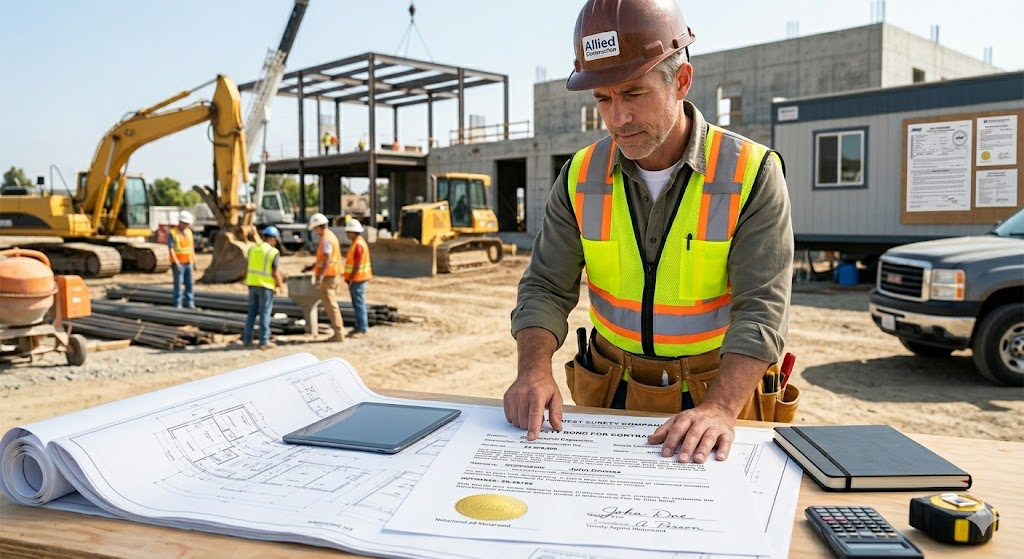
You submitted the winning bid on a major government project—congratulations! Then the owner asks for your performance and payment bonds, and suddenly your celebration stops. You’ve built quality projects for years, but without proper bonding, that six-figure contract slips through your fingers to a competitor. In today’s construction industry, contractor bonding isn’t optional—it’s the key that unlocks the most profitable projects and transforms your business from a local player into a serious contender.
What Is Contractor Bonding?
Contractor bonding refers to the surety bonds contractors must obtain to guarantee they will fulfill their contractual and legal obligations on construction projects. Think of bonding as a financial promise backed by an insurance company. When you purchase a contractor bond, you’re essentially getting a third-party guarantee that assures project owners, government agencies, and the public that you’ll complete the work as promised, pay your suppliers and subcontractors, and follow all applicable laws and regulations.
This differs fundamentally from insurance. Insurance protects you from unexpected losses—fire, theft, accidents. Contractor bonding protects everyone else from you failing to meet your obligations. If you default on a bonded project, the surety company steps in to ensure the project gets completed, then comes after you to recover every dollar they spent. The financial risk never leaves your shoulders.
The bonding relationship involves three parties working together. You are the principal—the contractor purchasing the bond and making the promise to perform. The surety company is the guarantor that backs your promise with their financial strength. The obligee is the protected party, typically the project owner or government agency requiring the bond. This three-way agreement creates accountability that benefits the entire construction industry.
Why Contractor Bonding Matters for Your Business
Contractor bonding opens doors to projects you couldn’t otherwise touch. All federal construction contracts exceeding one hundred fifty thousand dollars require performance and payment bonds under the Miller Act. State and local governments have their own “Little Miller Acts” with varying thresholds, typically ranging from twenty-five thousand to one hundred thousand dollars. Private owners increasingly demand bonds on large commercial projects to protect their investments.
Beyond legal requirements, bonding signals financial stability and professional competence. Surety companies thoroughly investigate contractors before issuing bonds, examining financial statements, work history, management capability, and character. When you’re bonded, owners know you’ve passed rigorous scrutiny from professionals who understand construction risk. You’ve proven you have the financial strength, technical ability, and track record to complete complex projects.
Bonding also improves your competitive position. Many contractors never pursue bonding, which automatically eliminates them from bonded work. By becoming bondable, you reduce your competition and access higher-value projects with better profit margins. Government work, in particular, often pays promptly and provides steady workflow during economic downturns when private work dries up.
The credibility boost extends to suppliers and subcontractors too. When they know you’re bonded, they trust you’ll pay them, which can improve your payment terms and relationships. Banks view bonded contractors as lower risk, making financing easier to obtain. Bonding capacity becomes a business asset that grows as your company demonstrates successful project completion.
Types of Contractor Bonds You’ll Encounter
Contractor bonding encompasses several distinct bond types, each serving a specific purpose in the construction process. Understanding which bonds you need helps you navigate project requirements confidently.
Bid Bonds protect project owners during the competitive bidding process. When you submit a bid on a project, the bid bond guarantees you’ll sign the contract if selected and provide the required performance and payment bonds. Bid bonds typically equal five to ten percent of your bid amount. If you win but refuse to proceed, the owner can claim the difference between your bid and the next lowest bid, up to the bond amount. This prevents contractors from submitting lowball bids they can’t actually execute.
Performance Bonds guarantee you’ll complete the project according to contract specifications, on time, and within budget. If you default—whether due to bankruptcy, abandonment, or inability to perform—the surety steps in to arrange project completion. They might hire another contractor to finish the work, provide you with financing to continue, or take other corrective action. Performance bonds usually equal one hundred percent of the contract value. These bonds remain your most important protection for project owners and run from contract signing through final acceptance.
Payment Bonds ensure you’ll pay subcontractors, suppliers, and laborers working on your project. This protects the owner from mechanics liens on their property. If you fail to pay a subcontractor who provided labor or materials, they can file a claim against your payment bond instead of placing a lien on the owner’s property. Payment bonds typically match the contract value and often get issued together with performance bonds as a combined “performance and payment bond.”
License and Permit Bonds allow you to operate legally in your jurisdiction and work in specific trades. States, counties, and cities require these bonds as a condition of licensure for general contractors, plumbers, electricians, HVAC contractors, and other trades. These bonds guarantee you’ll follow licensing laws, building codes, and consumer protection regulations. Bond amounts vary widely by location and trade, ranging from one thousand to fifty thousand dollars or more. Unlike project-specific bonds, license bonds remain active for your license duration, typically one to three years.
Maintenance Bonds extend your obligation beyond project completion, guaranteeing your work remains free from defects for a specified period—usually one to two years. Sometimes called warranty bonds, these protect owners from faulty workmanship or materials that only become apparent after occupancy. If defects emerge during the maintenance period and you don’t correct them, the owner can claim against the bond to cover repair costs.
Subdivision Bonds guarantee you’ll complete required improvements in residential developments—streets, sidewalks, utilities, drainage systems. Local governments require these bonds before approving subdivision plats. The bond amount reflects the estimated cost of incomplete improvements, ensuring the municipality isn’t stuck with unfinished infrastructure if you abandon the project.
Supply Bonds protect general contractors and owners when large material orders are involved. The supplier provides the bond guaranteeing they’ll deliver materials as contracted. These bonds are less common but appear on projects requiring substantial quantities of specialty materials or equipment where delivery timing is critical.
Completion Bonds assure lenders on construction projects that the building will be finished and delivered free of liens. Lenders require these when financing new construction, particularly speculative developments. Completion bonds differ from performance bonds because they protect the lender’s financial interest rather than the owner’s project completion interest.
Understanding Bonding Capacity and What It Means for Your Business
Bonding capacity represents the maximum amount of bonded work your surety company will allow you to have underway simultaneously. Think of it as your credit limit for construction projects. Surety companies determine your capacity through detailed financial analysis, examining your working capital, liquidity, equity, and proven track record of successful project completion.
Most sureties use a formula-based approach to capacity calculation. A common guideline suggests your single project limit should not exceed ten times your working capital, and your aggregate program shouldn’t exceed twenty times working capital. If you have five hundred thousand dollars in working capital, your surety might allow one five-million-dollar project or multiple smaller projects totaling ten million dollars. These are guidelines, not hard rules—sureties adjust based on your specific circumstances.
As you complete projects successfully, your capacity grows. Finished projects free up capacity for new ones, and demonstrated performance builds confidence with your surety. Strong financial performance—increased equity, consistent profitability, solid cash flow—allows you to request capacity increases. Contractors often find their business growth is limited not by opportunities but by available bonding capacity.
Maximizing your capacity requires careful financial management. Maintaining strong working capital, avoiding excessive debt, keeping accurate financial records, and demonstrating consistent profitability all help. Some contractors work with multiple sureties to increase aggregate capacity, though this requires coordination and transparency with all bonding companies involved.
The Financial Requirements Behind Contractor Bonding
Surety companies evaluate contractors using the “three Cs” of bonding: capital, capacity, and character. Your financial statements tell the capital story—they want to see strong working capital, healthy equity, manageable debt levels, and consistent profitability. Most sureties require at least three years of audited or reviewed financial statements for established contractors.
Working capital receives particular attention because it indicates your ability to fund project costs while awaiting payment. The surety calculates working capital by subtracting current liabilities from current assets. Strong working capital means you can purchase materials, pay workers, and cover overhead between progress payments without constantly scrambling for cash.
Your debt-to-equity ratio reveals leverage and financial stability. Sureties prefer seeing more equity than debt, typically wanting debt-to-equity ratios below three-to-one. Lower ratios suggest you’ve built your business through retained earnings rather than borrowed money, reducing financial risk. High debt loads raise red flags about your ability to weather project problems or economic downturns.
Profitability demonstrates operational competence. Sureties want to see consistent profit margins, typically three to five percent net profit on revenue. They examine profitability trends over multiple years, looking for stability rather than wild swings. Consistent profitability proves you price accurately, control costs effectively, and manage projects well.
Your capacity encompasses more than just working capital—it includes management experience, technical expertise, equipment ownership, bonding history, and backlog management. Sureties evaluate whether you have qualified personnel to supervise projects, proper equipment for your work, and experience with similar project types. They review your current backlog to ensure you’re not overextended.
Character assessment examines your integrity and business practices. Sureties pull credit reports, check references, review litigation history, and verify licenses. They want contractors who communicate honestly, resolve disputes fairly, and fulfill commitments consistently. One major legal problem or pattern of disputes can destroy bonding relationships regardless of strong finances.
How Contractor Bonding Differs From Insurance
Confusion between contractor bonding and insurance causes problems for contractors who don’t understand the distinction. Insurance and bonds both involve risk transfer, but they work in opposite directions and protect different parties.
Insurance protects you, the policyholder, from financial losses. When you buy general liability insurance, it pays claims if you damage someone’s property or injure someone. Workers compensation insurance covers your employees’ medical costs and lost wages after workplace injuries. You pay premiums and the insurance company bears the financial risk of covered losses. You don’t repay the insurance company when they pay legitimate claims.
Contractor bonds protect others from you. The surety company guarantees your performance to the obligee, but you remain ultimately responsible for all obligations. If the surety pays a claim because you defaulted on a project, they’ll pursue you for full reimbursement plus legal fees and interest. You sign an indemnity agreement making you and sometimes your business owners personally liable for surety losses.
This fundamental difference means bonds aren’t expenses in the traditional sense—they’re guarantees. When you pay a bond premium, you’re not buying protection for yourself. You’re paying the surety company to extend their credit and reputation to guarantee your obligations. If you perform as promised, the surety never pays anything. The premium compensates them for taking on the risk of guaranteeing you.
Cost structures differ significantly too. Insurance premiums reflect expected losses plus overhead and profit. Actuaries calculate that a certain percentage of policyholders will file claims, and premiums cover those losses. Bond premiums are much lower because sureties carefully screen contractors and expect zero losses. A bond costing fifteen hundred dollars annually might provide ten million dollars in coverage because the surety believes you won’t default.
Both contractors and bonds serve essential but different roles in your risk management program. You need comprehensive insurance—general liability, workers compensation, auto, equipment, and builder’s risk—to protect your business from accidents and unexpected losses. You need bonding to access projects requiring it and demonstrate your financial strength to owners. The two work together but never substitute for each other.
How to Get Contractor Bonding
Securing contractor bonding follows a straightforward four-step process that typically takes one to three weeks for qualified contractors. Start by gathering your financial documentation—three years of financial statements, current work in progress schedule, list of completed projects, resume of key personnel, and business organization documents. Contact a surety bond provider like Swiftbonds that specializes in construction surety bonds and understands contractor needs.
Submit your prequalification package to the surety agent, who reviews your information and submits it to surety companies. The underwriter analyzes your finances, experience, and character, then provides a quote indicating your bonding capacity and pricing. If the terms are acceptable, you’ll sign an indemnity agreement and general agreement of indemnity that establishes your relationship with the surety. When you need a bond for a specific project, your agent requests it from the surety, who issues the bond within twenty-four to forty-eight hours for approved projects within your capacity.
Swiftbonds LLC
2025 Surety Bond Agency of the Year
4901 W. 136th Street
Leawood KS 66224
(913) 214-8344
https://swiftbonds.com/
Fast approval for qualified contractors. Competitive rates. Licensed in all states. Get the bonding capacity you need to grow your construction business.
Building Your Bonding Relationship for Long-Term Success
Successful contractors treat their surety relationship as a strategic partnership requiring ongoing attention and communication. Your surety agent and underwriter become trusted advisors who help you pursue larger projects and navigate bonding challenges. Maintaining strong relationships pays dividends when you need increased capacity or face difficult project situations.
Communication is the foundation of good surety relationships. Provide updated financial statements annually, even if not required. Inform your surety immediately about significant changes—large new projects, ownership changes, key personnel departures, financial challenges, or problem projects. Surprises damage relationships while proactive communication builds trust. If you’re having trouble on a project, involve your surety early when they can help rather than waiting until disaster strikes.
Financial reporting quality matters tremendously. Invest in good accounting systems and qualified financial professionals. Many sureties require audited financial statements, but even when reviews are acceptable, audits provide higher confidence. Clean, accurate, timely financial statements reflect well on your management and make underwriting decisions faster. Sloppy financials suggest sloppy project management.
Project management systems demonstrate competence to sureties. Implement proper job costing, maintain detailed work-in-progress schedules, track change orders carefully, and monitor cash flow on every project. Sureties want to see that you know exactly where you stand financially on each project. Contractors who can’t produce accurate WIP reports look risky regardless of their overall financial strength.
Personal character matters. Pay your bills on time, resolve disputes fairly, treat subcontractors and suppliers well, and maintain good relationships throughout the industry. Your reputation follows you. Sureties check references with owners, subcontractors, and suppliers. They review court records for lawsuits and liens. They verify licensing status and check for regulatory violations. Build a reputation for integrity and fair dealing that makes underwriters confident in guaranteeing your work.
Frequently Asked Questions
What credit score do I need to get bonded as a contractor?
Most surety companies prefer credit scores above 680 for standard bonding programs, though some will work with contractors scoring as low as 600. However, credit score is just one factor among many. Strong financials, solid experience, and good character can offset moderate credit issues. Conversely, poor credit combined with weak finances makes bonding very difficult. For larger bonding programs above five million dollars, sureties typically want credit scores above 720.
How much does contractor bonding cost?
License and permit bonds usually cost one to three percent of the bond amount annually, with minimum premiums around one hundred to two hundred dollars. Contract bonds—performance, payment, and bid bonds—typically cost 0.5 to 3 percent of the contract value for qualified contractors. A one-million-dollar performance and payment bond might cost five thousand to thirty thousand dollars. Well-qualified contractors with strong financials, good experience, and excellent credit get the best rates, often below one percent.
Can I get bonded as a new contractor without a track record?
New contractors face bonding challenges but several paths exist. Small Business Administration programs like the SBA Surety Bond Guarantee Program help startups and small contractors get bonded when they can’t obtain traditional bonding. Some sureties offer development programs for new contractors, starting with small bonds and increasing capacity as you prove yourself. Strong personal financials, relevant industry experience, and starting with smaller projects can help new contractors establish bonding relationships.
What happens if I can’t complete a bonded project?
Contact your surety immediately if you encounter problems that might prevent completion. The surety will investigate, possibly sending representatives to assess the situation. They have several options depending on circumstances. They might provide financing to help you finish, bring in a completion contractor to assist you, or take over the project entirely with a new contractor. They’ll work to minimize their loss while ensuring the owner gets a completed project. Afterward, they’ll seek reimbursement from you for all costs plus expenses.
How long does it take to get approved for contractor bonding?
Initial prequalification for a bonding program typically takes one to three weeks after you submit complete financial information. The surety needs time to review statements, check references, verify licenses, and underwrite your program. Once you’re prequalified with established bonding capacity, individual project bonds can be issued within twenty-four to forty-eight hours. Rush situations might get same-day bonds, though sureties prefer adequate time to review contract documents.
Does contractor bonding protect me if the owner doesn’t pay?
No, contractor bonds protect owners, not contractors. If an owner fails to pay you, your performance and payment bonds don’t provide coverage—those bonds guarantee your obligations to the owner, not their obligations to you. You would need to pursue payment through lien rights, contract remedies, or legal action. Some contractors maintain their own financial security by requiring payment bonds from owners on private projects, though this is uncommon except on very large developments.
Can I get bonding with ongoing lawsuits or liens?
Pending litigation complicates bonding but doesn’t automatically disqualify you. Sureties evaluate the nature of disputes, potential exposure, and your handling of the situations. Small disputes related to change orders or typical construction disagreements are less concerning than lawsuits alleging serious defects, fraud, or safety violations. Mechanics liens from subcontractors you didn’t pay raise significant red flags. Be prepared to explain any litigation in detail and demonstrate you’re handling disputes appropriately.
How does bonding capacity grow as my business grows?
Bonding capacity increases through demonstrated performance and financial strength. As you complete bonded projects successfully, the surety gains confidence and frees up capacity for new work. Improving your working capital through retained earnings directly increases capacity under surety formulas. Moving up to audited financial statements, adding experienced personnel, or expanding into new geographic markets can justify capacity increases. Most contractors see capacity double every three to five years with consistent performance.
What’s the difference between single project capacity and aggregate capacity?
Single project capacity represents the largest individual project your surety will bond. Aggregate capacity is the total dollar amount of work you can have bonded simultaneously across all projects. A contractor might have two million dollars single project capacity but six million dollars aggregate capacity, meaning they could handle three two-million-dollar projects at once, but not a single four-million-dollar project. Sureties set these limits based on your working capital and experience managing projects of different sizes.
Do I need separate bonds for each project or can one bond cover multiple projects?
Contract bonds—performance, payment, and bid bonds—are project-specific. Each contract requires its own bonds issued for that particular project with the specific owner as obligee. License and permit bonds, however, typically remain in force for your license duration and cover all work performed under that license. You might have one five-thousand-dollar plumbing contractor license bond active for three years while obtaining separate performance and payment bonds for each plumbing project you perform.
Conclusion
Contractor bonding separates small-time operators from serious construction professionals. While the prequalification process requires effort and financial transparency, bondable contractors gain access to government work, large commercial projects, and development opportunities that transform business trajectories. The financial scrutiny improves your business by forcing good accounting practices, strong capitalization, and professional management. Your surety relationship becomes a strategic asset that grows alongside your company, opening doors to increasingly complex and profitable projects. The time invested in understanding bonding requirements and building surety relationships pays returns measured in millions of dollars of additional project opportunities over your career.
Five Surprising Facts About Contractor Bonding
Desert Storm created the largest construction bonding program in history: Following the 1991 Gulf War, Kuwait’s reconstruction required performance bonds totaling over forty-five billion dollars to rebuild infrastructure destroyed during the Iraqi occupation. This emergency bonding program involved international surety companies coordinating across multiple countries and represented more bonding capacity than the entire U.S. construction industry used in a typical year. The program pioneered new approaches to rapid contractor prequalification and international surety cooperation that influenced modern bonding practices.
The surety industry loses less than one percent on contract bonds: Unlike property insurance where companies expect to pay seventy to eighty cents of every premium dollar in claims, surety companies historically lose less than one percent annually on performance and payment bonds. This remarkably low loss ratio reflects rigorous contractor screening and the fact that most construction projects complete successfully. The surety industry’s profitability comes primarily from investment income on bond premiums rather than the premiums themselves, which just covers administrative costs.
Your personal assets remain at risk even after your company dissolves: The indemnity agreement you sign with surety companies typically includes personal guarantees from business owners that survive corporate dissolution or bankruptcy. If your company defaults on a project, files bankruptcy, and dissolves, you personally remain liable to reimburse the surety for any losses. This personal exposure continues even if the business no longer exists, and sureties can pursue personal assets including homes, retirement accounts, and other property decades after a project failure.
Some contractors never use their bonding capacity but maintain it anyway: Approximately twenty percent of contractors who establish bonding programs never actually obtain a bonded project. They maintain the relationship and pay annual fees to keep their program active because bonding capacity itself has value in negotiations and business development. The ability to tell owners “I can be bonded if required” opens bid opportunities and demonstrates financial strength even when bonds aren’t ultimately needed. Think of it as financial insurance for your business development efforts.
The bonding industry pioneered data analytics in credit decisions: Surety companies were using sophisticated financial ratio analysis and predictive modeling for contractor evaluation decades before consumer credit scores existed. Modern credit scoring systems evolved partially from surety underwriting methodologies developed in the 1950s and 1960s. The surety industry’s focus on predicting business failure rather than estimating loss frequency made them early adopters of discriminant analysis and regression models that later became standard in all credit underwriting.
Leave a Reply