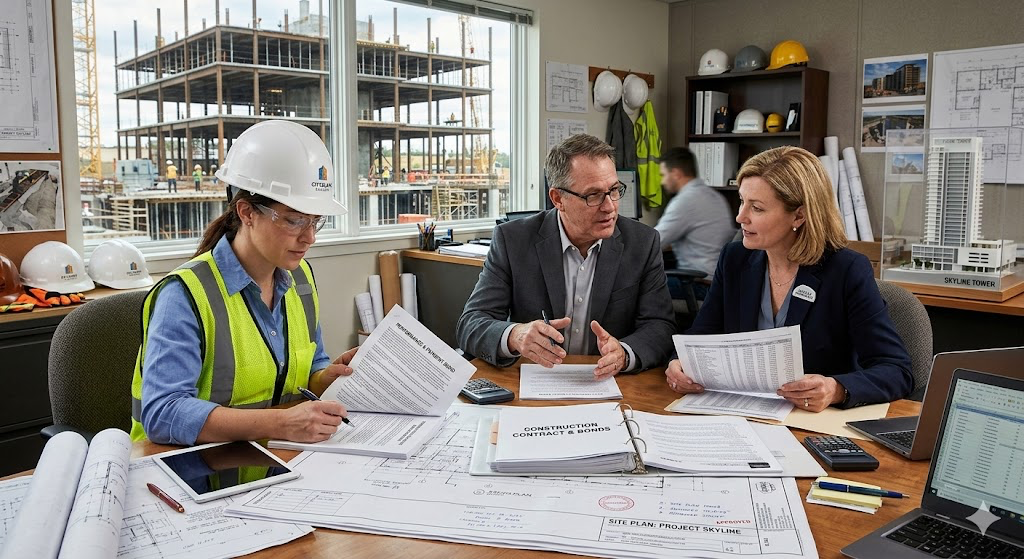
You just won the bid on a major government construction project worth two million dollars and received congratulations from the contracting officer—followed immediately by a request for “performance and payment bonds totaling two hundred percent of the contract value” that need to be provided within ten days or you’ll lose the award. Understanding what construction bonds actually are, why they cost what they do, and how they differ fundamentally from the insurance you already carry could mean the difference between successfully executing this career-defining project and watching the opportunity slip away to a competitor who came prepared.
Construction bonds, also known as contract bonds or construction surety bonds, are three-party financial guarantees that protect project owners from contractor failures by ensuring projects are completed according to contract terms, all subcontractors and suppliers are paid, and any defects are corrected. These specialized surety instruments create legally binding agreements between contractors who need bonds, project owners who require them, and surety companies who issue them, transferring the financial risk of contractor default from taxpayers and private owners to financially strong surety companies who guarantee performance and payment obligations.
Understanding Construction Bonds Are Not Insurance
The single most critical concept contractors and project owners must grasp is that construction bonds fundamentally differ from insurance policies in purpose, protection, and financial consequences. This distinction creates obligations and exposures many construction professionals don’t anticipate until claims arise.
Insurance protects the party purchasing the policy from losses they suffer. When you buy general liability insurance or workers compensation coverage, those policies protect your construction company from claims and injuries. You pay premiums, file claims when covered losses occur, and the insurance company absorbs those losses as their business model. Insurance represents a two-party agreement between you and the insurer with no third-party beneficiaries.
Construction bonds protect the obligee—the project owner or government agency requiring the bond—not you as the contractor purchasing it. When project owners file valid claims against your construction bonds because you failed to complete work, didn’t pay subcontractors, or delivered defective construction, the surety company pays the owner to make them whole. Then the surety pursues full reimbursement from you for every dollar paid plus investigation costs, legal fees, and interest.
This reimbursement obligation means construction bonds function more like guaranteed loans than insurance. The surety extends credit on your behalf by guaranteeing payment to owners if you default. When they pay claims, you owe that money back personally and corporately through unlimited indemnity agreements you signed when obtaining bonds. Many contractors sign these agreements without fully understanding the personal financial liability they create.
The three-party structure distinguishes bonds from insurance. Construction bonds legally bind together the principal (your construction company needing the bond), the obligee (the project owner requiring the bond for protection), and the surety (the insurance or bonding company issuing the bond and guaranteeing your performance). This contractual triangle creates rights and obligations that don’t exist in traditional two-party insurance relationships.
Understanding this distinction shapes how you approach bonding. Strong creditworthiness and solid financials matter enormously because sureties evaluate your ability to repay any claims they might pay. You’re not buying protection for yourself—you’re providing financial assurance to owners that they won’t lose money from your failures.
The Three-Party Construction Bond Framework
Construction bonds follow a standardized three-party framework creating distinct roles, rights, and responsibilities for each participant. Grasping these relationships clarifies your actual exposure and the protections provided to project stakeholders.
The principal represents your construction company, general contracting firm, or subcontracting business purchasing the bond and assuming all financial responsibility. As principal, you guarantee that you’ll complete projects according to contract specifications, pay all subcontractors and suppliers for their work and materials, and correct any defects during warranty periods. You pay bond premiums to maintain coverage, though these premiums pale compared to your potential liability. If you fail to meet contractual obligations and the surety pays claims to make owners whole, you must reimburse the surety for all amounts paid plus their costs.
The obligee is the project owner, government agency, general contractor, or public entity requiring the bond for protection. Obligees receive financial security from your potential failures without shouldering the risks of contractor default. They can file claims against bonds when you breach contracts, abandon work, fail to pay subcontractors, or deliver substandard construction. The bond gives them financial recourse without pursuing lengthy litigation against potentially insolvent contractors.
The surety is the insurance company, bonding company, or financial institution that underwrites and issues your construction bonds, evaluating your creditworthiness and construction capabilities before approval. Sureties guarantee payment to obligees if you fail to perform, maintaining the financial strength and reserves to pay substantial claims. They investigate all claims to verify validity before making payments, protecting both obligees and themselves from fraudulent demands. After paying valid claims, sureties pursue aggressive collection actions against principals to recover all amounts disbursed.
This structure means construction bonds protect project owners and the public from your failures while creating contingent liabilities on your balance sheet. The surety acts as financial intermediary guaranteeing immediate payment to harmed parties while maintaining absolute rights to recover everything from you.
Major Types of Construction Bonds
Construction bonding encompasses multiple specialized bond types addressing different phases of project lifecycles and protecting against distinct categories of contractor failures. Understanding which bonds apply when helps you prepare for procurement opportunities and manage compliance obligations.
Bid bonds guarantee that contractors who submit bids will enter into contracts if awarded projects and provide required performance and payment bonds before work begins. These bonds protect project owners from contractors who submit low bids to win selections but then refuse to honor their proposals or cannot secure necessary financing and bonding to actually perform. Bid bonds typically equal five to ten percent of bid amounts and usually cost nothing or nominal flat fees under one hundred dollars because they represent qualification checks rather than true performance guarantees.
Performance bonds guarantee that contractors will complete projects according to contract specifications, quality standards, and agreed timelines. These bonds protect owners from contractor defaults, abandonments, bankruptcies, and substandard work that fails to meet contractual requirements. Performance bonds typically equal one hundred percent of contract values and cost half a percent to three percent of contract amounts annually based on contractor creditworthiness and project complexity.
Payment bonds guarantee that contractors will pay all subcontractors, laborers, and material suppliers for work performed and materials provided on projects. These bonds protect subcontractors and suppliers from general contractor payment failures, preventing mechanics liens from encumbering project properties. Payment bonds typically equal one hundred percent of contract values and are almost always required alongside performance bonds on public projects where mechanics liens cannot attach to government property.
Maintenance bonds, also called warranty bonds, guarantee that contractors will correct defects in workmanship or materials that arise during specified warranty periods after project completion. These bonds extend contractor accountability beyond substantial completion into post-construction maintenance phases, typically covering one to ten years depending on contract terms. Maintenance bonds protect owners from contractors who complete projects but later refuse to honor warranty obligations or go out of business before warranty periods expire.
Supply bonds ensure that material suppliers will deliver products according to contract specifications and schedules. Suppliers provide these bonds to general contractors or project owners, guaranteeing against supplier defaults that could delay construction. Supply bonds prove especially important on large public projects where material availability directly impacts completion schedules.
Completion bonds provide assurance that projects will be finished on time, within budget, and free of mechanics liens from unpaid parties. These bonds differ from performance bonds by covering overall project completion rather than specific contractual obligations, addressing the totality of delivery requirements including financial closeout.
Subdivision bonds, sometimes called site improvement bonds, guarantee that developers will complete required public infrastructure improvements like roads, sidewalks, utilities, and drainage systems in new housing developments according to municipal specifications. Local governments require these bonds before approving subdivision plats to ensure developers complete infrastructure that municipalities will eventually maintain.
Retention bonds replace the withholding of retainage on construction projects, guaranteeing that all work will be completed satisfactorily. Rather than owners holding back five to ten percent of progress payments throughout construction, contractors can provide retention bonds allowing full payment while still protecting owners through bonded guarantees.
The Miller Act and Little Miller Acts
Understanding the Miller Act and its state-level equivalents helps contractors anticipate bonding requirements on government projects and prepare financially for public works opportunities.
Congress enacted the Miller Act in 1935 creating mandatory bonding requirements for federal construction projects exceeding certain dollar thresholds. This landmark legislation requires contractors on federal projects to provide performance bonds guaranteeing project completion and separate payment bonds ensuring subcontractors and suppliers receive compensation. The Act protects taxpayer investments in public infrastructure while providing payment security to construction industry participants who cannot file mechanics liens against federal property.
The Miller Act established the dual bond approach—requiring both performance and payment bonds totaling two hundred percent of contract values—that became standard practice across public construction. Before this legislation, federal projects experienced high contractor default rates and numerous payment disputes that delayed critical infrastructure development and created financial hardships for small subcontractors and suppliers.
States and municipalities adopted their own versions of the Miller Act, commonly called Little Miller Acts, extending similar bonding requirements to state and local government projects. These state statutes follow federal frameworks but establish their own dollar thresholds determining when bonds become mandatory. Some states require bonds on all public projects exceeding twenty-five thousand dollars while others set thresholds at one hundred thousand dollars or higher.
Little Miller Acts create patchwork bonding requirements across jurisdictions. Contractors pursuing public works in multiple states must understand varying thresholds, bond form requirements, and claim procedures in each jurisdiction. What qualifies as a bonded project in one state might fall below bonding thresholds in another, creating compliance challenges for regional and national contractors.
Private construction projects increasingly adopt Miller Act bonding approaches even without legal mandates. Sophisticated private owners recognize that separate payment bonds minimize mechanics lien filings against their properties while providing the same protections that benefit public agencies. The dual bond structure has become construction industry best practice regardless of whether laws require it.
When Construction Bonds Are Required
Construction bond requirements vary based on project funding sources, owner preferences, contract values, and applicable statutes. Understanding when you’ll face bonding obligations helps you prepare financially and maintain relationships with surety companies.
All federal government construction projects falling under Miller Act thresholds require performance and payment bonds before contractors can begin work. Federal contracting officers cannot waive these requirements except in extremely limited circumstances. Federal projects represent guaranteed bonding opportunities where preparation and established surety relationships prove essential.
State and local government projects typically require bonds under Little Miller Act statutes when contract values exceed statutory thresholds. Each state sets its own limits determining mandatory bonding, ranging from relatively low amounts like twenty-five thousand dollars to substantial thresholds exceeding one hundred thousand dollars. Municipal governments, school districts, water authorities, and other public entities follow their respective state bonding laws.
Private commercial and institutional projects increasingly require bonds even without legal mandates. Developers investing in office buildings, hospitals, shopping centers, industrial facilities, and multifamily housing want the same protections that government agencies demand. Private owners sophisticated in construction risk management voluntarily impose bonding requirements to safeguard their investments.
General contractors can require subcontractors to provide bonds protecting prime contractors from subcontractor failures. When you hold prime contracts with performance and payment bond obligations, requiring your major subcontractors to provide their own bonds transfers some risk downstream and protects you from subcontractor defaults that could trigger claims against your bonds.
Some states require contractor license bonds as conditions for obtaining or maintaining general contractor licenses. These license bonds protect consumers and project owners from contractor violations of licensing laws, fraud, or failures to complete contracted work. License bonds differ from project-specific construction bonds but represent additional bonding requirements contractors must satisfy.
Understanding whether projects require bonds before investing time in estimating and bidding prevents wasted effort on opportunities you cannot pursue. Review procurement documents carefully for bonding requirements and confirm your bonding capacity covers proposed contract values before committing resources to bids.
Construction Bond Costs and Pricing Factors
Construction bond premiums vary substantially based on bond type, contract value, contractor financial strength, and project characteristics. Understanding pricing factors helps you budget accurately and potentially improve rates through better financial management.
Bid bonds typically cost nothing or nominal flat fees under one hundred dollars regardless of bond amounts. Whether you need a fifty-thousand-dollar bid bond or a one-million-dollar bid bond, the premium stays minimal or zero. Sureties offer free bid bonds because they represent qualification checks confirming you can obtain performance and payment bonds if awarded contracts. Since sureties earn substantial premiums on subsequent contract bonds, offering free bid bonds makes business sense.
Performance and payment bonds cost half a percent to three percent of contract values annually based primarily on your creditworthiness and financial strength. Contractors with excellent credit scores above seven hundred twenty and strong financial statements qualify for rates at the low end of this range, potentially paying just half a percent. Average credit between six hundred and six hundred eighty pushes rates to one and a half to two percent. Poor credit below six hundred drives premiums to three percent or higher of contract amounts.
When performance and payment bonds are required together, as they typically are on public projects, expect to pay one and a half to two times what a single bond costs because both are calculated from the same contract amount. A two-million-dollar contract requiring both bonds at one percent each would cost approximately thirty thousand to forty thousand dollars in annual premiums rather than twenty thousand for a single bond.
Project complexity and type significantly influence pricing. Standard commercial construction using conventional methods carries less risk than specialized work involving experimental techniques, hazardous materials, or cutting-edge building systems. Sureties charge premium surcharges for high-risk projects where proven performance histories don’t exist.
Larger contracts often qualify for reduced percentage rates when contractors demonstrate strong financials. A contractor with excellent credit might pay one percent on a five-hundred-thousand-dollar contract but only three-quarters of a percent on a five-million-dollar contract due to volume discounts and economies of scale in surety underwriting.
Most surety companies maintain minimum premiums typically ranging from one hundred to five hundred dollars regardless of how small contracts are. Even if your percentage-based calculation yields a fifty-dollar premium, you’ll pay the surety’s minimum rate.
Financial statement strength, work-in-progress schedules, and backlog management all factor into premium calculations. Sureties want to see positive working capital, manageable debt levels, strong profitability, and project backlogs that don’t exceed your operational capacity. Weak financials or overextended backlogs trigger higher premiums or approval denials.
Understanding Bonding Capacity and Bond Lines
Bonding capacity represents one of the most important concepts for contractors pursuing bonded work, yet many construction professionals don’t fully understand how bond lines limit their business growth and project pursuits.
Your bonding capacity consists of two critical limits that sureties establish based on your financial strength and operational capabilities. The single limit represents the largest bond amount you can obtain for any one project. The aggregate limit represents the total amount of bonded work you can have active simultaneously across all projects combined.
For example, a contractor with a five-hundred-thousand-dollar single limit over a one-million-dollar aggregate limit can pursue individual projects up to five hundred thousand dollars in value. That same contractor could simultaneously handle two projects of five hundred thousand each, four projects of two hundred fifty thousand each, or eight projects of one hundred twenty-five thousand each, but the total bonded work cannot exceed one million dollars at any time.
These limits directly constrain which opportunities you can pursue and how much work you can have in process simultaneously. If you’re already carrying eight hundred thousand dollars in active bonded projects against your one-million-dollar aggregate limit, you can only bid on new work totaling two hundred thousand dollars or less until you complete current projects and free up bonding capacity.
Active bids count against your bond line whether or not you win the work. When you submit bid bonds for projects, that potential bonded work occupies your capacity until bid results are finalized. This makes it crucial to notify your surety agent of all bid results immediately so they can release capacity on projects you didn’t win, opening space for new opportunities.
Improving your bonding capacity requires strengthening the financial metrics sureties evaluate. Increasing working capital, reducing debt ratios, improving profitability, and demonstrating successful project completion history all help expand your bond lines. Many contractors find their business growth limited not by opportunities available but by bonding capacity that doesn’t keep pace with their ambitions.
Working with experienced surety agents helps you understand your current capacity, identify financial improvements that would expand limits, and strategically pursue projects that fit within your bonding constraints while building the track record necessary for future capacity increases.
How to Get Construction Bonds
Getting your construction bonds requires establishing surety relationships, maintaining strong financials, and working with experienced bonding professionals who understand construction industry underwriting. Start by gathering comprehensive financial documentation including three years of business financial statements prepared by CPAs, personal financial statements for all owners with ten percent or greater ownership stakes, current work-in-progress schedules showing all active projects and their completion status, and detailed resumes demonstrating construction experience and qualifications. Submit applications to surety companies or specialized construction bonding agencies like Swiftbonds that focus on contractor bonding and understand the unique underwriting requirements for construction surety products.
The surety conducts thorough underwriting examining your credit scores, analyzing financial statements to assess working capital and profitability, reviewing your construction experience and past project performance, and evaluating the specific project you’re pursuing including complexity and contract requirements. They provide premium quotes based on your complete risk profile and the bond types needed. Once you accept quoted terms and pay initial premiums, the surety issues bond documents that you provide to project owners according to contract deadlines. Maintaining these bonds throughout project lifecycles requires continued premium payments, prompt claim notifications if problems arise, and ongoing communication with your surety about project status and financial changes.
Swiftbonds LLC
2024 Surety Bond Provider of the Year
4901 W. 136th Street
Leawood KS 66224
(913) 214-8344
https://swiftbonds.com/
The Surety Underwriting and Vetting Process
Understanding how sureties evaluate bond applications helps you prepare documentation and manage expectations about approval timelines and capacity limits.
The bond underwriting process involves exhaustive review of contractor qualifications ensuring you possess the experience, character, credit quality, capacity, and resources to complete work outlined in contracts. Sureties evaluate the “Four Cs” of bonding—character, capacity, capital, and continuity—before extending bonding credit.
Character assessment examines your business reputation, licensing compliance, litigation history, and relationships with owners and subcontractors. Sureties want to see clean regulatory records, minimal disputes or lawsuits, and solid references from previous project owners. Criminal histories, licensing violations, or patterns of disputed claims raise serious underwriting concerns.
Capacity evaluation focuses on your operational ability to execute the proposed project successfully. Sureties review your experience with similar project types, sizes, and complexities. They examine your current project backlog to ensure you’re not overextended. They assess your workforce, equipment, and subcontractor relationships. Pursuing projects substantially larger or more complex than your history demonstrates triggers capacity concerns.
Capital analysis involves detailed financial statement review including evaluating balance sheets to assess working capital, net worth, and liquidity. Sureties want to see positive working capital at least ten percent of your largest anticipated project plus ability to absorb potential losses without insolvency. They analyze income statements examining profitability trends, overhead management, and earning consistency. They review tax returns verifying reported income and identifying any discrepancies with financial statements.
Continuity assessment examines whether your business can survive long enough to complete bonded projects. Sureties evaluate ownership succession planning, key person dependencies, and business stability. Companies heavily dependent on single owners nearing retirement without succession plans face continuity concerns that limit bonding.
This vetting process takes significant time to complete, especially for first-time bond applicants. Plan weeks or months of preparation before submitting your first bid bond application to ensure readiness when opportunities arise.
Ernst & Young Study on Bonded Project Performance
Research commissioned by the Surety and Fidelity Association of America provides compelling evidence that construction bonds deliver value exceeding their costs through improved project outcomes and reduced default rates.
The Ernst & Young study analyzed thousands of construction projects comparing bonded projects to unbonded work across multiple performance metrics. The findings demonstrated that construction projects protected by surety bonds experience lower contractor default rates than projects without bonding requirements. The financial screening and ongoing monitoring that bonding requires filters out financially weak contractors before they can access bonded work.
Bonded projects showed lower costs of completion in cases where defaults do occur. When bonded contractors fail, sureties step in immediately to arrange project completion through replacement contractors or direct remediation. This rapid response minimizes delay damages and prevents deterioration of partially completed work. Unbonded projects experiencing contractor defaults face lengthy procurement delays while owners scramble to find replacement contractors and negotiate new terms.
The research found bonded projects finish more quickly than unbonded work. The accountability that bonding creates incentivizes contractors to maintain schedules and meet milestones. Contractors know that schedule failures and quality deficiencies can trigger surety intervention and damage their future bonding capacity, creating powerful motivation for successful performance.
The overall value of surety bonds more than covers their cost for standard portfolios of construction projects. When accounting for reduced default rates, lower completion costs when failures occur, and faster project delivery, the net economic benefit of bonding exceeds the premium costs owners and contractors pay. This validates bonding as sound risk management rather than merely regulatory overhead.
Frequently Asked Questions
Why are construction bonds required if I have insurance and a contractor license?
Insurance protects you from claims against your business but doesn’t protect project owners from your failures to complete work or pay subcontractors. Contractor licenses verify minimum qualifications but provide limited financial recourse if you default on projects. Construction bonds create three-party financial guarantees specifically protecting owners from contractor performance failures and ensuring subcontractors receive payment. The bond’s surety company brings substantial financial resources ensuring projects complete even if you cannot finish them, providing security that insurance and licensing alone don’t deliver.
Can I get construction bonds with bad credit or limited financial strength?
Obtaining bonds with challenged credit proves difficult but not impossible. Specialized surety programs exist for contractors with credit issues, though you’ll pay significantly higher premiums potentially reaching three to five percent instead of one percent. Some sureties require collateral, cash deposits, or indemnitors with stronger financials to offset poor credit. Building your bonding capacity requires demonstrating successful project completion even with credit challenges, gradually expanding limits as you prove reliability. Starting with smaller bonded projects and completing them successfully creates track records that help overcome initial credit obstacles.
What’s the difference between aggregate and single bonding capacity?
Single bonding capacity represents the largest individual project you can bond at one time based on your financial strength and experience. Aggregate bonding capacity represents the total dollar value of all bonded work you can have active simultaneously across multiple projects. If you have a five-hundred-thousand-dollar single limit and one-million-dollar aggregate limit, you can pursue one project up to five hundred thousand or multiple smaller projects totaling no more than one million combined. Exceeding either limit requires completing current work to free capacity or improving financials to justify higher limits.
Do I need both performance and payment bonds or just one?
Most public projects and many private projects require both performance and payment bonds simultaneously. Performance bonds guarantee project completion while payment bonds ensure subcontractors and suppliers receive compensation. Federal Miller Act projects mandate both bonds totaling two hundred percent of contract values. Some smaller private projects might require only performance bonds, but best practice involves both bonds for comprehensive protection. Expect to provide dual bonds on any substantial construction project.
How long do construction bonds remain active?
Bid bonds expire when contracts are awarded or after bid validity periods specified in procurement documents, typically sixty to ninety days. Performance and payment bonds remain active until projects achieve final completion and all warranties expire, often one to two years after substantial completion. Maintenance bonds continue for specified warranty periods typically ranging one to ten years after project acceptance. The obligee must release bonds formally once all conditions are satisfied rather than bonds expiring automatically.
What happens if my surety goes out of business while my bonds are active?
If your surety company becomes insolvent or loses its license, your bonds may become invalid requiring immediate replacement with bonds from a financially stable surety. Most construction contracts include provisions requiring bonds from sureties with minimum financial strength ratings. If your surety’s rating drops below required thresholds or the company fails, you must obtain replacement bonds quickly to avoid contract default. This highlights the importance of selecting financially strong, well-rated sureties rather than simply choosing the lowest premium options.
Can project owners make claims against my bonds even if I dispute their allegations?
Yes. Obligees can file bond claims whenever they believe you’ve breached contract terms or failed to meet obligations, regardless of whether you agree with their assessment. The surety investigates all claims to determine validity before making payments, examining contract terms, project documentation, and the merits of both parties’ positions. However, during investigation periods, project work may stop and your surety relationships can suffer even if claims ultimately prove invalid. Preventing claims through excellent performance and clear communication proves far better than defending against them after filing.
Do construction bonds cover natural disasters, strikes, or other events beyond my control?
Force majeure events beyond your control typically don’t trigger bond coverage, though this depends on specific contract and bond language. Performance bonds generally cover your failures to complete work but not impossibility of performance from acts of God, wars, or other extraordinary events. However, some modern bonds include pandemic-related coverage or exclude force majeure protection in the wake of COVID-19 disruptions. Review your contract’s force majeure clause and bond terms carefully to understand what events excuse performance versus what failures remain bonded regardless of external causes.
If I complete ninety percent of a project before defaulting, does the bond only cover the remaining ten percent?
No. When you default on bonded projects, sureties may choose to pay the full bond amount to owners or arrange completion of remaining work. The bond amount represents maximum liability, but sureties can pay that full amount even if substantial work remains incomplete. Owners also may incur delay damages, engineering costs, and other expenses beyond pure completion costs that the bond covers up to its limit. Completing ninety percent of work doesn’t reduce bond exposure to just ten percent—total claims can approach or reach full bond amounts depending on circumstances.
Can I transfer my construction bonds to buyers if I sell my construction company?
Bond transfers during business sales require surety approval and are never automatic. Your bonds are issued based on your financial strength, experience, and creditworthiness—characteristics that may not transfer to new owners. Sureties must underwrite potential buyers independently, evaluating whether the new ownership possesses qualifications to complete bonded work. Many business sales fail because buyers cannot qualify for bonding to assume seller’s active projects. Address bond transfer requirements early in sale negotiations and make buyer bonding qualification a condition precedent to closing.
Conclusion
Construction bonds represent the most comprehensive risk management tools available to protect construction projects against contractor defaults while ensuring contractual obligations are met throughout project lifecycles. These three-party financial guarantees create legally binding agreements between contractors who purchase bonds, project owners who require them for protection, and surety companies who guarantee performance and payment obligations.
Understanding that construction bonds fundamentally differ from insurance—protecting obligees rather than principals and requiring full reimbursement of any claims paid—helps contractors appreciate their true exposure under bonding programs. The indemnity obligations you assume when obtaining bonds create contingent liabilities that can reach substantial amounts if projects fail.
The Miller Act and Little Miller Acts mandate bonding on virtually all public construction projects, making surety relationships essential for contractors pursuing government work. The dual bond approach requiring both performance and payment bonds totaling two hundred percent of contract values has become construction industry standard practice extending well beyond legally mandated public projects into private commercial construction.
Bonding capacity limitations constrain contractor growth and opportunity pursuit more than many construction professionals realize. Understanding your single and aggregate bond line limits, managing backlog strategically, and improving financial metrics to expand capacity represent critical business management functions for contractors dependent on bonded work.
Research demonstrates that bonded projects experience lower default rates, reduced completion costs when failures occur, and faster delivery than unbonded work. The overall value of construction bonds exceeds their premium costs when accounting for improved project outcomes and risk mitigation, validating bonding as sound investment rather than regulatory burden.
Working with experienced surety professionals, maintaining strong financial statements, demonstrating successful project completion, and building long-term surety relationships position contractors for success in bonded construction markets. The time invested in understanding bonding requirements and preparing financial documentation pays dividends through access to lucrative public works and private projects requiring comprehensive surety protection.
Five Critical Facts About Construction Bonds Missing From Standard Resources
The concept of “consent of surety” requirements in construction contracts creates hidden approval rights that many contractors don’t discover until critical project moments. Most construction contracts contain clauses requiring surety consent before contractors can make major changes like substituting key personnel, modifying project schedules, changing subcontractors, or extending completion dates. These consent provisions give your surety company veto power over significant project decisions even when owners approve changes. Contractors who negotiate contract modifications with owners sometimes discover their sureties refuse to consent, effectively blocking agreed changes. Understanding these consent requirements before signing contracts prevents frustration when sureties exercise approval rights contractors didn’t know existed.
The distinction between “common law bonds” and “statutory bonds” creates dramatically different claim procedures and defenses that most resources never explain. Common law bonds on private projects allow sureties to invoke numerous technical defenses against claims including notice defects, obligee actions that prejudice the surety, and various contractual violations that might release the bond. Statutory bonds required under Miller Act and Little Miller Acts severely limit surety defenses, requiring payment on valid claims regardless of technical procedural issues. Contractors working on both public and private projects must understand which bond type applies because the same actions might constitute valid defenses on private work but prove irrelevant on public projects.
The surety’s right of subrogation after paying claims creates unexpected conflicts when sureties pursue recovery from parties beyond just the defaulted contractor. When sureties pay performance bond claims and complete projects through replacement contractors, they automatically acquire all rights the project owner held against third parties who may have contributed to the default. This means sureties can sue design professionals for defective plans, material suppliers for faulty products, or even owners for improper contract administration. Subcontractors and suppliers sometimes find themselves pursued by sureties seeking to offset claim payments by recovering from anyone whose actions contributed to the contractor’s failure.
The Federal Acquisition Regulation’s individual surety provisions allow contractors to pledge personal assets directly to the government as bond security instead of using corporate surety companies, though virtually no resources mention this option. FAR Part 28 permits contractors with substantial personal assets to offer Treasury securities, certificates of deposit, or irrevocable letters of credit as collateral directly backing their performance obligations. The Treasury Department evaluates pledged assets and determines appropriate security levels. This rarely-used alternative to traditional bonding can benefit contractors with strong personal wealth but weak corporate financials or poor credit that prevents corporate surety approval.
The practice of “dual obligee bonds” where both the prime contractor and project owner are named as obligees on subcontractor bonds creates complex claim rights that differ from standard bonding structures. When general contractors require subcontractor bonds naming both the GC and the owner as obligees, the owner gains direct rights to file claims against subcontractor bonds for failures even when the prime contractor hasn’t defaulted. This dual obligee structure proves common on public projects but creates confusion about claim priority when both obligees file competing claims for the same subcontractor failure. Understanding whether bonds name single or dual obligees affects claim strategy and recovery rights.
Leave a Reply