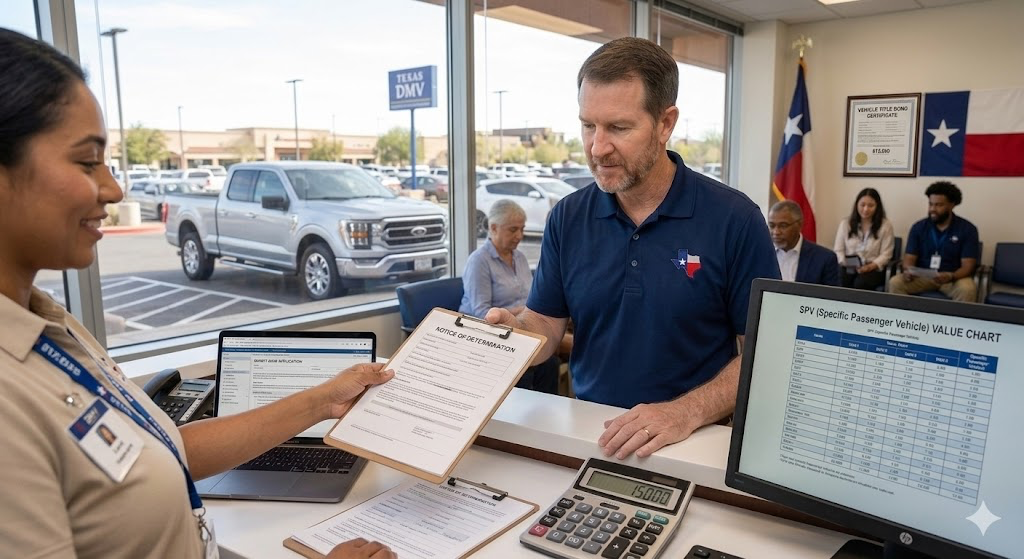
The Notice of Determination letter from the Texas Department of Motor Vehicles arrived in your mailbox three days after you submitted your bonded title application at the regional service center stating your fourteen-thousand-dollar vehicle requires a twenty-one-thousand-dollar surety bond before the state will issue a certificate of title, but the notice provides absolutely no explanation about how much this bond will actually cost you in premiums versus the face amount printed on the document, whether your fair credit score qualifies you for standard rates or forces you into expensive high-risk programs, how quickly you must purchase this bond before the notice expires requiring you to restart the entire application process from scratch, or why Texas demands bonds valued at one-and-a-half times vehicle values when you simply need legal proof of ownership to register the truck you legally purchased with cash from a private seller who lost the title before completing the transfer. Understanding the actual out-of-pocket cost of Texas bonded title bonds ranging from one hundred dollars for modest vehicles to thousands of dollars for luxury cars, how surety companies calculate premiums based on bond amounts and credit profiles, which timeline deadlines you must meet throughout the multi-step bonded title process, and what happens if you miss filing windows or fail to obtain required bonds could mean the difference between quickly securing legal ownership of your vehicle or watching registration deadlines pass while struggling to comprehend bonding costs that seem intentionally confusing rather than transparently explained to Texas motorists seeking legitimate title solutions.
A Texas bonded title is a certificate of ownership issued by the Texas Department of Motor Vehicles when original vehicle titles are missing, damaged, incorrectly assigned, or otherwise unavailable for transfer, requiring vehicle owners to purchase surety bonds valued at one-and-a-half times vehicle values as financial guarantees protecting previous owners, lien holders, and future buyers from fraudulent ownership claims during three-year bonded title periods before certificates convert to standard clean titles if no valid claims arise challenging ownership. The bond itself creates a three-party agreement among the vehicle owner seeking the bonded title, the Texas DMV as the government entity requiring the bond, and the surety company guaranteeing the owner’s legitimate claim to ownership while protecting others from financial losses if ownership disputes reveal the bonded title was fraudulently obtained through stolen vehicles, forged documents, or invalid transfers concealing true ownership.
What a Texas Bonded Title Actually Costs
The actual cost of a Texas bonded title bond represents a small percentage of the total bond amount required rather than the full face value printed on your Notice of Determination, with most vehicle owners paying between one hundred dollars and several hundred dollars in premiums for bonds protecting their ownership claims for three-year periods.
Premium costs follow tiered pricing structures based on total bond amounts required, with bonds up to six thousand six hundred ninety-nine dollars typically costing a flat one hundred dollar premium regardless of exact amount, bonds from sixty-seven hundred to fifteen thousand dollars costing approximately fifteen dollars per thousand dollars of coverage, and bonds exceeding fifteen thousand dollars requiring custom quotes from surety companies evaluating credit profiles and underwriting factors beyond standardized rate sheets. This pricing structure means a vehicle valued at four thousand dollars requiring a six-thousand-dollar bond costs the same one-hundred-dollar premium as a vehicle valued at forty-five hundred dollars requiring a sixty-seven-hundred-fifty-dollar bond, creating cost savings for owners of modest-value vehicles through flat-rate minimums.
Alternative premium calculations used by different surety companies range from one to five percent of total bond amounts depending on applicant credit scores, with excellent credit applicants above seven hundred typically paying one to two percent while those with poor credit below six hundred face premiums of three to five percent or higher through specialized high-risk programs. A vehicle owner with strong credit requiring a twenty-thousand-dollar bond might pay three hundred to four hundred dollars in premiums, while someone with challenged credit could pay six hundred to one thousand dollars for identical coverage, demonstrating how creditworthiness significantly impacts actual out-of-pocket costs despite identical bond amounts and vehicle values.
Some bonding companies advertise starting rates as low as seventy-nine dollars for bonds under five thousand dollars with no existing liens on vehicles, though most providers settle around the one-hundred-dollar minimum for small bonds and fifteen dollars per thousand for moderate amounts. Premium quotes typically include three-year terms matching bonded title active periods, meaning the quoted cost covers the entire duration without annual renewal fees or additional charges beyond the initial premium payment securing the bond.
Understanding Bond Amount Requirements
Texas law requires bonded title bonds equal to one-and-a-half times vehicle values as determined through specific valuation methods prescribed by the Department of Motor Vehicles, creating bond amounts substantially exceeding actual vehicle worth to provide cushion protecting against ownership disputes and fraudulent claims.
The Standard Presumptive Value calculator maintained by TxDMV serves as the primary valuation source, using vehicle identification numbers, make, model, year, and mileage data to determine fair market values matching average retail prices for comparable vehicles in current market conditions. If Standard Presumptive Values are unavailable for specific vehicles due to age, rarity, or other factors preventing automated valuation, the National Auto Dealers Association reference guide provides secondary valuation through industry-standard used vehicle pricing data accounting for condition, equipment, and market demand factors.
When neither Standard Presumptive Value nor NADA pricing exists for unusual vehicles, custom builds, or significantly modified cars, licensed motor vehicle dealers or insurance adjusters conduct manual appraisals using Form VTR-125 documenting vehicle condition, modifications, comparable sales data, and professional opinions of value. These appraisals must be dated and submitted within thirty days to ensure valuations reflect current market conditions rather than outdated assessments failing to account for depreciation or appreciation during prolonged application processes.
Special valuation rules apply to specific vehicle categories, with vehicles twenty-five years old or older receiving automatic four-thousand-dollar minimum values regardless of actual worth when appraisals indicate values below four thousand dollars, preventing extremely low bond amounts on antique vehicles that might appreciate substantially or involve complex ownership histories requiring meaningful financial protections. Trailers follow simplified valuation schedules based solely on length, with trailers under twenty feet valued at four thousand dollars and those twenty feet or longer valued at seven thousand dollars, eliminating appraisal requirements for these simpler vehicle types.
The one-and-a-half multiplier applied to determined values creates the final bond amount, meaning a ten-thousand-dollar vehicle requires a fifteen-thousand-dollar bond, a twenty-thousand-dollar car needs a thirty-thousand-dollar bond, and so forth across all value ranges. This multiplier provides financial cushion ensuring sufficient funds exist to compensate rightful owners if disputes prove bonded titles were improperly issued to individuals lacking legitimate ownership claims.
Why Texas Requires Bonded Titles
Common scenarios triggering bonded title requirements include purchasing vehicles from private sellers who lost original titles before transfers, inheriting vehicles from deceased relatives without proper estate documentation transferring ownership, receiving vehicles as gifts without completed title transfers, buying vehicles at lien sales or auctions without receiving titles from selling entities, relocating to Texas with out-of-state vehicles whose titles were lost during moves, and discovering title errors like incorrect names or missing signatures preventing standard transfer procedures.
Original title loss represents the most frequent bonded title cause, occurring when sellers misplace titles between sale agreements and closing dates, leaving buyers with bills of sale and possession but no legal ownership documentation. Similarly, damaged titles rendered illegible through water damage, fire, excessive wear, or torn signatures create situations where existing titles cannot be processed by county tax offices demanding pristine documents for standard transfers.
Incorrect ownership documentation arises when titles list wrong names due to misspellings, outdated married or maiden names, business name changes, or incomplete transfers where selling dealers or individuals failed to properly assign titles to buyers during sales transactions. These errors prevent straightforward title corrections through standard amendment processes, requiring bonded title procedures establishing current owner identities despite flawed paper trails.
Inherited vehicles often lack proper title transfers when family members pass away leaving cars to heirs without executing wills specifically addressing vehicle ownership, creating gaps in title chains that county tax offices cannot resolve through normal probate procedures. Gifted vehicles face similar challenges when gift givers fail to complete title assignments or recipients never receive promised titles after taking possession of vehicles given informally without formal transfer documentation.
Complete Bonded Title Eligibility Requirements
Texas restricts bonded title eligibility to specific applicants and vehicle conditions designed to prevent fraud while providing legitimate ownership solutions for qualifying situations.
Applicant eligibility requires Texas residency or active military service with duty stations in Texas, excluding non-residents who purchased vehicles in Texas but maintain legal residences elsewhere and lack military connections to the state. This residency requirement ensures Texas maintains regulatory authority over bonded title holders and can enforce ownership obligations throughout three-year bond periods.
Vehicle possession requirements mandate applicants physically possess vehicles at application time and throughout bonded title processes, preventing individuals from obtaining titles for vehicles they do not actually own or control. Possession serves as preliminary ownership evidence supporting bonded title applications even when documentary proof remains incomplete or missing.
Vehicle condition restrictions prohibit bonded titles for junked vehicles, nonrepairable vehicles, stolen vehicles, or those involved in pending litigation challenging ownership or creating legal clouds preventing clear title issuance. Vehicles need not be operational but must include complete frames, bodies, and motors for standard automobiles, or frames and motors for motorcycles, ensuring bonded titles apply to actual vehicles rather than parts collections or salvage components.
Lien restrictions create the most significant eligibility barrier, prohibiting bonded titles when vehicles have recorded liens less than ten years old without original release letters or no-interest statements from lien holders. This restriction protects financial institutions and lien holders from losing security interests through bonded title procedures that might improperly transfer ownership despite existing loans or security agreements. Applicants must obtain lien releases before qualifying for bonded titles, or alternatively pursue court orders establishing ownership free of liens through legal proceedings separate from administrative bonded title processes.
Out-of-state vehicles face additional requirements including Vehicle Identification Number inspections by auto theft investigators using Form VTR-68-A when vehicles have never been titled or registered in Texas, ensuring VIN accuracy and preventing title fraud involving stolen vehicles with altered identification numbers. Certified safety inspection stations conduct these inspections after applicants contact local law enforcement agencies or Motor Vehicle Crime Prevention Authority grantee organizations to schedule appointments with authorized inspectors.
The Step-by-Step Bonded Title Process
Obtaining a Texas bonded title follows a multi-stage process spanning several weeks from initial application through final title receipt at county tax offices.
The process begins with gathering supporting ownership evidence including bills of sale, purchase invoices, canceled checks, prior registration documents, insurance records, or any other documentation suggesting legitimate ownership even when original titles remain unavailable. These documents accompany completed Bonded Title Application forms (VTR-130-SOF) submitted to Texas Department of Motor Vehicles Regional Service Centers serving applicant counties, along with acceptable photo identification and fifteen-dollar administrative fees payable by cash when filing in person or check or money order when mailing applications.
Out-of-state vehicle owners must obtain Law Enforcement Identification Number Inspections before submitting applications, scheduling appointments with auto theft investigators who physically examine vehicles, verify VIN accuracy, check for signs of alteration or theft, and complete Form VTR-68-A documenting inspection results. Local police departments, sheriff offices, or MVCPA grantee organizations provide these inspections, though Texas DMV itself does not conduct VIN verifications requiring applicants to seek services from authorized law enforcement personnel.
Upon application approval after DMV review of submitted documentation, applicants receive Notices of Determination for Bonded Title or Tax Assessor-Collector Hearing (Form VTR-130-ND) stating exact bond amounts required based on vehicle valuations. These notices remain valid for one year from issuance dates, providing twelve-month windows to purchase required bonds before notices expire requiring new applications and valuations if original timelines are missed.
Applicants unable to obtain automated valuations through Standard Presumptive Value or NADA pricing may need Tax Assessor-Collector Hearings where licensed dealers or insurance adjusters appraise vehicles using Form VTR-125, with completed appraisals returned to DMV within thirty days for determination of final bond amounts based on professional value assessments.
How to Get Your Bonded Title Bond
Once you receive your Notice of Determination specifying the required bond amount, contact specialized surety bond providers like Swiftbonds that offer Texas certificate of title bonds with expertise navigating state requirements and competitive premium rates for all credit profiles. Complete the simple online application providing your Notice of Determination information, vehicle details, and personal information, then receive your premium quote typically ranging from one hundred dollars for small bonds to custom rates for larger amounts based on the one-and-a-half times vehicle value calculation. Pay your premium through secure online checkout, and most providers deliver executed bond certificates within twenty-four to forty-eight hours via email for bonds under fifteen thousand dollars, with larger bonds potentially requiring same-day underwriting before issuance. After receiving your bond certificate, physically sign the document as required by Texas law, then proceed to your county tax office within thirty days of bond purchase to file your complete bonded title application before the filing window expires.
Swiftbonds LLC
Voted 2025 Surety Bond Agency of the Year
4901 W. 136th Street
Leawood KS 66224
(913) 214-8344
https://swiftbonds.com/
Critical Timeline Requirements
Texas imposes strict deadlines throughout bonded title processes, with missed timelines forcing applicants to restart entire procedures from initial applications through bond purchases.
The one-year window from Notice of Determination issuance to bond purchase represents the first critical deadline, requiring applicants to secure bonds within twelve months of receiving valuation letters or face expired notices forcing new applications, updated valuations, and fresh determination letters before proceeding. This generous timeline accommodates applicants needing time to save money for premiums, shop among multiple bonding companies for competitive rates, or resolve credit issues improving qualification for standard premium programs.
The thirty-day window from bond purchase to county tax office filing creates the tightest deadline in bonded title processes, requiring swift action after obtaining bonds to complete final filing steps before windows close. Applicants missing thirty-day deadlines face rejected applications despite valid bonds, forcing them to purchase new bonds with fresh thirty-day windows since expired filing periods invalidate original bond certificates under Texas regulations.
Within these thirty-day windows, applicants must visit county tax offices with original Notice of Determination forms, purchased surety bonds with physical signatures, completed Applications for Texas Title and/or Registration (Form 130-U), and additional documents including Law Enforcement Identification Number Inspections for vehicles never titled in Texas, weight certificates for commercial vehicles or trucks, customs declaration forms for imported vehicles, and proof of liability insurance meeting Texas minimum coverage requirements.
The three-year active period begins when county tax offices process complete bonded title applications and issue certificates of title noting bonded status, protecting applicants’ ownership claims while simultaneously creating windows for previous owners or lien holders to file claims challenging ownership if fraud or errors occurred during bonded title processes. After three years without valid claims, bonded titles automatically convert to standard clean titles removing bond notations and eliminating surety company guarantee obligations.
Special Provisions and Exceptions
Beyond standard bonded title procedures, Texas law creates special provisions for unique vehicle categories and circumstances requiring modified processes or documentation.
Salvaged vehicles that have been repaired, rebuilt, reconstructed, or reassembled require Texas Rebuilt Vehicle Statements (Form VTR-6) detailing all work completed, parts replaced, inspection results, and restoration outcomes before bonded title applications can proceed. These statements ensure transparency about vehicle histories and repair quality, protecting future buyers from undisclosed damage or substandard rebuilds concealed through bonded title processes avoiding normal salvage disclosure requirements.
Custom built vehicles and street rods demand Automotive Service Excellence Safety Inspections verifying construction quality, component compatibility, and safety compliance before bonded titles issue. Texas defines street rods as vehicles at least twenty-five years old of model years after nineteen forty-eight, or vehicles manufactured to resemble twenty-five-year-old post-1948 models through altered designs or bodies constructed from non-original materials, creating specialized inspection requirements for these modified or replica vehicles.
The four-thousand-dollar minimum valuation for vehicles twenty-five years or older with appraisals below that threshold prevents unreasonably low bond amounts on antique vehicles that might appreciate substantially over time, cause significant financial harm if ownership disputes arise, or involve complex histories requiring meaningful financial protections despite modest current values. This provision particularly affects original-condition vintage vehicles, project cars awaiting restoration, or classics depreciated through deterioration but potentially valuable after proper refurbishment.
Trailer valuation simplifications based solely on length rather than detailed appraisals streamline bonded title processes for simpler vehicle types unlikely to generate significant ownership disputes, with flat four-thousand-dollar values for trailers under twenty feet and seven-thousand-dollar values for those twenty feet or longer creating predictable bond amounts and premiums without requiring professional appraisals or complex valuation analyses.
Frequently Asked Questions
What happens if I cannot afford the bonded title bond premium?
If bond premiums exceed your budget, consider saving funds over the twelve-month window between Notice of Determination issuance and bond purchase deadline, allowing time to accumulate necessary premium amounts without rushing into high-interest financing or unfavorable payment arrangements. Some bonding companies offer financing options spreading premium costs across multiple payments, though these arrangements typically include interest charges increasing total costs beyond single-payment premiums. Shopping among multiple surety providers helps identify the most competitive rates, as premiums vary based on company underwriting criteria and risk assessments of identical bond amounts.
Can someone else purchase the bond on my behalf?
The person listed as the principal on the bonded title application must be the same person purchasing and signing the surety bond, preventing third parties from obtaining bonds in your name even when offering to pay premiums as gifts or loans. However, others can financially assist with premium payments as long as you personally complete bond applications, sign documents, and submit paperwork to county tax offices establishing yourself as the legal applicant and bonded title recipient.
What if my vehicle is worth more than valuation sources indicate?
When you believe official valuations underestimate actual vehicle worth due to rare options, exceptional condition, valuable modifications, or strong local markets, you can request professional appraisals from licensed motor vehicle dealers or insurance adjusters documenting higher values through Form VTR-125. These appraisals must include specific justifications for increased valuations, comparable sales data supporting higher prices, detailed condition assessments, and professional opinions explaining why your vehicle exceeds standard pricing guides. The DMV reviews appraisals and determines whether to accept higher valuations or maintain automated pricing, with decisions based on appraisal quality and supporting documentation strength.
Do I need to renew my bonded title bond after three years?
No, bonded title bonds remain active for three years without renewal requirements, automatically expiring when bonded titles convert to standard clean titles if no valid ownership claims arose during bond periods. You pay one-time premiums covering entire three-year terms rather than annual premiums requiring ongoing payments throughout bond durations. Once bonded titles become clean titles after three-year periods, surety company obligations end and bonds close without further action or payments from vehicle owners.
Can I sell my vehicle during the three-year bonded title period?
Yes, you can legally sell vehicles with bonded titles at any point during three-year active periods, though you must disclose bonded status to buyers and explain that titles include surety bonds protecting previous owners from fraudulent claims. Bonded status often reduces vehicle values as buyers perceive increased risks purchasing cars with ownership questions serious enough to require bonds, potentially limiting buyer pools to those comfortable with bonded title implications. Bonds remain active for full three years regardless of ownership transfers, meaning buyers assume risks of previous owner claims even after purchasing vehicles from bonded title holders.
What if someone files a claim against my bonded title bond?
When previous owners, lien holders, or other parties file claims alleging your bonded title was fraudulently obtained or improperly issued despite their superior ownership rights, surety companies investigate claims by reviewing documentation, interviewing involved parties, examining vehicle histories, and determining claim validity under bond terms and Texas law. If investigations conclude claims are valid, sureties pay claimants up to full bond amounts compensating them for losses caused by improper bonded titles, but then immediately demand you reimburse them for all claim payments plus investigation costs and legal fees through indemnity agreements you signed when obtaining bonds. This reimbursement obligation creates potentially substantial personal liability if ownership disputes prove you lacked legitimate claims to vehicles when bonded titles were issued.
How does bad credit affect my bonded title bond cost?
Poor credit scores typically increase bonded title bond premiums by fifty to two hundred percent compared to rates charged applicants with excellent credit, with exact impacts varying among surety companies using different underwriting criteria and risk assessment models. Some providers advertise acceptance of all credit types, suggesting they write bonds for challenged credit applicants denied by standard markets, though these specialized programs charge premium surcharges compensating for increased default risks. Shopping among multiple bonding companies helps identify providers offering the most favorable rates for your specific credit profile, as some sureties specialize in subprime markets while others focus on prime applicants.
Conclusion
Texas bonded title bonds cost significantly less than face amounts printed on Notices of Determination, with most vehicle owners paying one hundred to several hundred dollars in premiums for bonds valued at thousands of dollars protecting ownership claims during three-year periods before bonded titles convert to clean certificates. The tiered pricing structure charging flat one-hundred-dollar minimums for small bonds and approximately fifteen dollars per thousand for moderate amounts creates predictable costs for most applicants, while credit scores and surety company selection influence actual premiums paid for identical bond amounts.
Understanding that bond amounts equal one-and-a-half times vehicle values determined through Standard Presumptive Values, NADA pricing, or professional appraisals helps applicants anticipate required bond sizes and corresponding premium costs before submitting applications to Texas DMV. The multi-step process from initial application through Notice of Determination receipt, bond purchase, and final county tax office filing requires attention to strict deadlines including one-year windows for bond purchases and thirty-day limits for filing completed applications after obtaining bonds.
Special provisions for vehicles twenty-five years or older with four-thousand-dollar minimum values, trailer valuations based solely on length, and lien restrictions preventing bonds when recorded liens under ten years exist without releases create additional complexity beyond standard bonded title procedures. Eligibility requirements limiting bonded titles to Texas residents or military personnel stationed in Texas with vehicles in their possession that are not junked, nonrepairable, or involved in litigation ensure the process serves legitimate ownership needs rather than facilitating fraud or improper title transfers.
The relatively modest premium costs ranging from seventy-nine to several hundred dollars for most vehicle bonded titles make the process financially accessible to owners lacking original titles, damaged certificates, or incorrect documentation preventing standard transfers. Combined with twelve-month windows allowing time to save premium funds and shop for competitive rates, bonded title procedures provide practical solutions for establishing legal ownership when conventional title processes fail due to missing documents or flawed paper trails.
Five Lesser-Known Facts About Texas Bonded Titles
Texas pioneered the modern bonded title system in the nineteen-seventies when rising used vehicle sales between private parties created increasing numbers of title problems as sellers lost documents, moved before completing transfers, or died leaving vehicles without clear ownership chains, prompting the legislature to establish surety bond requirements as alternatives to expensive court proceedings where judges issued ownership decrees after adversarial hearings requiring attorneys and formal litigation that cost far more than bonded title processes despite accomplishing identical ownership establishment goals.
The three-year bonded title active period matches Texas statutes of limitations for most civil fraud claims, ensuring sufficient time for legitimate previous owners to discover improper title transfers and file claims seeking compensation through surety bonds while eventually converting bonded titles to clean certificates after reasonable investigation periods expire without valid challenges arising from parties who might have superior ownership rights based on theft, forgery, or other wrongdoing by bonded title applicants.
Texas DMV rejects approximately fifteen percent of initial bonded title applications for deficient documentation, incomplete forms, ineligible vehicles with active liens under ten years, or applicants lacking required Texas residency or military status, forcing rejected applicants to cure deficiencies and resubmit applications before receiving Notices of Determination authorizing bond purchases, with common rejection reasons including missing VIN inspections on out-of-state vehicles, unsigned application forms, or failure to provide lien release letters when vehicle records show recent financing.
The one-hundred-dollar flat-rate premium minimum charged by most bonding companies regardless of small bond amounts ranging from fifteen hundred to sixty-six hundred ninety-nine dollars creates situations where actual premium percentages vary from one-point-five percent to six-point-seven percent depending on exact bond amounts, with owners of very low-value vehicles paying proportionally higher percentages than those with vehicles at the upper end of flat-rate thresholds approaching the sixty-seven-hundred-dollar break point where per-thousand pricing begins.
Some Texas counties process over one thousand bonded title applications annually while others receive fewer than twenty, creating dramatic regional variations in county tax assessor experience with bonded title procedures, familiarity with required documentation, and processing efficiency, with urban counties near major cities maintaining dedicated bonded title specialists while rural counties assign bonded title duties to general clerks handling all title types without specialized training in the unique requirements and timelines governing bonded certificates versus standard title transfers.