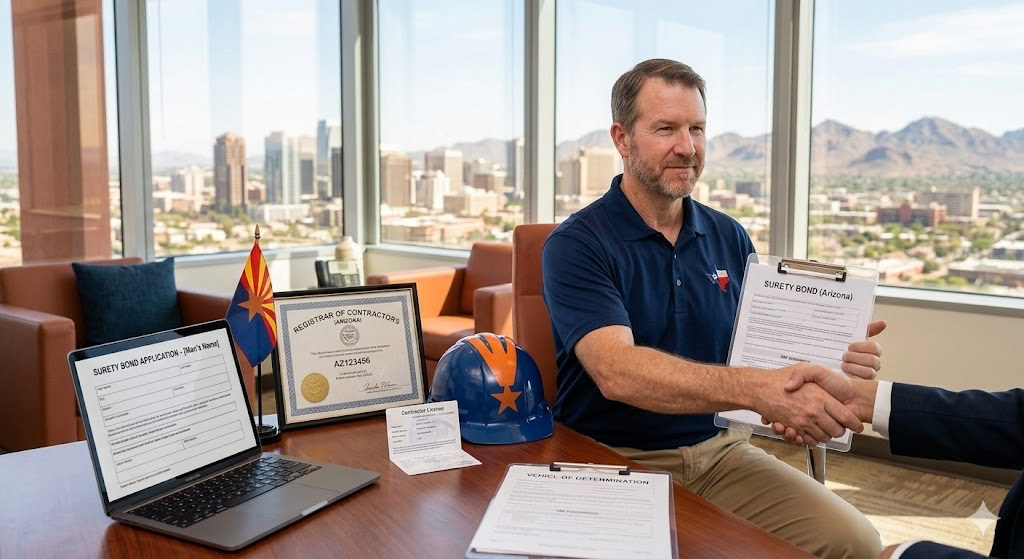
The general contractor license application you submitted to the Arizona Registrar of Contractors three weeks ago finally received approval notification this morning instructing you to post a twenty-five-thousand-dollar surety bond within thirty days to finalize your license, but the approval letter provides no explanation about what surety bonds actually guarantee, which insurance companies issue these financial instruments, whether your modest credit score will prevent bond approval despite your ten years of construction experience, or why Arizona requires contractors to purchase bonds protecting customers rather than simply purchasing general liability insurance policies already covering your business operations and employee activities. Understanding what Arizona surety bonds accomplish across licensing, construction contracting, court proceedings, and specialized business activities, how the three-party surety structure creates reimbursement obligations fundamentally different from traditional insurance products, and which specific bond amounts Arizona statutes require for your particular business classification could mean the difference between launching your licensed business within weeks or watching opportunities vanish while struggling to comprehend unfamiliar bonding requirements that seem designed to confuse rather than protect legitimate business operators seeking compliance with state regulations.
An Arizona surety bond is a legally binding three-party financial agreement guaranteeing that businesses or individuals will comply with applicable Arizona laws, administrative rules, and contractual obligations as required by government agencies, courts, municipalities, or project owners demanding bonds before issuing licenses, awarding contracts, or approving permits essential to business operations throughout the state. These bonds function differently from insurance policies by protecting third parties rather than bond purchasers, creating situations where you pay premiums for coverage that exclusively benefits others while exposing you to complete reimbursement liability when claims arise from your failures to meet bonded obligations. The Arizona surety bond market encompasses over fifty distinct bond types required across construction, transportation, finance, healthcare, legal, and countless other industries where state or local regulations mandate financial guarantees protecting consumers, taxpayers, and business partners from losses caused by license holders who violate laws, breach contracts, or commit fraud.
Understanding the Three-Party Surety Bond Structure
Every Arizona surety bond creates triangular relationships among three distinct parties with different roles, rights, obligations, and financial exposures under bonding agreements that fundamentally differ from two-party insurance contracts familiar to most business owners.
The principal represents the business or individual required to obtain the Arizona surety bond, assuming complete financial responsibility for all obligations guaranteed under the bond including compliance with licensing laws, faithful contract performance, honest business practices, timely payment of taxes, or whatever specific requirements the obligee establishes as bond conditions. You as the principal pay premiums to surety companies in exchange for bonds enabling license applications, contract bids, or court proceedings, but unlike insurance where premiums purchase protection for yourself, surety bond premiums purchase guarantees protecting others from your potential failures to meet legal or contractual obligations.
The obligee is the government agency, court, municipality, or private party requiring the Arizona surety bond as a condition of issuing licenses, awarding contracts, or approving legal proceedings, benefiting from financial protections when principals fail to meet bonded obligations through business closures, contract defaults, legal violations, or fraudulent activities. Common Arizona obligees include the Registrar of Contractors requiring contractor license bonds, the Department of Transportation Motor Vehicle Division requiring auto dealer bonds, county courts requiring probate bonds, municipalities requiring permit bonds, and private project owners requiring construction performance bonds.
The surety company issues bonds guaranteeing principals’ compliance with bond conditions and obligees’ financial protections when principals fail to meet bonded obligations, but unlike insurers who expect to absorb claim costs as part of business models funded through premium pools, sureties pursue aggressive reimbursement from principals for every dollar paid on claims plus investigation costs, legal fees, interest charges, and administrative expenses through indemnity agreements creating legally enforceable debt obligations. Arizona requires sureties to hold certificates of authority to transact surety business in the state issued by the Director of the Department of Insurance and Financial Institutions, prohibiting individual sureties or unauthorized companies from issuing bonds regardless of financial strength or collateral offered.
When you default on bonded obligations by violating licensing laws, abandoning construction contracts, failing to pay subcontractors, committing fraud, or otherwise breaching bond conditions, injured parties file claims against your bond seeking compensation for losses suffered due to your failures. Sureties investigate claims by reviewing documentation, interviewing principals and claimants, examining business records, and determining claim validity based on bond language and Arizona law. If sureties conclude claims are valid, they pay claimants up to full bond amounts compensating them for damages, but then immediately turn to you demanding complete reimbursement for claim amounts plus all costs incurred during investigation and payment processes. This reimbursement obligation creates potentially devastating financial consequences including lawsuits, judgments, liens against business and personal assets, garnishments, collection actions, and potentially bankruptcy if you cannot promptly repay sureties who compensated injured parties on your behalf under bond guarantee terms you accepted when obtaining bonds.
Arizona Contractor License Bond Requirements and Amounts
Arizona Revised Statutes Section 32-1152 establishes detailed contractor license bond requirements varying dramatically based on license classifications and anticipated annual construction volumes, creating one of the most complex contractor bonding systems in the United States.
General commercial building contractors and their subclassifications must furnish surety bonds or cash deposits in amounts determined by estimated annual construction volumes. If your anticipated work volume reaches ten million dollars or more annually, you must post bonds between fifty thousand and one hundred thousand dollars. Work volumes between five million and ten million dollars require bonds from thirty-five thousand to seventy-five thousand dollars. Volumes from one million to five million dollars demand bonds ranging from fifteen thousand to fifty thousand dollars, while volumes between five hundred thousand and one million dollars need bonds from ten thousand to twenty-five thousand dollars. Smaller operations with volumes from one hundred fifty thousand to five hundred thousand dollars post bonds between five thousand and fifteen thousand dollars, and contractors anticipating less than one hundred fifty thousand dollars in annual work must post five-thousand-dollar bonds.
Specialty commercial contractors follow different schedules with generally lower bond amounts reflecting their narrower scopes compared to general contractors. Those performing ten million dollars or more in specialty work annually post bonds from thirty-seven thousand five hundred to fifty thousand dollars. Volumes from five million to ten million dollars require bonds between seventeen thousand five hundred and thirty-seven thousand five hundred dollars. Work from one million to five million dollars demands bonds ranging from seven thousand five hundred to twenty-five thousand dollars, while volumes between five hundred thousand and one million dollars need bonds from five thousand to seventeen thousand five hundred dollars. Smaller specialty contractors performing one hundred fifty thousand to five hundred thousand dollars annually post bonds from twenty-five hundred to seventy-five hundred dollars, and those below one hundred fifty thousand dollars must post twenty-five-hundred-dollar bonds.
General residential contractors and their subclassifications furnish bonds between five thousand and fifteen thousand dollars regardless of work volume, while specialty residential contractors post bonds from one thousand to seventy-five hundred dollars. Dual licensed contractors holding both commercial and residential classifications must combine the bond amounts required for each classification based on anticipated volumes in both categories, creating potentially substantial bonding requirements for contractors operating across residential and commercial markets.
Beyond basic license bonds, Arizona imposes additional consumer protection requirements on dual licensed contractors and residential contractors who must either furnish additional two-hundred-thousand-dollar surety bonds or cash deposits solely for actual damages suffered by residential claimants, or alternatively participate in the Residential Contractors’ Recovery Fund by paying assessments prescribed by statute. This consumer protection layer provides enhanced financial recourse for homeowners damaged by residential contractors beyond the relatively modest license bond amounts that might prove insufficient to compensate victims of substantial contractor fraud or incompetence.
Some contractors face separate Transaction Privilege Tax bond requirements when registering with the Arizona Department of Revenue, ensuring proper collection and payment of state sales taxes on construction services. These TPT bonds differ from Registrar of Contractors license bonds, creating dual bonding obligations for contractors in specific tax situations determined by the Department of Revenue based on business activities and tax compliance histories.
Common Arizona License and Permit Bonds
Arizona requires dozens of license and permit bonds across industries beyond construction, creating widespread bonding obligations for businesses operating throughout the state.
Motor vehicle dealer bonds protect consumers from dealer fraud, title problems, odometer tampering, or failure to pay off liens when dealers go out of business after selling vehicles but before completing title transfers. Arizona dealers must post one-hundred-thousand-dollar bonds with the Department of Transportation Motor Vehicle Division before receiving dealer licenses, with bonds remaining active throughout dealer operations. When dealers sell vehicles with rolled-back odometers creating artificially low mileage representations, fail to deliver promised titles, or close businesses without paying off vehicle liens creating title complications for buyers, damaged consumers file claims against dealer bonds seeking compensation for losses suffered through dealer misconduct.
Freight broker bonds required by the Federal Motor Carrier Safety Administration demand seventy-five-thousand-dollar bonds from brokers arranging transportation of property by motor carriers, protecting shippers and carriers from broker failures to pay for services rendered. Although federally mandated, Arizona freight brokers must post these bonds to operate legally within and from the state.
Mortgage broker and banker bonds protect consumers from mortgage professional fraud, improper loan handling, fee diversion, or regulatory violations. Arizona mortgage brokers working with institutional investors must post ten-thousand-dollar bonds, while those also working with non-institutional investors need fifteen-thousand-dollar bonds reflecting increased consumer protection concerns when dealing with individual rather than institutional lenders.
Collection agency bonds guard debtors from illegal collection practices, harassment, privacy violations, or improper handling of collected funds. Arizona collection agencies must post bonds ranging from ten thousand to thirty-five thousand dollars depending on annual collection volumes, ensuring agencies maintain professional standards when pursuing debts on behalf of creditors.
Notary public bonds protect the public from notary errors, fraud, or improper authentication of documents. Arizona notaries must post five-thousand-dollar bonds for four-year terms covering their commission periods, creating financial recourse when notaries improperly notarize documents, fail to verify signer identities, or commit notarization fraud.
Arizona Contract Bonds for Construction Projects
Arizona Revised Statutes Section 34-222 mandates performance and payment bonds for public construction contracts involving state, county, city, town, or district projects including public buildings, public works, improvements, irrigation systems, power facilities, drainage systems, flood control, and tax-levying improvement districts.
Performance bonds in amounts equal to full contract values guarantee contractors will faithfully perform contracts according to plans, specifications, and conditions, protecting public bodies awarding contracts from contractor defaults, abandonments, or substandard work requiring costly remediation. These bonds solely benefit public entities rather than contractors, creating one-way protections ensuring taxpayer-funded projects complete successfully even when contractors fail financially or operationally.
Payment bonds also in amounts equal to full contract values protect claimants supplying labor or materials to contractors or subcontractors, ensuring workers and suppliers receive payment even when general contractors become insolvent, abscond with project funds, or refuse payment for delivered services or materials. Arizona law requires payment bonds because mechanic’s liens cannot be filed against public property, eliminating traditional collection remedies available to unpaid subcontractors and suppliers on private projects.
Both bond types must include provisions allowing prevailing parties in lawsuits on bonds to recover reasonable attorney fees fixed by judges, creating incentive for sureties to settle valid claims promptly rather than forcing claimants into expensive litigation to collect damages clearly owed under bond terms.
Arizona prohibits bid invitations or contracting officials from requiring bonds be furnished by particular surety companies or through particular agents or brokers, preventing corruption where public officials might steer business to preferred insurance providers in exchange for kickbacks or political contributions. This anti-steering provision ensures fair competition among sureties and protects contractors from being forced to use expensive or inadequate bonding sources favored by corrupt officials.
Arizona Court and Probate Bonds
Arizona courts require various bonds protecting estates, minors, incapacitated persons, and parties to legal proceedings from losses caused by fiduciaries, administrators, or litigants who mishandle funds, breach duties, or improperly pursue legal remedies.
Administrator bonds protect estates when courts appoint administrators to settle deceased persons’ affairs, ensuring administrators faithfully perform duties, properly account for estate assets, pay valid debts and taxes, and distribute remaining assets to rightful heirs according to law or will provisions. Bond amounts typically equal estate values plus anticipated income, protecting beneficiaries from administrator theft, mismanagement, or self-dealing.
Conservator and guardian bonds protect incapacitated persons or minors when courts appoint fiduciaries to manage their financial affairs or personal care, guaranteeing conservators and guardians will handle funds properly, make prudent investment decisions, maintain accurate records, and prioritize protected persons’ wellbeing over personal interests. These bonds remain active throughout guardianships or conservatorships, releasing only when courts determine fiduciary duties have ended and final accountings prove proper asset management.
Appeal bonds secure judgments during appeal processes, ensuring successful plaintiffs collect awarded amounts if appeals fail while preventing defendants from avoiding payment through prolonged appellate proceedings designed solely to delay satisfaction of valid judgments.
Arizona Surety Bond Costs and Premium Factors
Arizona surety bond premiums typically range from one to five percent of bond amounts annually, with specific rates determined by multiple factors that sureties evaluate during underwriting processes assessing likelihood of claims arising during bond terms.
Credit scores dramatically impact premium rates, with applicants possessing strong scores above seven hundred typically paying rates between one and three percent of bond amounts while those with poor credit below six hundred face rates between five and fifteen percent or outright declinations from standard markets. A contractor requiring a twenty-five-thousand-dollar license bond with excellent credit might pay two hundred fifty to seven hundred fifty dollars annually, while someone with poor credit could pay twelve hundred fifty to thirty-seven hundred fifty dollars for identical coverage.
Bond amounts influence total premiums paid, with larger bonds generating proportionally higher costs even at identical percentage rates. A one-hundred-thousand-dollar auto dealer bond at three percent costs three thousand dollars annually, while a five-thousand-dollar notary bond at the same rate costs just one hundred fifty dollars.
Professional experience and business tenure affect rates as established businesses with long operational histories and clean compliance records qualify for better pricing than startups or businesses with regulatory violations, bankruptcies, or past bond claims demonstrating higher risks.
Financial strength shown through balance sheets, income statements, cash flow, and working capital analysis impacts contractor bond underwriting for larger amounts, with financially solid contractors receiving favorable rates while those with negative working capital, excessive debt, or inconsistent profitability face higher rates or requirements for collateral securing surety positions.
Business type influences pricing as some industries generate higher claim frequencies than others based on regulatory complexity, customer dispute rates, or operational risk levels. Construction contractors typically pay higher rates than notaries due to greater claim exposures in construction compared to document authentication.
How to Get Your Arizona Surety Bond
Obtaining your Arizona surety bond starts by identifying the specific bond type and amount required by the obligee mandating the bond, whether that’s the Registrar of Contractors, Department of Transportation, local court, municipality, or other regulating authority. Contact specialized surety bond agencies like Swiftbonds that maintain relationships with multiple surety companies authorized to write bonds in Arizona, providing access to competitive markets and expert guidance navigating state-specific bonding requirements unique to Arizona’s regulatory environment. The application process involves submitting documentation including business and personal financial information, credit authorization forms, professional background details, and specifics about the bond requirement and obligee. Sureties underwrite applications by evaluating creditworthiness, financial strength, industry experience, and claim risk, then provide premium quotes typically ranging from one to five percent of bond amounts depending on overall risk assessments. After accepting quotes and paying premiums, you receive official bond forms that must be filed with obligees according to their specific procedures and deadlines to satisfy bonding requirements and complete licensing, contracting, or legal processes.
Swiftbonds LLC
2025 Surety Bond Agency of the Year
4901 W. 136th Street
Leawood KS 66224
(913) 214-8344
https://swiftbonds.com/
Arizona Fidelity Bonds
While most Arizona surety bonds are legally mandated, some businesses voluntarily obtain fidelity bonds protecting customers from employee theft, dishonesty, or fraud even when regulations don’t require such coverage.
Business service bonds protect clients from theft, larceny, or fraud committed by business owners or employees during service delivery, creating competitive advantages when businesses can demonstrate bonded status assuring customers of financial recourse if service providers steal property, divert funds, or commit fraud while performing contracted work in customer homes or businesses.
Janitorial service bonds protect building owners and occupants from employee theft during cleaning operations when janitorial workers access facilities after hours with keys, alarm codes, and freedom to move throughout premises while occupants are absent. Bonded janitorial companies demonstrate commitment to hiring trustworthy employees and accepting financial responsibility if workers steal valuables, embezzle funds, or commit fraud while performing cleaning services.
ERISA bonds required for employee benefit plan administrators protect retirement funds, health plans, and other employee benefit assets from theft or misappropriation by plan fiduciaries, trustees, or administrators who might embezzle contributions, make fraudulent investments, or divert plan assets for personal gain.
Frequently Asked Questions
How long does it take to get an Arizona surety bond?
Simple license and permit bonds for applicants with good credit typically process within twenty-four to forty-eight hours from application submission to bond delivery, while larger contractor bonds or applications involving credit challenges may require three to seven business days for underwriting reviews, financial analysis, and surety approval processes. Some bond providers offer instant online approval for small bonds under ten thousand dollars when applicants have excellent credit scores and straightforward bond requirements. Complex contract bonds for large construction projects may take one to two weeks when sureties conduct detailed financial reviews, examine business operations, interview principals, and evaluate project risks before committing to guarantee contract performance.
Can I get an Arizona surety bond with bad credit?
Yes, applicants with poor credit scores, bankruptcies, tax liens, or past bond claims can still obtain Arizona surety bonds through specialized high-risk programs willing to write coverage when standard markets decline applications, though premiums will be substantially higher than rates available to strong credit applicants. High-risk programs may charge five to fifteen percent of bond amounts instead of the one to three percent that excellent credit applicants pay, and may require collateral such as cash deposits, letters of credit, or pledges of business or personal assets securing surety positions if claims arise. Some sureties impose additional conditions like mandatory financial reviews, progress reporting, or third-party oversight when bonding poor credit applicants in high-risk industries like construction.
What happens if someone files a claim against my Arizona surety bond?
When claimants file claims against your bond alleging you violated bonded obligations, sureties investigate by reviewing claim documentation, interviewing you and claimants, examining business records, consulting attorneys about legal issues, and determining claim validity based on bond language and applicable law. If sureties conclude claims are valid, they pay claimants up to full bond amounts compensating them for damages suffered through your violations. However, you must immediately reimburse sureties for all claim payments plus investigation costs, legal fees, interest, and administrative expenses through indemnity agreements you signed when obtaining bonds, creating potentially substantial debts enforceable through lawsuits, judgments, liens, garnishments, and collection actions if you cannot promptly repay amounts owed.
Do Arizona surety bonds renew automatically?
Most Arizona license and permit bonds require annual or biennial renewals to remain active throughout license periods, with sureties sending renewal notices before expiration dates allowing you to pay renewal premiums maintaining continuous coverage. Contractor license bonds typically renew biennially coinciding with two-year license terms, while notary bonds last four years matching commission periods. Bond renewals aren’t automatic because sureties reassess risk annually based on updated credit information, claims history, financial condition changes, and regulatory compliance records, potentially adjusting premium rates or declining renewal if your risk profile deteriorated significantly since initial bond issuance. Failing to renew bonds before expiration dates causes license suspensions, contract disqualifications, or legal proceeding delays until you obtain replacement coverage.
How do I cancel my Arizona surety bond?
Bond cancellations require written requests to sureties requesting termination of coverage, though sureties typically cannot cancel immediately because Arizona regulations or bond terms often mandate thirty to ninety day advance notice periods before cancellations become effective, protecting obligees from sudden coverage gaps when you might still hold active licenses or ongoing contractual obligations. After receiving cancellation requests, sureties notify obligees and you of pending cancellations effective after required notice periods, giving you time to obtain replacement coverage if you plan to continue licensed operations or fulfill remaining obligations. For contractor license bonds, cancellations trigger automatic license suspensions thirty days after notification unless you file replacement bonds before suspensions occur, while contract bonds often cannot be canceled until project completion and final acceptance regardless of your wishes to terminate coverage.
What is the difference between Arizona contractor license bonds and contract performance bonds?
Contractor license bonds are required by the Arizona Registrar of Contractors as conditions of issuing or renewing contractor licenses, guaranteeing contractors will comply with state licensing laws, pay employees and subcontractors, satisfy tax obligations, and fulfill basic legal requirements throughout license periods regardless of which specific projects they perform. These bonds protect the state and general public from systemic contractor violations affecting multiple customers over time. Contract performance bonds are project-specific guarantees required by individual project owners or public agencies for particular construction contracts, ensuring contractors will complete specific projects according to plans and specifications, meet quality standards, finish on schedule, and fulfill all contractual obligations unique to individual projects. License bonds cover ongoing business operations while contract bonds cover individual project performance.
Conclusion
Arizona surety bonds create legally binding three-party financial agreements guaranteeing businesses and individuals will comply with state laws, contractual obligations, and regulatory requirements across dozens of industries where licensing authorities, courts, municipalities, or project owners demand bonds protecting third parties from losses caused by principals who violate bonded obligations. Understanding the fundamental distinction between surety bonds protecting others and insurance protecting yourself helps business owners appreciate why bond premiums purchase guarantees benefiting customers, taxpayers, or business partners while creating complete reimbursement liability when claims arise from your failures to meet legal or contractual standards.
The complex Arizona contractor license bond system with amounts varying from one thousand to one hundred thousand dollars based on license classifications and anticipated work volumes demonstrates the state’s recognition that different contractor categories present varying risk levels requiring proportionate financial guarantees protecting consumers from incompetent or fraudulent construction businesses. The additional two-hundred-thousand-dollar consumer protection bond or Recovery Fund participation requirement for residential contractors reflects legislative concern about homeowners’ vulnerability to contractor fraud compared to commercial property owners with greater sophistication and resources to vet contractors before awarding projects.
Arizona’s prohibition against individual sureties or unauthorized bonding companies issuing bonds ensures only financially stable surety companies with proper regulatory oversight can guarantee principal performance, protecting obligees and claimants from discovering their bonds were issued by insolvent or unreliable sureties unable to pay valid claims when principals default. The statutory anti-steering provisions preventing public officials from requiring bonds through particular companies or agents protects contractors from corruption while promoting competitive bonding markets benefiting both contractors seeking affordable coverage and taxpayers funding public projects where bond costs ultimately impact bid amounts.
Premium rates typically ranging from one to five percent of bond amounts create relatively modest annual costs for most Arizona bonds compared to potential claim exposures, making surety bonds affordable risk management tools protecting businesses from catastrophic liability while simultaneously protecting consumers, governments, and business partners from losses caused by business failures, fraud, or incompetence among licensed professionals and contractors.
Five Hidden Realities About Arizona Surety Bonds
The Arizona Residential Contractors’ Recovery Fund has paid over thirty million dollars in claims to homeowners damaged by licensed residential contractors since its creation in the nineteen-eighties, providing enhanced consumer protection beyond basic license bond amounts that often prove insufficient to compensate victims of substantial contractor fraud, demonstrating the fund’s critical role protecting Arizona homeowners from construction disasters that would otherwise leave them with uncompensated losses and damaged properties requiring costly remediation at their own expense.
Arizona allows contractors to post cash deposits with the state treasurer as alternatives to purchasing surety bonds, with the state investing deposited funds and crediting earnings to the general fund rather than returning investment gains to contractors who posted cash, creating situations where contractors effectively provide interest-free loans to Arizona while simultaneously tying up working capital that could fund business operations or expansion if deployed in surety bonds requiring much smaller premium payments instead of full cash deposits often reaching tens of thousands of dollars.
The Arizona Registrar of Contractors maintains authority to require bonds up to ten times normal amounts as disciplinary measures when contractors or qualifying parties have suspension or revocation histories, participated in violations by companies they affiliated with as officers or partners, or demonstrated patterns of regulatory noncompliance suggesting extraordinary supervision needs, creating potentially devastating bonding requirements reaching into millions of dollars that effectively end contracting careers for individuals with serious disciplinary histories who cannot possibly obtain such massive bonds from sureties unwilling to assume such extreme risks.
Arizona’s public construction bond law dating to the mid-twentieth century includes unique anti-steering language prohibiting bid invitations from requiring bonds through particular surety companies or agents, addressing historical corruption problems where public officials awarded construction contracts based partly on contractors’ willingness to purchase bonds from politically connected insurance agencies providing kickbacks or campaign contributions to officials steering lucrative bonding business toward favored providers regardless of whether those providers offered competitive rates or quality service.
The Arizona Department of Insurance and Financial Institutions maintains strict standards for surety companies authorized to issue bonds in the state, requiring sureties to maintain specific financial strength ratings, capital reserves, and regulatory compliance records before receiving certificates of authority, with periodic reviews ensuring only financially stable sureties capable of paying claims remain authorized to write Arizona bonds protecting consumers and governments from discovering too late that their bonds were issued by insolvent companies unable to honor guarantee commitments.