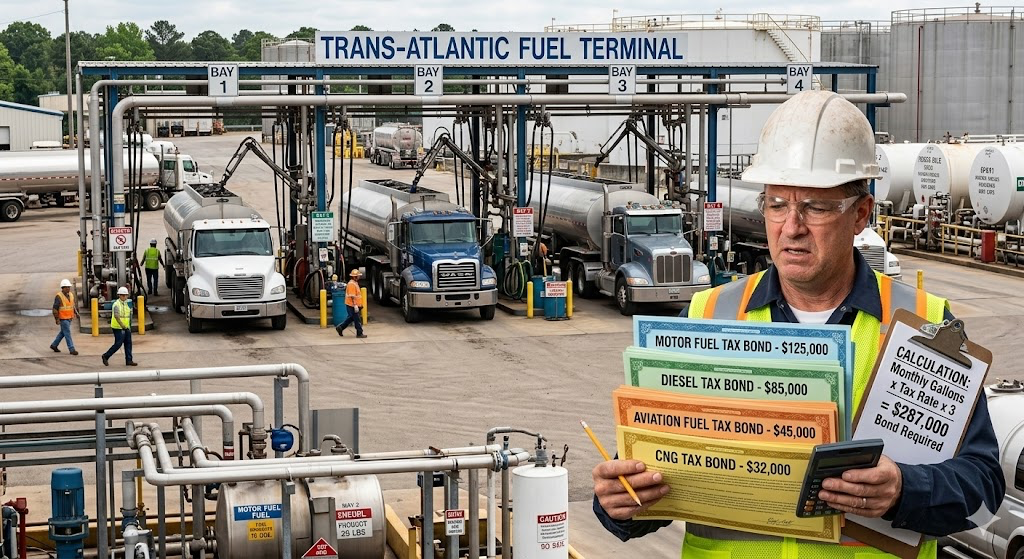
Your fuel distribution company just landed a contract to supply diesel to a regional trucking fleet, tripling your monthly gallons from fifty thousand to one hundred fifty thousand. You call your accountant celebrating the revenue increase, and she responds with news that kills your excitement: “Your current ten thousand dollar fuel tax bond won’t cover this volume. Texas calculates bonds at twice your monthly tax liability—you’ll need to increase your bond to sixty thousand dollars immediately, and it’s non-cancellable meaning the surety stays liable even if you stop paying premiums.” Your celebration just became a scramble to secure a bond six times larger than your current coverage, with underwriting requiring three years of financial statements you’re not sure will qualify you.
What Is a Fuel Tax Bond
A fuel tax bond is a commercial surety bond that fuel wholesalers, distributors, retailers, suppliers, importers, exporters, blenders, and transporters must obtain to guarantee payment of state and federal fuel excise taxes. This financial guarantee ensures that businesses handling gasoline, diesel, aviation fuel, compressed natural gas, liquified natural gas, alternative fuels, and other taxable petroleum products will remit collected taxes to government authorities on time and in full. Unlike insurance policies that protect your business from accidents and operational risks, fuel tax bonds exclusively protect government tax agencies and taxpayers from revenue losses caused by your failure to pay taxes, submit accurate tax returns, or comply with fuel tax reporting regulations.
The bond creates a legally binding three-party agreement between you as the principal purchasing the bond, the state revenue department or tax commission as the obligee requiring the bond, and the surety company that underwrites and issues the bond. When you purchase a one hundred thousand dollar fuel tax bond, you’re not buying one hundred thousand dollars of protection for your fuel business. You’re providing the state government with a one hundred thousand dollar guarantee that tax revenue remains protected if you fail to remit collected taxes, manipulate volume reports to reduce tax liability, or go bankrupt while owing substantial back taxes.
State governments require fuel tax bonds because fuel excise taxes represent major revenue sources funding highway construction, road maintenance, bridge repairs, and transportation infrastructure programs that entire state economies depend upon. Fuel distributors and retailers collect these taxes from consumers at the pump or through wholesale transactions, holding government money temporarily before remitting it during quarterly or monthly reporting periods. The bond requirement ensures these collected taxes actually reach government coffers rather than disappearing into business bank accounts when companies face cash flow problems, business failures, or fraudulent diversion of tax revenues.
The bonding requirement applies across the fuel industry including traditional distributors who purchase fuel from refineries and sell to retail stations, terminal operators who store bulk fuel and facilitate loading for transportation, importers who bring fuel across state or national borders, exporters who send fuel to other jurisdictions, blenders who mix different fuel types or add ethanol to gasoline, suppliers who deliver fuel directly to commercial customers, and retailers who sell directly to consumers at gas stations. Some states even require bonds from bulk users of alternative fuels like compressed natural gas fleets or businesses operating their own private fuel storage systems.
Why Fuel Taxes Generate Such Large Bond Requirements
Fuel excise taxes generate enormous revenue streams that dwarf most other state tax categories outside of income and sales taxes. States collect anywhere from eight cents to sixty cents per gallon depending on fuel type and jurisdiction, creating situations where fuel distributors handle millions of dollars in tax collections annually even with modest distribution volumes. A mid-size distributor moving two million gallons monthly at thirty cents per gallon tax rate collects six hundred thousand dollars monthly in taxes—seven million two hundred thousand dollars annually passing through their business accounts before remittance to the state.
This massive cash flow creates obvious temptation for struggling businesses to use tax collections as unauthorized short-term loans, delaying remittances to cover operational expenses, payroll, or supplier payments while hoping improved business conditions allow eventual tax payment. States learned through decades of enforcement that simply imposing penalties and interest for late payment proved insufficient deterrent because bankrupt distributors disappeared owing hundreds of thousands in back taxes with no practical collection mechanism. Fuel tax bonds shifted this collection risk from state budgets to surety companies that conduct rigorous underwriting before issuing bonds.
The government’s dependence on fuel tax revenue also explains why bond amounts dramatically exceed typical license bonds in other industries. A contractor license bond might require ten thousand to fifty thousand dollars protecting against consumer complaints and regulatory violations. Fuel tax bonds commonly require one hundred thousand to six hundred thousand dollars because a single quarter’s tax delinquency from a medium-sized distributor can exceed small license bond amounts. States calculate bond requirements as multiples of expected monthly or quarterly tax liability rather than flat amounts, scaling protection to actual risk exposure.
State-by-State Bond Calculation Methods
States employ widely varying formulas for calculating required fuel tax bond amounts, creating confusion for multi-state distributors who must track different methodologies across jurisdictions. Understanding these calculation methods proves essential for budgeting bond costs and ensuring adequate coverage during business expansion.
| State | Calculation Method | Example Calculation |
|---|---|---|
| Texas | 2x monthly tax liability | 100,000 gallons × $0.20 tax × 2 = $40,000 bond |
| Missouri | Gallons × tax rate × 3 months | 50,000 gallons × $0.17 × 3 = $25,500 bond |
| Florida | 3x average monthly tax from previous year | $15,000 avg monthly tax × 3 = $45,000 bond |
| Idaho | Average monthly gallons × tax rate × 2 | 75,000 gallons × $0.32 × 2 = $48,000 bond |
Texas uses a straightforward multiplier approach requiring bonds equal to twice the amount of tax that could accrue during a single reporting period, typically calculated as one month’s maximum expected tax liability doubled. This method allows new distributors to estimate requirements before operations begin using projected volumes, though underestimating leads to insufficient bonds requiring mid-term increases.
Missouri employs a three-month calculation multiplying monthly gallons by applicable tax rates and extending across a full quarter, creating higher bond requirements than Texas despite similar volume levels. This longer time horizon reflects Missouri’s quarterly rather than monthly tax reporting requirements, ensuring bond coverage extends through an entire reporting cycle plus collection lag time.
Florida implemented significant changes effective July 2020, increasing maximum bond requirements from one hundred thousand to three hundred thousand dollars while adopting a three-times-monthly-average calculation. The Florida Department of Revenue notifies distributors when current bonds fall below three months of actual tax liability based on prior year filings, triggering mandatory bond increases that catch growing businesses by surprise.
Idaho offers the most flexible bonding options including traditional surety bonds, cash bonds using certified funds, or joint savings accounts where distributors maintain funds earning interest while securing state tax interests. The two-times-monthly calculation provides middle ground between Texas and Missouri approaches while the alternative bonding methods help distributors with challenged credit avoid expensive surety premiums.
Most states cap maximum bond requirements between two hundred fifty thousand and six hundred thousand dollars regardless of actual volume, preventing bonds from becoming prohibitively expensive for large distributors. However, these caps mean the largest distributors operate with bonds covering only a fraction of potential tax liability, relying on frequent reporting and payment cycles to minimize state exposure.
The Critical Non-Cancellable Risk Factor
Fuel tax bonds carry a unique and dangerous characteristic that separates them from most other commercial surety bonds—they are typically non-cancellable, meaning surety companies remain liable to the state for the full bond amount regardless of the principal’s financial deterioration or failure to pay ongoing premiums. This non-cancellable provision creates catastrophic risk for sureties and explains why fuel tax bond underwriting proves more rigorous than standard license bonds.
Most commercial surety bonds allow sureties to cancel coverage with thirty to ninety days notice when principals stop paying premiums, commit fraud, or experience financial decline indicating increased claim risk. The cancellation provision lets sureties exit deteriorating relationships before claims materialize. Fuel tax bonds eliminate this safety valve because states need continuous coverage throughout reporting periods and cannot risk coverage gaps allowing tax evasion between bond cancellation and license revocation.
The non-cancellable structure means a surety issuing a one hundred thousand dollar fuel tax bond to a distributor remains obligated for that full amount even if the distributor stops paying annual premiums, declares bankruptcy, experiences criminal charges for tax fraud, or shows clear signs of imminent business failure. The surety cannot exit the bond until the state releases them or the license terminates, creating situations where sureties pay hundreds of thousands in claims on bonds generating only five hundred to two thousand dollars annual premiums.
This extreme risk profile explains several unique characteristics of fuel tax bonds including much higher premium rates than comparable bond amounts in other industries, extremely conservative underwriting requiring strong financial statements and excellent credit, frequent collateral requirements when financial strength proves marginal, and outright declinations from most sureties when applicants show any warning signs of instability. Fuel tax bonds represent the riskiest commercial bond category many underwriters handle.
Fuel Excise Tax Bonds vs IFTA Bonds
The fuel bonding landscape encompasses two distinct categories serving different segments of the industry with different purposes and requirements. Understanding these distinctions prevents confusion when researching bond requirements or receiving quotes from multiple providers.
Fuel excise tax bonds represent the traditional state-level requirements for distributors, wholesalers, suppliers, retailers, blenders, and terminal operators who handle fuel within a single state’s borders. These bonds guarantee payment of state fuel excise taxes collected at wholesale or retail levels, protect state revenue from diversion or non-payment, and typically involve large bond amounts calculated from volume-based formulas. Every state with fuel tax bonding requirements mandates these bonds for in-state fuel handling operations regardless of whether fuel crosses state lines.
IFTA bonds serve the interstate trucking industry under the International Fuel Tax Agreement, a cooperative arrangement among forty-eight states and ten Canadian provinces allowing commercial motor carriers to report fuel taxes through a single base jurisdiction rather than obtaining separate fuel permits in every state traveled. IFTA bonds guarantee that motor carriers will accurately report fuel consumption across all jurisdictions, file quarterly tax returns on time, and pay any net tax obligations to their base jurisdiction for distribution to other states.
Importantly, IFTA bonds are not generally required for IFTA licensing in most jurisdictions—they function as optional enforcement tools that states can impose on carriers demonstrating problematic tax reporting or payment histories. A new trucking company applying for IFTA credentials typically obtains their license without bonding, but repeated late filings, bounced tax payments, or audit discrepancies trigger bond requirements ranging from five thousand to fifty thousand dollars ensuring future compliance.
The two bond types protect different government interests and cover different activities despite both relating to fuel taxation. Fuel excise tax bonds protect the state where fuel is distributed or sold from losses when businesses handling fuel fail to remit collected taxes. IFTA bonds protect the base jurisdiction from losses when motor carriers under-report fuel consumption in high-tax states while over-reporting in low-tax states to manipulate net tax obligations. Multi-state fuel distributors operating their own truck fleets potentially need both bond types—excise tax bonds for their distribution operations and IFTA bonds if their fleet has problematic reporting history.
Who Needs Fuel Tax Bonds
Fuel distributors who purchase gasoline, diesel, or other petroleum products from refineries or pipelines and sell to retail stations, commercial customers, or other wholesalers represent the most common bonding requirement category. These middlemen in the fuel supply chain take title to fuel, pay terminal operators for volumes removed, and collect fuel taxes from downstream customers that must be remitted to state revenue departments. States require bonds before issuing distributor licenses because distributors handle the largest fuel volumes and tax collections in the supply chain.
Terminal operators who own or manage bulk fuel storage facilities where pipelines deliver refined products require bonds in most states despite not taking title to fuel. Terminal operators facilitate loading of transport trucks, maintain custody of fuel awaiting distribution, and generate official documentation showing volumes leaving terminals that states use for tax tracking. Their role in the fuel supply chain’s custody and documentation creates bonding requirements ensuring accurate reporting and cooperation with tax enforcement efforts.
Importers who bring fuel from other states or countries into a jurisdiction become immediately liable for that state’s fuel taxes and must obtain bonds before receiving import permits. The bonding requirement prevents importers from bringing large fuel shipments across borders, selling quickly at below-market prices to undercut legitimate distributors, and disappearing before tax payments come due. States particularly scrutinize importers near border areas where fuel arbitrage opportunities encourage fly-by-night operations.
Exporters who send fuel to other jurisdictions require bonds in some states even though exported fuel typically escapes state taxation. The bonding requirement ensures exporters maintain adequate documentation proving fuel actually left the state rather than being diverted to untaxed in-state sales. Exporter bonds also protect against fraudulent schemes where businesses claim exports to avoid taxes while actually selling fuel locally through unregistered channels.
Blenders who mix different fuel types, add ethanol to gasoline, or create custom fuel formulations face bonding requirements because blending activities change fuel classification and tax rates. Ethanol blending proves particularly sensitive as federal and state governments offer various tax credits and reduced rates for renewable fuel content. States require bonds from blenders to prevent fraudulent tax credit claims where businesses report more renewable content than actually blended or claim credits multiple times through various distribution channels.
Retailers who sell fuel directly to consumers at gas stations usually operate under distributor licenses that cover tax remittance responsibilities, but some states require separate retail bonds when retailers purchase fuel from multiple distributors or handle tax remittance independently rather than through distributors. The retail bond protects against situations where retailers collect taxes at the pump but fail to remit them upstream to distributors or states.
Alternative fuel providers and bulk users operating compressed natural gas fueling stations, liquified natural gas fleets, or biodiesel blending operations require bonds in many states as alternative fuel taxation expands beyond traditional petroleum products. These emerging fuel sectors face identical bonding requirements as conventional fuels once states establish tax structures covering their products.
How Much Fuel Tax Bonds Cost
Fuel tax bond premiums typically range from less than one percent to five percent of the total bond amount annually depending on financial strength, credit quality, industry experience, and prior tax compliance history. This percentage-based pricing creates substantial premium variations—a fifty thousand dollar bond costs five hundred to twenty-five hundred dollars yearly while a three hundred thousand dollar bond runs three thousand to fifteen thousand dollars annually for the same business depending on underwriting factors.
Credit scores drive premium calculations because fuel tax bonds function as massive unsecured lines of credit given their non-cancellable nature. When sureties pay claims on fuel tax bonds, they expect full reimbursement from principals through indemnity agreements, making creditworthiness the primary predictor of whether principals can reimburse claims. Applicants with excellent credit above seven hundred twenty typically qualify for rates below one percent of bond amounts. Good credit from six hundred fifty to seven nineteen results in rates of one to two percent. Fair credit between six hundred and six forty-nine pushes premiums to two to four percent, while poor credit below six hundred faces rates exceeding five percent and potentially reaching ten to fifteen percent or outright declinations from most carriers.
Beyond credit scores, financial statement strength proves equally critical given the non-cancellable risk. Sureties examine liquid assets, working capital, debt ratios, profitability trends, and cash flow adequacy to determine whether businesses can survive temporary disruptions without diverting tax collections to operations. Companies with strong balance sheets showing substantial liquid assets relative to bond amounts obtain significantly better pricing than financially stretched operations running on tight margins with minimal cash reserves.
Industry experience and compliance history dramatically impact pricing and even bond availability. New entrants to fuel distribution with no prior tax remittance history face increased scrutiny and higher premiums reflecting uncertainty about compliance capabilities. Distributors with clean tax filing records over multiple years demonstrating consistent on-time payments earn premium discounts, while any history of late payments, tax liens, or audit deficiencies triggers either declined applications or dramatically elevated premiums potentially doubling costs.
Collateral requirements emerge when underwriting reveals marginal financial strength or challenged credit. Sureties may issue bonds to less-qualified applicants by requiring cash deposits, letters of credit, real estate liens, or personal guarantees backed by tangible assets providing additional security beyond indemnity agreements. These collateralized bonds allow businesses to obtain required bonding despite financial weaknesses but significantly increase effective costs when factoring in opportunity costs of restricted capital.
How to Get a Fuel Tax Bond
Obtaining a fuel tax bond requires gathering financial documentation, submitting applications to experienced fuel bond providers, completing underwriting reviews, and securing state approval before operations begin. Start by calculating your required bond amount using your state’s specific formula based on projected monthly fuel volumes, applicable tax rates, and reporting period multipliers. Contact a surety provider like Swiftbonds that specializes in fuel tax bonds and maintains relationships with multiple carriers comfortable with the non-cancellable risks inherent in this bond type.
Complete bond applications providing business formation documents, federal tax identification numbers, detailed business plans showing projected fuel volumes and sources, and personal information for all owners and officers. Financial underwriting requires business financial statements including balance sheets and income statements for established companies, or personal financial statements for new ventures. The surety evaluates your credit history, financial strength, industry experience, and tax compliance record to determine whether they can issue the bond and at what premium rate. Approval timelines range from same-day for well-qualified applicants with straightforward situations to one week for complex multi-state operations or financially challenged applicants requiring elevated underwriting review.
Swiftbonds LLC
2025 Surety Bond Agency of the Year
4901 W. 136th Street
Leawood KS 66224
(913) 214-8344
https://swiftbonds.com/
Fast approval on fuel tax bonds nationwide. Expertise with non-cancellable bond risks. Competitive rates for all credit levels. Multi-state fuel bonding specialists. Get your bond today.
Common Fuel Tax Bond Violations and Claims
Failing to remit collected fuel taxes on time according to state reporting schedules represents the most straightforward claim scenario. Distributors who collect taxes from customers but delay remittance beyond statutory deadlines violate bond conditions, allowing state revenue departments to file claims recovering overdue taxes plus penalties and interest. These claims typically result from cash flow problems where businesses use tax collections to cover operational expenses, expecting to catch up with future revenues that never materialize.
Filing inaccurate volume reports to reduce tax liability constitutes fraud that clearly violates bond terms. Some distributors manipulate reported volumes by understating gallons sold, claiming excessive export volumes supposedly leaving the state, or reporting fuel types in lower tax categories than actually sold. State audits comparing reported volumes to pipeline deliveries, terminal loadings, and retail sales data reveal these discrepancies, triggering claims for unpaid taxes plus penalties for fraudulent reporting.
Continuing operations after license suspension or revocation without valid bonding creates situations where distributors handle fuel and collect taxes without protection for the state. When these unlicensed operations eventually face enforcement, states file claims against the last valid bond demanding taxes owed during unlicensed periods. The non-cancellable bond structure means sureties remain liable even though the license terminated, creating expensive claims from extended periods of unlicensed activity.
Diverting dyed diesel sold tax-free for off-road use into taxable on-road markets represents serious fuel tax fraud generating large claims. States dye diesel intended for agricultural equipment, construction machinery, or heating oil to distinguish it from taxable highway diesel. Distributors who remove dye through illegal filtering or simply sell dyed fuel to truck stops evade substantial taxes, with audits triggering claims for the tax differential plus significant fraud penalties.
Bankruptcy during periods of substantial tax delinquency creates the worst-case scenario for sureties with non-cancellable bonds. When distributors cease operations owing multiple quarters of back taxes, states immediately file bond claims for the full bond amount knowing they rank as priority creditors in bankruptcy proceedings. The surety pays the claim up to bond limits and joins other creditors pursuing the bankrupt distributor for reimbursement, typically recovering pennies on the dollar.
Multi-State Operations and Separate Bond Requirements
Fuel distributors operating across state lines face the complex reality that each state requires completely separate bonds with no reciprocity or multi-state bonding programs consolidating requirements. This fragmentation creates substantial administrative burden and cumulative costs for regional or national operations handling fuel in multiple jurisdictions.
Each state mandates separate bonds specifically naming that state as obligee, calculated using that state’s unique formula, filed with that state’s revenue department or tax commission, and renewed on that state’s schedule. A distributor operating terminals in Texas, Louisiana, Oklahoma, and Arkansas must maintain four separate bonds potentially totaling two hundred thousand to four hundred thousand dollars depending on volumes in each state, with four separate premium payments, four renewal dates to track, and four different compliance programs satisfying varied state requirements.
The requirement for separate bonds per fuel type in some states multiplies complexity. Florida mandates distinct bonds for motor fuel, diesel fuel, aviation fuel, and pollutants, meaning a full-service distributor handling all four categories needs four separate Florida bonds beyond any bonds required in other operating states. This per-product bonding creates situations where distributors maintain eight to twelve simultaneous bonds across multiple states and product lines.
No national bonding program or reciprocal agreements exist allowing bonds issued in one state to satisfy requirements elsewhere. Multi-state distributors cannot purchase a single large bond covering all operations—they must maintain the state-by-state patchwork despite obvious inefficiencies. This lack of reciprocity stems from states’ sovereign authority over fuel taxation within their borders and their unwillingness to depend on other states’ enforcement or bond administration.
Frequently Asked Questions
Why are fuel tax bonds non-cancellable when most other bonds allow surety cancellation?
Fuel tax bonds remain non-cancellable because states need continuous coverage protecting tax collections throughout reporting periods and cannot risk coverage gaps between bond cancellation and license revocation. Unlike contractor bonds protecting consumer deposits or auto dealer bonds securing title transfers, fuel tax bonds guarantee government revenue essential for highway funding and transportation infrastructure. States structure fuel tax reporting on monthly or quarterly cycles where distributors collect millions in taxes before remittance deadlines. Allowing surety cancellation would create windows where distributors operate without bonds, potentially diverting final tax collections before license revocation becomes effective. The non-cancellable structure ensures sureties remain liable even if distributors stop paying premiums or show clear signs of financial failure, protecting state revenue until licenses formally terminate and operations cease.
Can I get a fuel tax bond with poor credit or limited financial statements?
Obtaining fuel tax bonds with poor credit or weak financials proves extremely difficult because the non-cancellable nature creates enormous risk for sureties who cannot exit deteriorating situations. Most standard surety markets decline applicants with credit scores below six hundred or limited liquid assets relative to bond amounts. However, specialty surety programs accept high-risk applicants through collateralized bonds requiring cash deposits, letters of credit, or real estate liens providing additional security. These collateralized bonds might require twenty-five to one hundred percent cash deposits depending on risk factors, effectively eliminating the financing benefit of surety bonds. New distributors without established business financials rely heavily on personal financial strength and credit of owners, potentially requiring multiple indemnitors or outside guarantors to qualify.
What happens if I owe back taxes and my fuel tax bond gets claimed?
When states file claims against fuel tax bonds for unpaid taxes, the surety investigates the claim by reviewing tax returns, payment records, audit findings, and documentation supporting the claimed amount. If the investigation confirms legitimate tax delinquency, the surety pays the state up to the bond’s full amount and immediately demands reimbursement from you through the indemnity agreement you signed when obtaining the bond. You become personally liable for every dollar paid plus investigation costs and legal fees regardless of whether your business is operating, bankrupt, or dissolved. Failure to reimburse the surety triggers collection lawsuits, asset seizures, and personal judgments that survive bankruptcy discharge. Additionally, the bond claim makes obtaining future fuel bonds virtually impossible for five to ten years, effectively ending your ability to operate in the fuel distribution industry.
Do I need separate bonds for gasoline, diesel, and aviation fuel?
Requirements for separate bonds by fuel type vary dramatically by state. Florida explicitly requires distinct bonds for motor fuel, diesel fuel, aviation fuel, and pollutants, meaning distributors handling multiple products must maintain separate bonds for each category. Most other states allow single bonds covering all fuel types a distributor handles, simplifying bonding but potentially increasing individual bond amounts to cover combined tax liability across products. The separate bond requirement in states like Florida protects government interests by segregating liability for different fuel programs with different tax rates, but substantially increases compliance costs for full-service distributors. When expanding into new states or adding new fuel products, verify specific state requirements about single vs multiple bonds before assuming your existing bond provides adequate coverage.
How long does it take to get approved for a fuel tax bond?
Approval timelines for fuel tax bonds range from same-day for well-qualified applicants with excellent credit and strong financials to one to two weeks for complex situations involving challenged credit, new businesses, or very large bond amounts. Straightforward applications with credit scores above seven hundred, established businesses with three-plus years of profitable operations, and bond amounts under one hundred thousand dollars often receive instant underwriting and same-day bond issuance. More complex scenarios requiring manual underwriting review of financial statements, evaluation of tax compliance history, or assessment of collateral options extend timelines to three to seven business days. Starting applications at least two weeks before your required filing deadline ensures bonds are issued and filed before license applications expire or operations must commence.
Can sureties increase my premium at renewal if my business grows significantly?
Surety companies absolutely can and do increase premiums at renewal when distributors’ fuel volumes grow substantially, creating larger tax liabilities and increased bond exposures. Most fuel tax bonds require annual renewal with premiums recalculated based on current volumes, recent financial statements, and updated credit reports. A distributor whose volumes doubled during the bond year faces both increased bond amounts under state formulas and potentially higher percentage rates if growth strained working capital or created thin margins. The surety reviews current financial strength relative to the new bond amount and adjusts pricing accordingly. Distributors experiencing rapid growth should notify sureties mid-year about increasing volumes rather than surprising them at renewal, allowing sureties to prepare for higher exposures and potentially moderate premium increases through advance planning rather than reactive underwriting.
Are fuel tax bonds refundable if I close my business or stop distributing fuel?
Fuel tax bond premiums are generally non-refundable once bond terms begin, though some sureties offer pro-rata refunds for early cancellations during the first year. The non-cancellable structure complicates refunds because sureties remain liable for past periods even after operations cease. Most states require distributors to file final tax returns and receive clearance letters confirming all taxes are paid before releasing bonds and terminating licenses. This clearance process often extends months beyond operations ending while states complete audits and verify no outstanding liabilities exist. Sureties typically retain full annual premiums covering this entire risk period regardless of when operations actually ceased. Distributors planning to close operations should coordinate with states and sureties about formal license termination and bond release procedures to minimize premium waste, though recovering significant portions of annual premiums proves unlikely.
Do fuel tax bonds cover penalties and interest on late tax payments?
Yes, fuel tax bonds explicitly cover penalties, interest, and additional costs beyond base tax amounts when distributors fail to remit taxes on time. State statutes typically specify that bonds must cover “all taxes, penalties, interest, fees, and costs” owed to the state, making bond exposure significantly exceed collected tax amounts alone. For example, taxes owed for six months accrue substantial daily interest at rates often reaching ten to eighteen percent annually, plus penalties of five to twenty-five percent of the unpaid tax. A distributor owing fifty thousand dollars in back taxes might face total bond liability of seventy thousand to eighty thousand dollars including penalties and interest. This expanded coverage explains why bond amounts calculated as multiples of expected tax liability provide adequate cushion—the multiplier accounts for penalties and interest that accumulate during collection delays.
What’s the difference between cash bonds and surety bonds for fuel taxes?
Some states like Idaho offer cash bond options where distributors deposit certified funds directly with the state rather than purchasing surety bonds. Cash bonds eliminate premium costs and approval barriers since no underwriting occurs, but tie up capital equal to the full bond amount earning little or no interest while securing state interests. A distributor requiring a one hundred thousand dollar cash bond must deposit that full amount with the state tax commission and cannot access those funds for operations, equipment purchases, or other uses throughout their licensing period. Surety bonds provide the same protection to the state but cost only one to five percent annually in premiums, freeing ninety-five to ninety-nine percent of the bond amount for operational use. The tradeoff involves underwriting requirements and personal liability through indemnity agreements versus simple capital commitment. Cash bonds work well for distributors with substantial liquid assets and challenged credit making surety bonds expensive or unavailable.
Are fuel tax bonds required in all fifty states?
No, not all states require fuel tax bonds, though the majority of states mandate them for distributors, wholesalers, and terminal operators. Requirements vary dramatically with some states imposing comprehensive bonding programs covering all fuel types and industry roles while others rely on alternative enforcement mechanisms including frequent reporting, audit programs, or simplified tax structures reducing diversion opportunities. States without bonding requirements still regulate fuel distribution through licensing and monitoring but shift enforcement emphasis from bonding to direct penalties and license revocations. Multi-state distributors must research requirements in every operating jurisdiction rather than assuming universal bonding mandates. Legislation changes frequently with states adopting new bonding requirements or modifying existing programs, making regular compliance reviews essential.
Conclusion
Fuel tax bonds serve as essential revenue protection mechanisms ensuring state governments receive billions in fuel excise taxes funding critical transportation infrastructure while providing no protection for the businesses required to purchase them. Understanding the unique non-cancellable structure separating fuel tax bonds from most commercial bonds proves critical for distributors assessing business risks and potential personal liability through indemnity agreements that survive business failures. The complex state-by-state calculation methodologies multiplying expected tax liability by two or three times create bond amounts ranging from tens of thousands to hundreds of thousands of dollars, with premiums of one to five percent translating to substantial annual costs for multi-state operations. Distributors must recognize that fuel tax bonds represent massive unsecured lines of credit requiring strong financial statements, excellent credit, and demonstrated tax compliance history to obtain at reasonable rates. The requirement for separate bonds in each operating state and sometimes for each fuel type creates administrative complexity and cumulative costs that small distributors struggle to manage while national operations treat as routine compliance expenses. Most importantly, the non-cancellable provision means surety companies cannot exit deteriorating situations, making underwriting extremely conservative and claims catastrophically expensive for principals who must personally reimburse every dollar paid plus all costs regardless of business bankruptcy or dissolution.
Five Surprising Facts About Fuel Tax Bonds
The underground fuel economy costs states an estimated three billion dollars annually in uncollected fuel taxes, making fuel tax bonds one of the few effective enforcement tools preventing even larger revenue losses. Fuel tax evasion schemes range from simple under-reporting of retail volumes to sophisticated operations importing fuel illegally, removing dyes from tax-exempt diesel, or operating entire distribution networks without licenses. Some criminal enterprises establish legitimate-appearing distribution companies, operate for six to twelve months building substantial tax liabilities, then disappear before remittance deadlines leaving states holding unpaid tax bills. Others exploit treaty rights on Native American reservations where tribal sovereignty complicates state tax enforcement, creating cigarette-style arbitrage opportunities selling untaxed fuel. The bonding requirement forces distributors to pass surety underwriting that screens out many high-risk operators before they can establish distribution networks, though sophisticated criminals occasionally obtain bonds through fraud. State fuel tax enforcement divisions maintain specialized investigation units tracking volume anomalies, price discrepancies, and suspicious distribution patterns that often lead back to bonding violations.
The federal government maintains its own separate fuel tax bonding program for activities involving federal excise taxes, creating situations where large distributors need both state and federal bonds covering different aspects of the same operations. The Internal Revenue Service requires bonds from importers, exporters, and producers involved in federal fuel tax obligations including the eighteen-point-four cents per gallon federal gasoline tax and twenty-four-point-four cents per gallon federal diesel tax. These federal bonds function independently from state programs with separate calculations, underwriting, and claims processes administered by IRS rather than state revenue departments. Distributors importing fuel or claiming federal tax credits must navigate both systems simultaneously, potentially requiring separate surety relationships when carriers specializing in state fuel bonds decline federal exposures or vice versa. The dual bonding requirement particularly impacts biodiesel blenders claiming federal blending credits, who need state bonds guaranteeing state tax remittance and federal bonds ensuring proper credit claims and tax payments to IRS.
Hurricane impacts and natural disasters create unique fuel tax bonding complications when emergency fuel shipments bypass normal distribution channels and documentation requirements become impossible to satisfy during crisis response. States typically relax fuel licensing and bonding requirements temporarily during declared emergencies allowing out-of-state distributors to deliver emergency fuel supplies without normal permitting. However, these emergency shipments still generate tax obligations that must eventually be reconciled, creating disputes about which state’s taxes apply, what documentation proves delivery versus diversion, and whether emergency waivers exempt fuel from certain taxes. After Hurricane Katrina, states spent years resolving fuel tax disputes from emergency distribution when normal record-keeping proved impossible during evacuation and recovery. Some distributors who obtained emergency permits later faced unexpected tax bills and bond claims when states determined that emergency fuel was diverted to non-emergency markets. The temporary licensing waivers didn’t eliminate tax obligations, just delayed enforcement until post-disaster accounting revealed discrepancies.
The rise of electric vehicles creates significant uncertainty about long-term fuel tax bond programs as states experiment with alternative road funding mechanisms that may eventually eliminate fuel taxes entirely. Several states now pilot mileage-based road usage charges replacing gallons-based fuel taxes, recognizing that electric vehicle adoption will eventually erode fuel tax revenue supporting highway systems. Oregon, Utah, and Virginia operate voluntary programs allowing drivers to pay per-mile charges instead of fuel taxes, with technology tracking miles driven through GPS or odometer reporting. If these programs expand to mandatory participation, the entire fuel tax bonding framework becomes obsolete as tax collection shifts from fuel distributors to vehicle owners or usage monitoring systems. States with substantial fuel tax bonding programs would need transition plans addressing how to unwind non-cancellable bonds while maintaining revenue collections during conversion to mileage charges. The uncertainty affects fuel bond underwriting as sureties consider whether twenty-year distribution businesses will remain viable as transportation electrifies.
Native American tribal sovereignty creates complex fuel tax bonding situations where state-licensed distributors selling to tribally-owned retail operations face disputes about tax obligations, resulting in expensive bond claims that courts take years to resolve. Several landmark legal cases established that states cannot tax fuel sold to tribal members on reservation land, creating situations where distributors supply tribally-owned gas stations without collecting state fuel taxes. However, complications arise when significant volumes of that untaxed fuel flow to non-tribal customers who should pay state taxes, either through tribal stations serving primarily non-member customers or through diversion of tribal fuel off-reservation. States argue that distributors supplying these operations should bond for potential state tax liability on fuel ultimately consumed by non-tribal members, while tribes assert sovereign immunity prevents state taxation entirely. Distributors caught between these competing claims sometimes face bond demands from states for unpaid taxes on tribal sales, while tribal governments argue the fuel sales occurred within reservation boundaries where state tax authority doesn’t reach. These disputes generate expensive litigation with bond claims held in abeyance for years while courts resolve jurisdictional questions, leaving sureties with uncertain exposures and distributors with potential six-figure liabilities on transactions both parties believed were properly exempt.